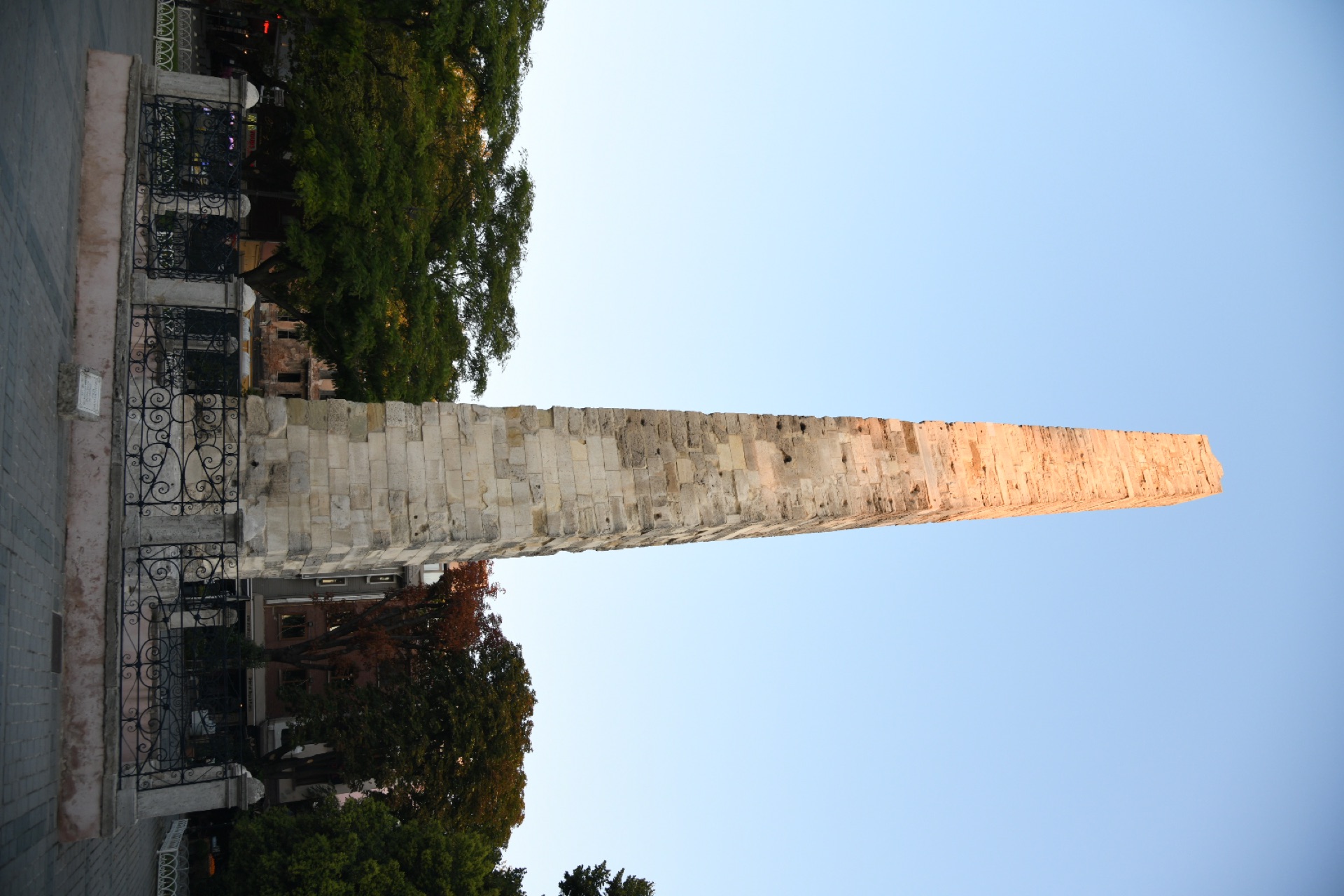
In the middle of today's Sultanahmet Square stands a monument older than Constantinople, older than the Roman Empire, and even older than many of the political empires whose history we learn in school. The so-called Obelisk of Theodosius was originally erected in ancient Egypt, in the 15th century BC under Pharaoh Thutmose III. It stood in the temple precinct of Karnak near Thebes, where it had a completely different religious and political function than it would later have in Constantinople.
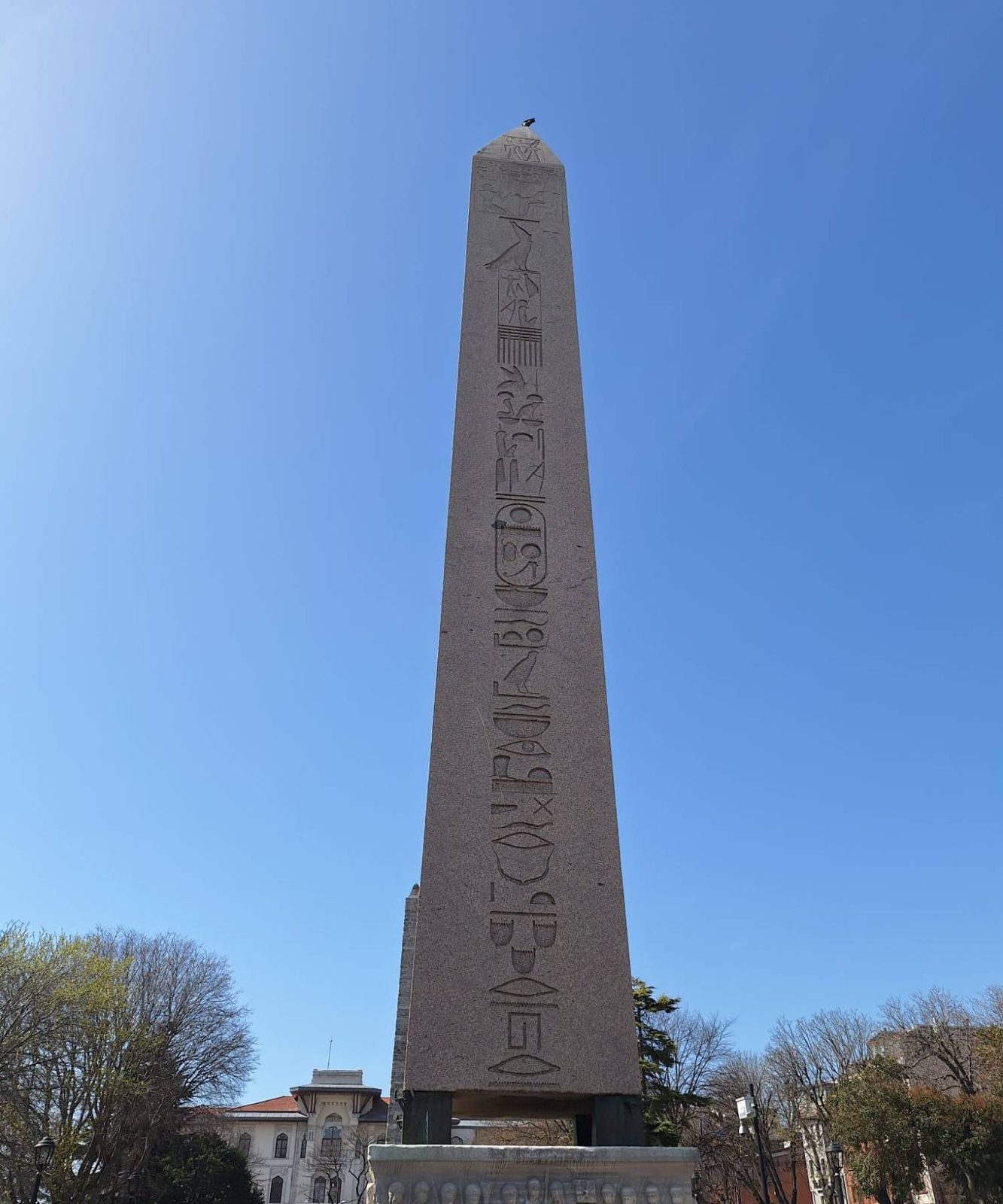
The obelisk on Sultanahmet Square was erected in ancient Egypt under Pharaoh Thutmose III and had already stood for centuries at Karnak before Emperor Theodosius I had it raised in the Hippodrome of Constantinople in 390 AD.
More than a millennium and a half after its Egyptian origins, Emperor Theodosius I had the obelisk erected in the Hippodrome of Constantinople in 390 AD. In the process, a monument of pharaonic rule became part of Roman-Byzantine self-representation. It's exactly this shift that makes it so interesting: the stone itself stayed the same, but its meaning was rewritten several times over. Today thousands of people walk past it daily, often on their way to the Blue Mosque or the Hagia Sophia, without realizing they're passing an object that was already monumental in the age of Egypt's New Kingdom.
- The obelisk was erected in ancient Egypt under Thutmose III.
- It stood in the temple complex of Karnak and was already many centuries old before Constantinople was even founded.
- Emperor Theodosius I had it set up in the Hippodrome in 390 AD.
- The stone visible today is likely only the upper part of the original obelisk.
- The hieroglyphs praise the Egyptian pharaoh and his connection to the gods.
- The late antique marble base, by contrast, shows Theodosius and the Roman court world.
Where the obelisk originally stood
The stone was not made for Constantinople. It comes from Egypt and was erected in the temple precinct of Amun-Re at Karnak. Thutmose III was one of the most powerful rulers of Egypt's New Kingdom. Under him, Egypt reached an enormous territorial extent, and monumental architecture served to visibly connect this power with divine order.
An obelisk was therefore no mere decorative pillar. Its shape and its inscriptions were religiously charged. Obelisks often stood in pairs in front of temples, referred symbolically to the sun, and carried texts that linked ruler, gods and cosmic order together. In its original setting, today's stone in Istanbul was thus part of an Egyptian sacred space, not part of a Roman sports stadium.
By the time it later arrived in Constantinople, people there likely understood the hieroglyphs only in a limited way, if at all. Still, its Egyptian origin remained visible, and precisely because of that, prestigious. The monument's foreignness was part of its effect.
Why Roman emperors loved Egyptian obelisks
Since the Roman conquest of Egypt, obelisks were transported to Rome and later to other parts of the empire. The effort involved was immense. Such stones weighed hundreds of tons, had to be moved overland, loaded onto ships and re-erected at their destination. Whoever managed this demonstrated not just technical skill, but also the ability to incorporate the monuments of ancient cultures into their own capital.
Roman interest was therefore twofold. On one hand, Egyptian monuments were considered ancient, mysterious and venerable. On the other, relocating them signaled that Rome ruled over the regions these monuments came from. The obelisk thus became a kind of stone proof of imperial reach.
Constantinople, which was built up into the new imperial capital in the 4th century, likewise needed monuments that made its status visible. The Hippodrome was the ideal place for this. Tens of thousands of people gathered there, and there the emperor staged himself before the population.
How the obelisk came to Constantinople
Exactly when the stone was shipped out of Karnak isn't clear in every detail. It's often assumed that Emperor Constantius II already arranged for the transport of an obelisk from Egypt as early as the 4th century. What is certain, in any case, is that the monument was ultimately erected in the Hippodrome under Theodosius I.
Transporting such a monolith was a technical masterpiece. Its weight had to be distributed across ships, the route across the Mediterranean had to be managed, and the stone then had to be brought from the harbor to the Hippodrome. After that came the hardest phase: raising it upright.
The fact that the Romans and Byzantines mastered such transports shouldn't be downplayed by comparison with modern technology. Without engines, steel cranes or hydraulics, ropes, pulleys, wooden scaffolding, ramps and enormous human labor had to work together with precision. A single mistake could have shattered the stone or endangered numerous workers.
The erection under Theodosius I
The obelisk was erected in the Hippodrome in 390 AD. At the time, Emperor Theodosius I ruled over an empire deep in political, military and religious transformation. Under him, Christianity finally gained the dominant position in the empire, while traditional pagan cults were increasingly pushed back.
That's exactly what makes it remarkable that an ancient Egyptian monument could still be used as a symbol of power in an empire growing more Christian. The obelisk no longer had to carry the same religious meaning it had in Karnak. It could be read anew, politically: as a sign of age, world empire and imperial power.
On the new marble base, Theodosius had scenes placed showing him together with his court and family at events. That's how the Egyptian stone gained a late-antique Roman commentary.
What the hieroglyphs say
The hieroglyphs glorify Thutmose III and his relationship to the god Amun-Re. They speak of royal power, victories and religious legitimacy. To an Egyptian viewer, these inscriptions were part of a familiar political and religious visual language.
In Constantinople, their exact meaning became secondary. What mattered instead was that the stone was obviously ancient, foreign and of monumental origin. People could marvel at it without being able to read a single sign.
Today this creates a fascinating contrast. Anyone taking a photo usually notices first the seemingly perfectly preserved hieroglyphs. Yet directly below, the base already tells a completely different story in Greek, Latin and relief images. Two empires speak over one another, without either having fully erased the other.
The base tells a second story
The reliefs on the base show Theodosius with members of his court. On one side the emperor appears in the imperial box, while in front of him the world of the Hippodrome is organized. On another panel, scenes connected to the raising of the obelisk are visible.
For historians, this base is almost as important as the obelisk itself. The Egyptian stone tells of a pharaoh from the 15th century BC; the base, by contrast, documents the political self-presentation of a late antique Roman emperor almost 1,800 years later.
The hierarchy of the figures is especially interesting. The emperor doesn't stand centrally and elevated by accident. Size, position and gaze visually order society. Rule is not just described here, but staged spatially.
Why the obelisk is shorter today
Today's obelisk is about 20 meters tall, somewhat more including its base. The original stone was likely considerably taller. It's therefore assumed that only part of the original obelisk made it to Constantinople, whether during transport or even before.
Exactly how and when the lower section was lost cannot be reconstructed with certainty. Popular accounts sometimes act as if we know precisely which day it broke. The available sources don't support that kind of certainty.
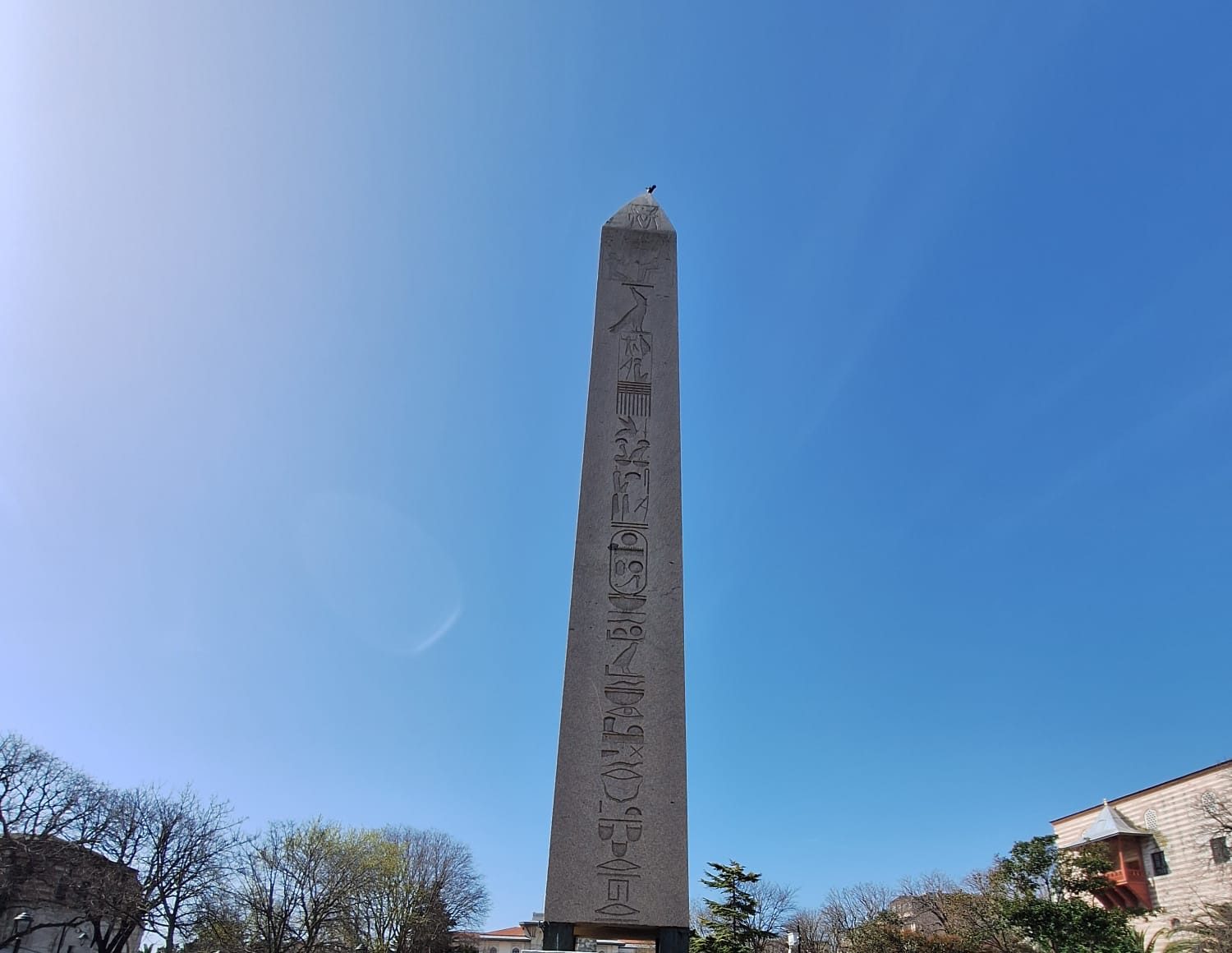
Still, the surviving piece is remarkably well preserved. Granite is resilient, and the hieroglyphs in places look so sharp that it's easy to forget how old they are.
What it reveals about the Hippodrome
The Hippodrome was no empty racetrack. Its central dividing wall, the spina, was decorated with statues and monuments brought from various regions of the empire. So the obelisk stood amid a veritable collection of imperial plunder, memories and prestige objects.
Here chariot races, public celebrations, political acclamations and conflicts took place. The emperor could show himself before a huge crowd. Monuments like the obelisk provided the fitting backdrop for this political stage.
Today little of the Hippodrome survives above ground. That's exactly why the obelisk is so valuable: it still marks roughly the central axis of the space where chariots once raced at breakneck speed and tens of thousands of spectators roared.
"Theodosius had the obelisk made in Egypt." False. By the time of Theodosius the stone was already about 1,800 years old. The emperor had it erected in Constantinople and fitted with a new base.
"The hieroglyphs tell the story of Constantinople." No. They come from pharaonic Egypt and praise Thutmose III. Constantinople's story only begins with the late antique base.
Why the obelisk in the Hippodrome was more than decoration
In the Hippodrome, the obelisk didn't stand somewhere off to the side, but on the spina, the long central barrier around which the chariot races moved. That meant it stood in the sightline of emperor, court and tens of thousands of spectators during practically every major race. Its position made it a political monument within a place that was much more than a sports arena. In the Hippodrome, rulers were cheered or booed, factions organized, political demands were voiced, and imperial ceremonies took place before a mass audience. Monuments on the spina created a backdrop for all of this that staged Constantinople as the heir of the entire ancient world.
The Egyptian obelisk was especially well suited to this. It brought the prestige of a much older high civilization into the new capital and made visible that Constantinople did not want to appear as a city without a past. By having the obelisk raised, Theodosius linked pharaonic monumentality, Roman engineering skill and his own rule together. This was no accidental combination, but a deliberate political image: the emperor stood above an empire that united different peoples, languages and traditions, bringing their monuments together in his capital.
The base reliefs as a snapshot of the late antique court
The base reliefs are especially fascinating because they don't show the stone's Egyptian past, but the society of the late 4th century. Theodosius appears together with members of his family and court in a strictly hierarchical order. His position is elevated and central, while representatives of foreign peoples, dignitaries and spectators are arranged below or beside him. This visual language was easy to understand: the emperor stands at the center, and every other group is defined through its relationship to him.
On one side of the base, the technical raising of the obelisk is also depicted. That makes the monument a rare source for how a construction achievement was publicly celebrated. The base essentially says: it's not only the ancient stone that deserves admiration, but also the emperor who had it brought here and erected. This creates a double message of power. Thutmose III speaks through the hieroglyphs from the second millennium BC; Theodosius answers almost 1,800 years later with reliefs and inscriptions on the base.
A Christian capital, a pagan monument — why that didn't have to be a contradiction
Theodosius I played a decisive role in establishing Nicene Christianity in the Roman Empire. Even so, he kept using a monument whose original religious meaning was deeply rooted in ancient Egyptian cult. This shows that late antiquity shouldn't simply be understood as a sudden swap of "pagan for Christian." Old monuments could lose their original sacred function while continuing to live on as artworks, political symbols, or signs of Roman universal rule.
For the residents of Constantinople, the exact theological meaning of the obelisk from Karnak had long stopped being decisive. It was an ancient prestige object. Similar reinterpretations happened all over the empire: temples were repurposed, statues re-inscribed, columns relocated, and older artworks placed into new political contexts. Constantinople was, therefore, already in the 4th century a city built out of reused stories.
What's still original today, and what isn't
The granite monolith itself is ancient Egyptian. The marble base, by contrast, dates from the time it was erected under Theodosius. Today's surroundings are of course modernly altered. The ground level of the former Hippodrome lay lower, the stands are gone, and the huge racetrack can only be guessed at from the long shape of the square. Anyone looking at the obelisk today should therefore mentally lift it out of the tidy park and place it back in the middle of an arena with tens of thousands of spectators.
The fact that the obelisk looks so cleanly isolated today is also a result of modern heritage preservation. In antiquity and the Middle Ages it was part of a densely furnished ensemble of monuments. Other columns, statues and commemorative markers stood beside it. Today's standalone monument was back then part of a far more complex visual stage.
My take on this place
I find it almost crazy that, right in the middle of Sultanahmet, between the Hagia Sophia, the Blue Mosque and all the people, you can walk past a stone that was already thousands of years old when Constantinople didn't even exist yet. You're so busy photographing the big buildings that this obelisk quickly starts to feel like "just another monument."
But if you stop for a moment, the span of time is barely graspable. A pharaoh has an obelisk inscribed in Egypt. Centuries later, Roman emperors bring such monuments into their own world. Centuries after that again, the same stone stands in a Christian Constantinople. Then comes the Ottoman Empire. And today we stand in front of it with our phones.
That's exactly why I love this city so much: you don't always have to walk into a museum to stand in front of something that completely scrambles your sense of time.
– Amra