
The Çamlıca Tower is the complete counterpart to Istanbul's historic monuments. No dome, no centuries-old walls, no Ottoman foundation. Instead: reinforced concrete, antenna technology, viewing platforms, and a futuristic structure visible far across the Asian side. That's exactly why it belongs to the city's story. Istanbul isn't only the past. It's a metropolis that still has to build technical infrastructure — and tries to turn that very infrastructure into a new landmark.
Advertising: If you book through our links, we may receive a commission – at no extra cost to you.
No dome, no centuries-old walls, no Ottoman foundation. Instead: reinforced concrete, antenna technology, and a futuristic structure visible far across the Asian side.
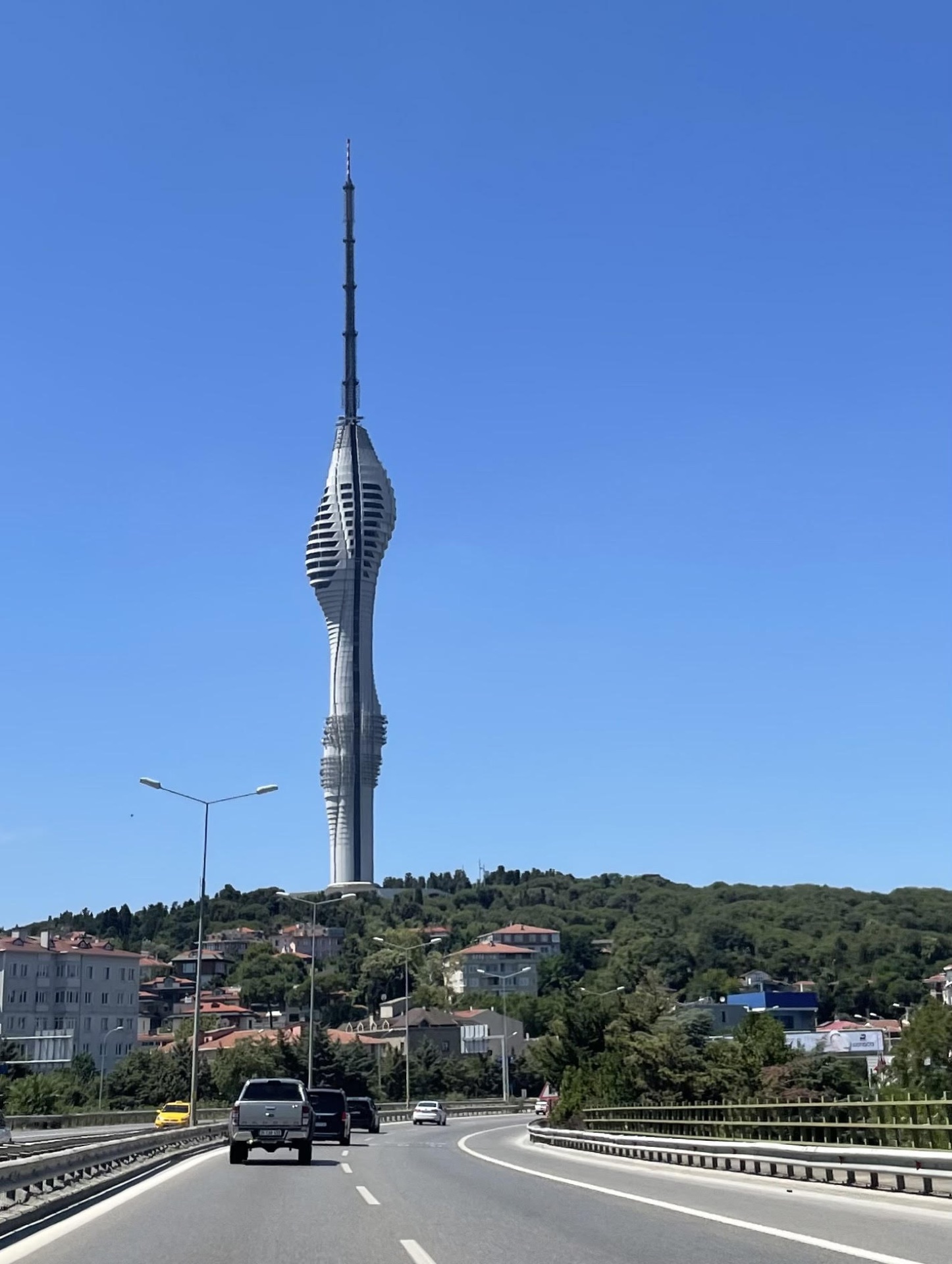
Its official height above ground level is 369 metres; including its position on the Çamlıca hill, its tip reaches 587 metres above sea level. The tower was built to consolidate numerous individual radio and television transmitters into one central facility. What used to be scattered across the hill as a forest of antennas was meant to be technically concentrated and visually calmed down. At the same time, Istanbul gained a new viewing platform, offering a completely different view of the city than the Galata Tower or Pierre Loti Hill.
- The Çamlıca Tower is a modern radio and television tower on Istanbul's Asian side.
- It stands 369 metres above ground level and reaches 587 metres above sea level.
- The tower has 49 levels, including basement floors.
- Two viewing levels sit roughly 148.5 and 153 metres above entrance level.
- Restaurants sit even higher up.
- The tower's main purpose isn't tourism, but consolidating numerous broadcast transmitters.
- Regular broadcasting began in 2020.
- The tower's organic shape is deliberately designed as a modern symbol, not a technical accident.
Why Istanbul Needed a New Television Tower at All
For decades, the Çamlıca hill was covered in numerous individual radio and television antennas. This system worked for technical supply purposes, but visually the hill looked like a dense forest of masts. The idea behind the new tower wasn't therefore just to build an additional viewing platform. Several transmission facilities were meant to be consolidated into one central piece of infrastructure, and part of the old antennas removed.
Technically, that's more demanding than it sounds. Different broadcasters need different frequencies, outputs, and transmission systems. At the same time, a structure of this height has to account for wind, earthquake risk, and strong temperature swings. At its core, the tower is therefore a highly complex technical building, even though visitors mainly notice its restaurants and viewing areas. Its curved outer form isn't just decoration, but part of an attempt to give an otherwise very functional piece of infrastructure an iconic silhouette.
At more than 300 metres total height, the structure clearly towers over its immediate surroundings. Because Çamlıca itself already sits high up, an extraordinary perspective emerges over the Bosphorus, the historic peninsula, the financial district, and the Asian districts. At the same time, the view shows something classic Istanbul panoramas like to leave out: the city has long since stopped consisting only of domes and minarets. High-rises, bridges, motorways, dense residential areas, and new business centres belong to it just as much.
That's exactly why I find the tower fascinating as contemporary architecture. You can argue over whether its shape is elegant, or whether it feels too dominant. But debates like this show that Istanbul doesn't just preserve historic buildings. The city keeps building — sometimes very self-confidently — and every generation adds its own marks to the panorama.
A city of millions needs countless radio and broadcast links. Over the decades, numerous individual transmission masts arose on the Çamlıca hills. Each fulfilled its technical function, but together they created a visual problem: one of Istanbul's most striking elevated sites was increasingly dominated by antennas.
There were technical drawbacks too. Multiple facilities meant multiplied energy use, maintenance effort, and complicated frequency coordination. The new tower was therefore meant to consolidate many of these functions into a single structure.
The idea wasn't merely to build "a fancy tower for tourists." Touristic use was combined with an infrastructure task. That matters, because otherwise it's easy to get the impression Istanbul simply put a gigantic viewing tower on the hill for prestige reasons.
The Forest of Antennas on Çamlıca
Çamlıca is ideal for transmitters because of its height. That's exactly why more and more masts gathered there over time. Anyone familiar with older images of the hill sees a genuine technical forest.
The new tower was part of a project to centralise these transmitters and dismantle many old antennas. Official statements explicitly emphasise reducing visual and technical burden.
The result is paradoxical: to remove many smaller technical structures from the cityscape, a single very large structure was put in their place. Whether you find that more beautiful is a matter of taste. From an urban-planning perspective, though, the idea makes sense.
How Today's Tower Came to Be
The project emerged from an architectural competition. Construction was technically demanding, because Çamlıca brings both wind load and considerable earthquake requirements. A slender tower over three hundred metres tall, on an exposed hill, has to absorb different forces than an ordinary high-rise.
Its concrete core was built using complex formwork and climbing techniques. Its outer form isn't simply a straight cylinder. It narrows and widens, so the tower looks different from different viewing angles.
Broadcasting began in 2020. Visitor areas were then opened gradually afterward.
How Tall Is It, Really?
Different figures quickly arise here, because several heights are cited at once. The tower itself rises roughly 369 metres above the terrain. Add the height of the Çamlıca hill, and its tip sits roughly 587 metres above sea level.
A total constructed height including underground areas is also sometimes cited. It's therefore always worth specifying which figure is meant.
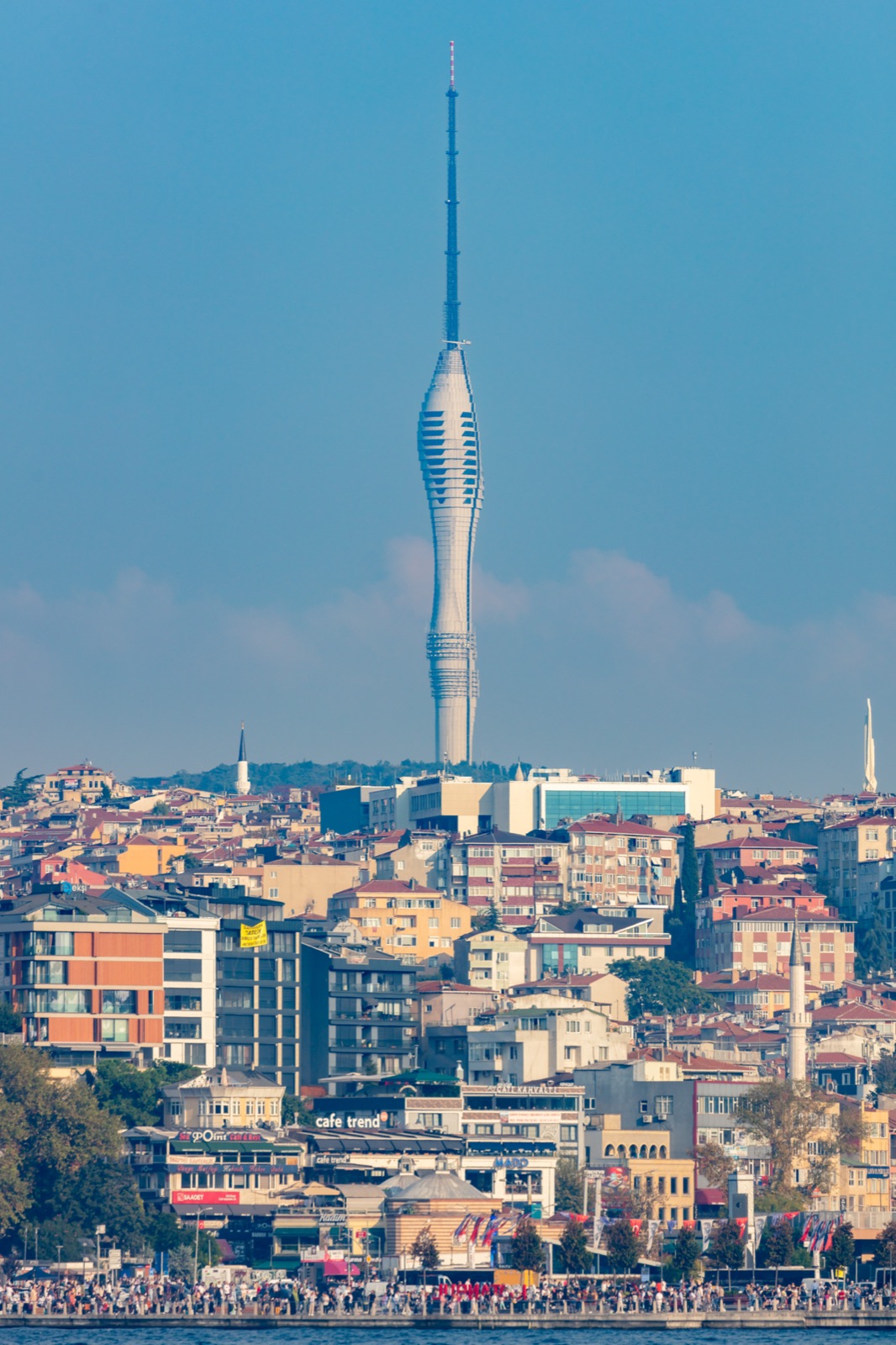
The official operator cites 369 metres above the terrain and 587 metres above sea level. That makes it Istanbul's tallest structure, if you go by pure building height.
If you want to see Istanbul from above, you can arrange the tower ticket in advance. Here is the matching option.
Viewing Platforms and Restaurants
Its two visitor terraces sit on its upper floors. From there, you see the Bosphorus, the historic peninsula, the European side, and large parts of Asian Istanbul. In clear weather, the view reaches far beyond what you'd perceive from classic city-centre viewpoints.
Restaurants sit even higher up. That markets the tower not just as a brief viewing stop, but as a place to spend time.
The view, though, is completely different from the Galata Tower. There, you stand in the middle of the historic city and make out individual roofs, mosques, and streets. From Çamlıca, Istanbul becomes a huge metropolis. Only then do you grasp how far the built-up area actually extends.
What the Tower Achieves Technically
Its operators cite the ability to transmit around a hundred radio frequencies simultaneously, without the broadcasters interfering with one another. The tower also supports telecommunications services.
Its centralised system is meant to make energy use and maintenance more efficient. So the technology isn't a backdrop for the viewing platform; rather, the viewing platform sits within a functioning broadcast tower.
Architecture: Why Does It Look Like This?
Its curved form is meant to express dynamism and has been linked, in official descriptions, to a tulip moving in the wind, or to organic lines, among other things. Whether you actually see a tulip in it is up to you.
What matters more is that the tower was deliberately not meant to look like a classic concrete mast. Istanbul already has enough iconic historic silhouettes. A modern tower therefore had to find its own form, rather than simply imitating an XXL Galata Tower.
Earthquakes and Wind: Why a Tower Like This Is Technically Tricky
For a tower of this height, wind isn't a minor comfort issue. Tall structures move, and these movements have to be calculated so that the structure, technical systems, and visitor areas all function safely. At the same time, Istanbul lies in an earthquake-prone region. Its load-bearing structure, foundation, and flexible components therefore have to meet different requirements than a normal high-rise.
That visitors notice as little of this as possible is precisely the success of the engineering. You ride the lift up, maybe have a coffee, and look out at the city. Behind this seemingly simple experience, though, lies a structure that has to permanently absorb wind loads, temperature differences, and seismic risk. The tower is therefore as much a feat of engineering as it is a viewpoint.
Istanbul lies in a seismically hazardous region. At the same time, the tower stands on an exposed hill, where wind loads act especially strongly. For a slender tall structure, both factors are decisive. Its structure has to be able to move in a controlled way, without that movement becoming dangerous or unpleasant for visitors.
Modern engineers model wind flows, material behaviour, and different earthquake scenarios for this. Its reinforced-concrete core, antenna mast, and outer shell each fulfil different tasks. What looks from outside like a free-flowing organic shape is, structurally, calculated to a very high degree.
This point, in particular, sets Çamlıca apart from historic towers. At the Galata Tower, structural problems were solved over centuries through thick walls, repairs, and experience. At the Çamlıca Tower, the construction had to satisfy digital simulations and modern safety standards before it even opened.
From Transmission Mast to Destination
Technical infrastructure usually stays invisible, or ugly. You need it, but don't necessarily want to visit it. Çamlıca tries the opposite: the transmission tower is meant to be a restaurant, a viewpoint, and an architectural landmark all at once.
This multiple use helps economically too. Visitors pay for the view and the dining, while the building exists anyway because of its technical task. Similar models are known from television towers in Berlin, Toronto, or Tokyo.
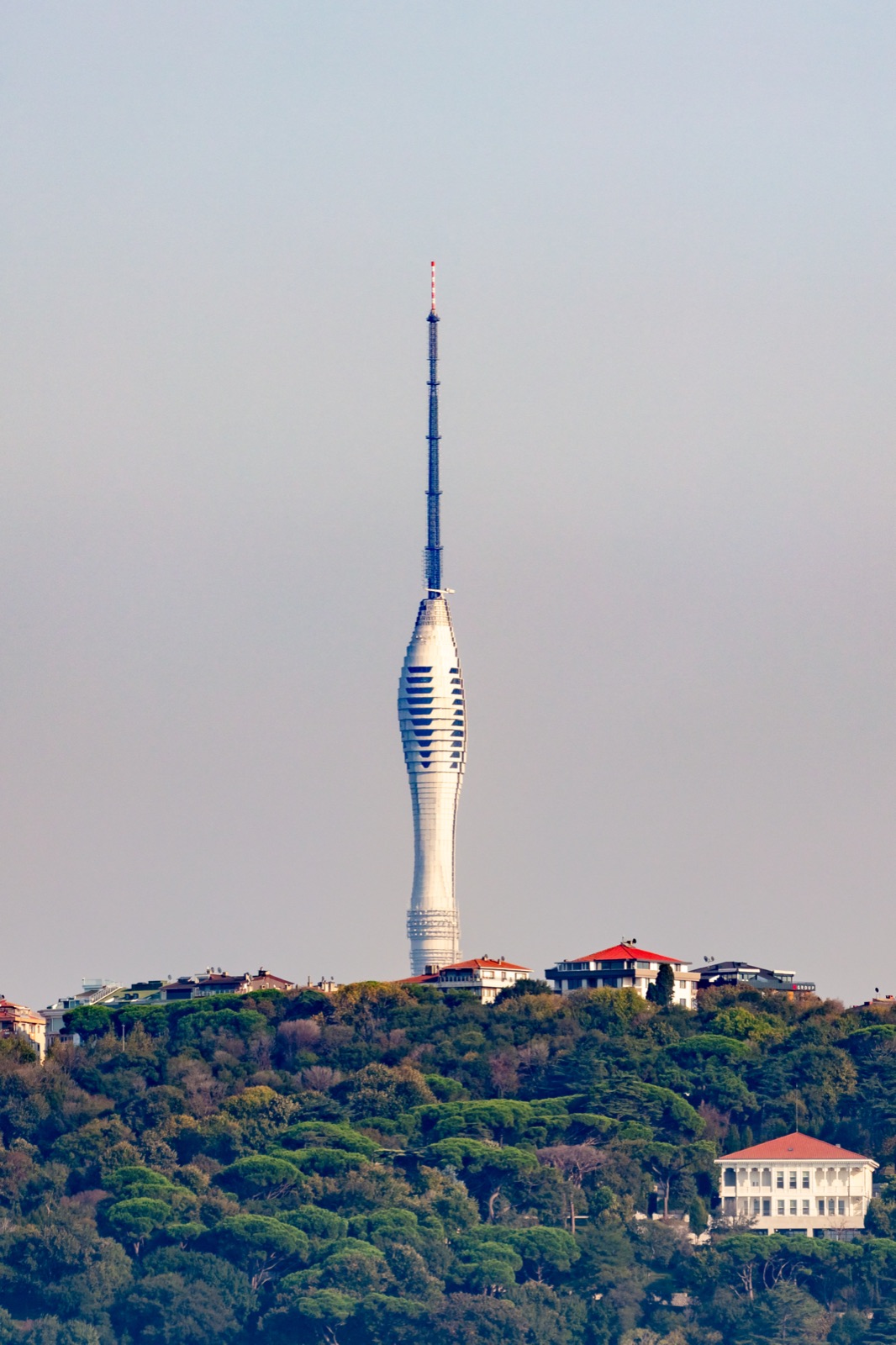
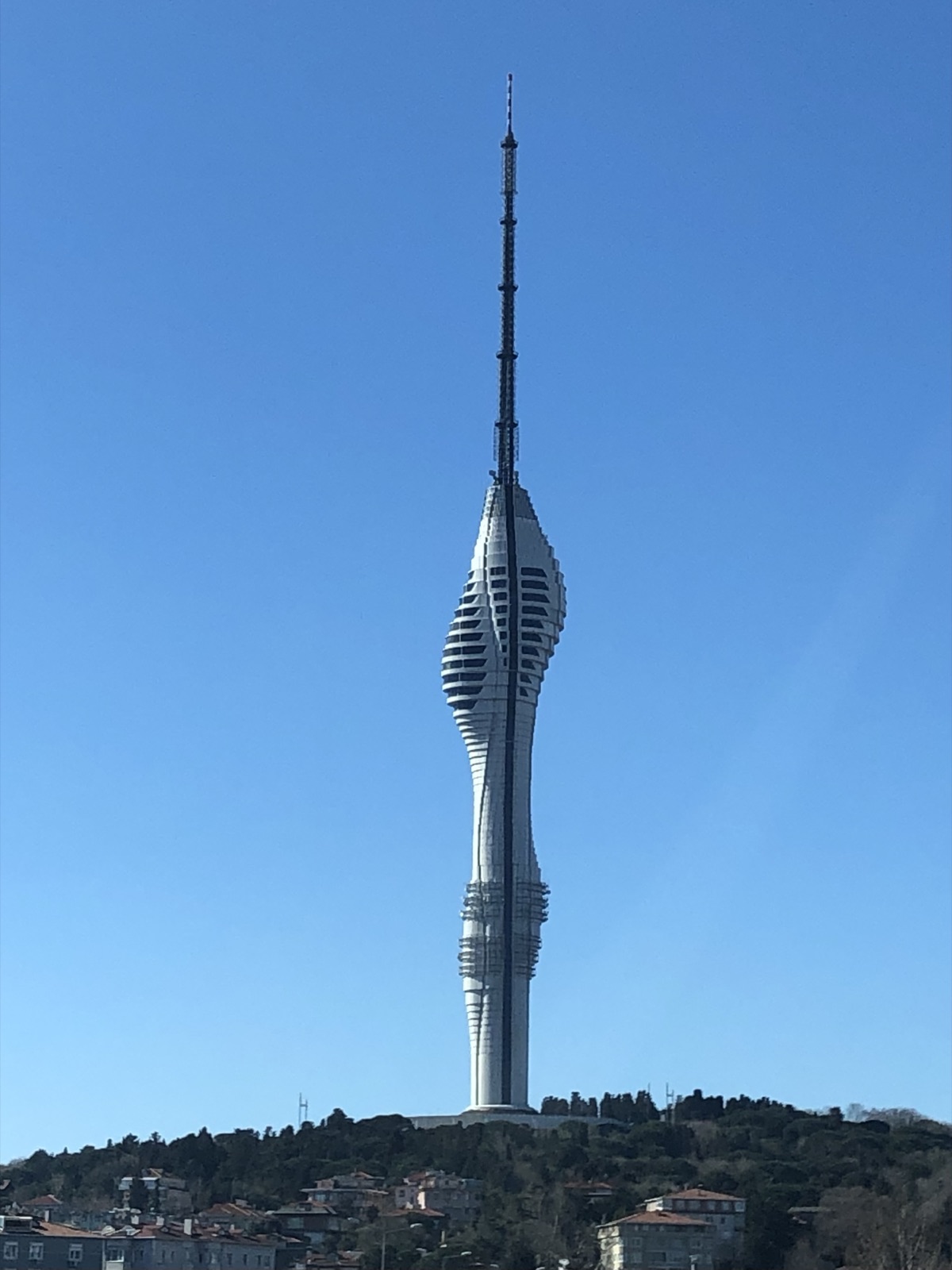
Istanbul thereby adds a global building type to its own skyline. The tower speaks less of Ottoman history than of how modern metropolises publicly stage technology.
What You Actually Recognise From Above
In clear weather, the geography especially stands out. You understand how narrow the Bosphorus is at certain points, how far the Asian built-up area extends, and how the bridges connect different centres to one another. The historic peninsula suddenly looks small compared to the city as a whole.
Anyone who's only travelled touristically between Sultanahmet, Karaköy, and Taksim gets a reality check here: Istanbul isn't a compact old town with a bit of suburb around it. It's a huge urban space stretching across dozens of kilometres.
The Old Çamlıca Tower Was a Different Structure
Before today's tower arose, older radio and television towers already stood on the hill. So anyone who spots a slender transmission tower in older photos of Istanbul isn't automatically looking at today's structure. The technical landscape changed several times.
The new tower was meant to consolidate exactly these scattered structures. Its construction is therefore also part of a longer history of broadcasting in Turkey — from state radio to hundreds of private stations. The more channels arose, the greater the need for coordinated infrastructure became.
That a technical problem, of all things, led to a new landmark is actually typical of modern cities. Bridges, stations, and television towers are often built only because something has to function — and only later do we photograph them for their shape.
Why Viewpoints Change Our Idea of Istanbul
From the ground, we always experience Istanbul in fragments. A street, a ferry landing, a mosque, a hill. From the Çamlıca Tower, the scale shifts. Suddenly it becomes visible just how far the city extends beyond its familiar historic centres.
That can feel almost sobering. The postcard city of the Hagia Sophia, the Galata Tower, and the Bosphorus is only a small part of a metropolis with motorways, high-rises, industrial areas, and huge residential districts.
That's exactly why I find viewpoints like this valuable. They don't destroy Istanbul's romance — they add reality to it. A city with many millions of residents can't consist only of historic domes.
"The Çamlıca Tower is 587 metres tall." Only if you mean its position above sea level. The structure itself rises about 369 metres above the terrain.
"It was built purely as a tourist attraction." False. Its main function is broadcast and telecommunications infrastructure.
"It replaced all of Istanbul's antennas." No. It consolidates a great many transmitters, but other communications infrastructure obviously still exists elsewhere in the city.
- If you'd like to see Istanbul from above once, you can check tickets and available visiting times for the Çamlıca Tower here.
- View tickets for the Çamlıca TV Tower
Our Experience: The Grounds Are the Real Highlight
So far this has been about technology, height and views. Our personal experience is different: for us it was precisely the grounds around the tower that were beautiful – a real recreation area.
We experienced green spaces there, small streams, swans, play facilities for children, paths for walking and seating. There are also small vendors with simit and snacks and in places gifts or souvenirs. You can simply spend time here and relax.
We enjoyed it very much as a family. For us it was a recreation paradise for young and old.
Important: you don't have to go up the TV tower. Going up to the viewing levels costs admission (please check current prices and opening times in advance – according to visitor information the tower is closed on Mondays). But even without a ticket the trip can be worthwhile because of the surroundings. This is expressly our experience and not a description of the whole complex; what is on offer and how the grounds are laid out can change.
In our Istanbul route this is the quiet finish of day 5: Istanbul in 5 Days.
My Thought on This Place
I probably always like old buildings a little more than new towers — I'll admit that openly. But from up here, you understand Istanbul in a way you simply can't from below. You always think you know how big the city is, until you see, from this high up, just how long it simply keeps going.
And I actually find it rather fitting that, alongside all the mosques, palaces, and old towers, there eventually stands a structure that clearly says: Istanbul doesn't live off its past alone. This city broadcasts, builds, grows, and keeps changing.
– Amra