
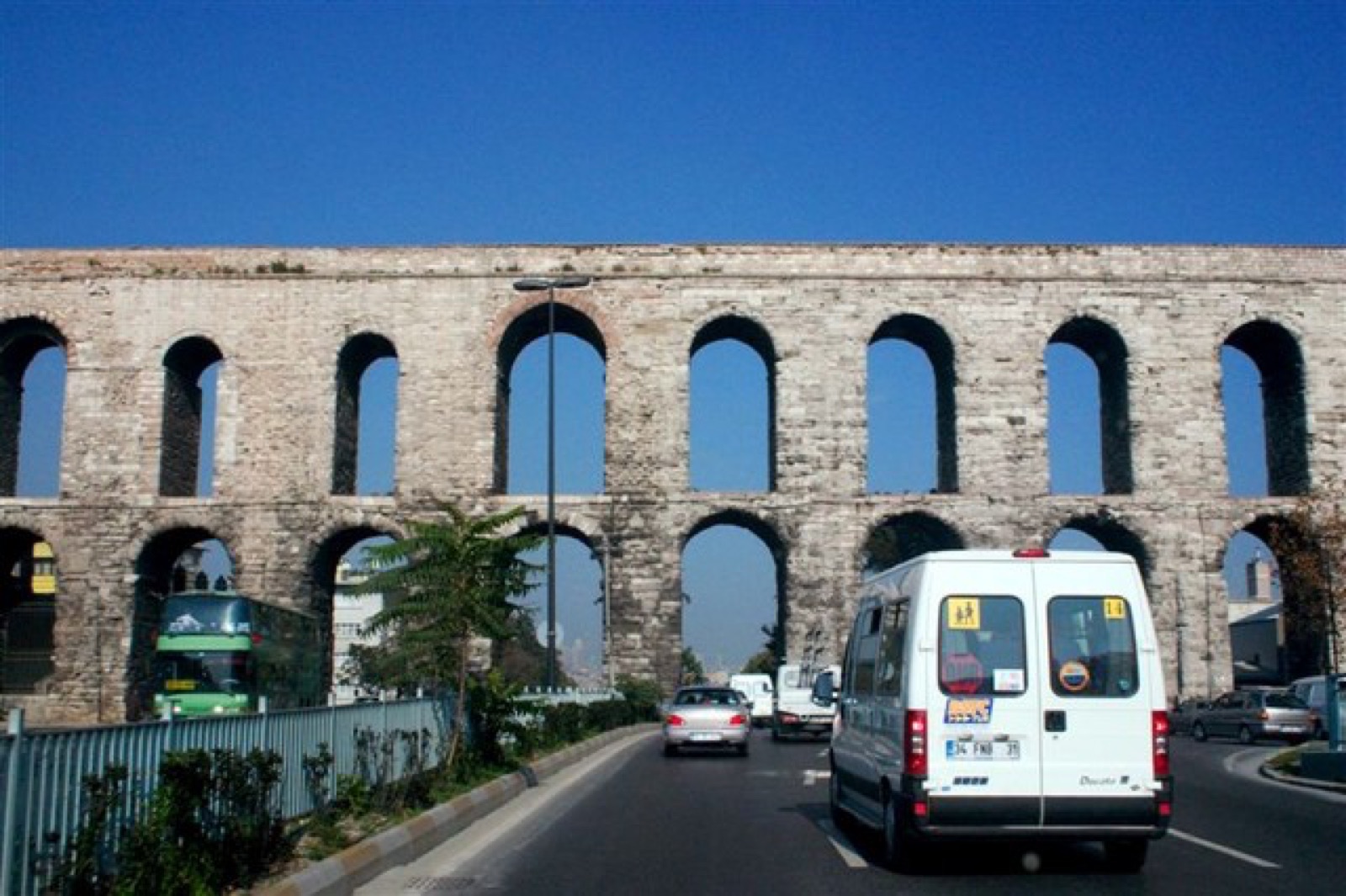
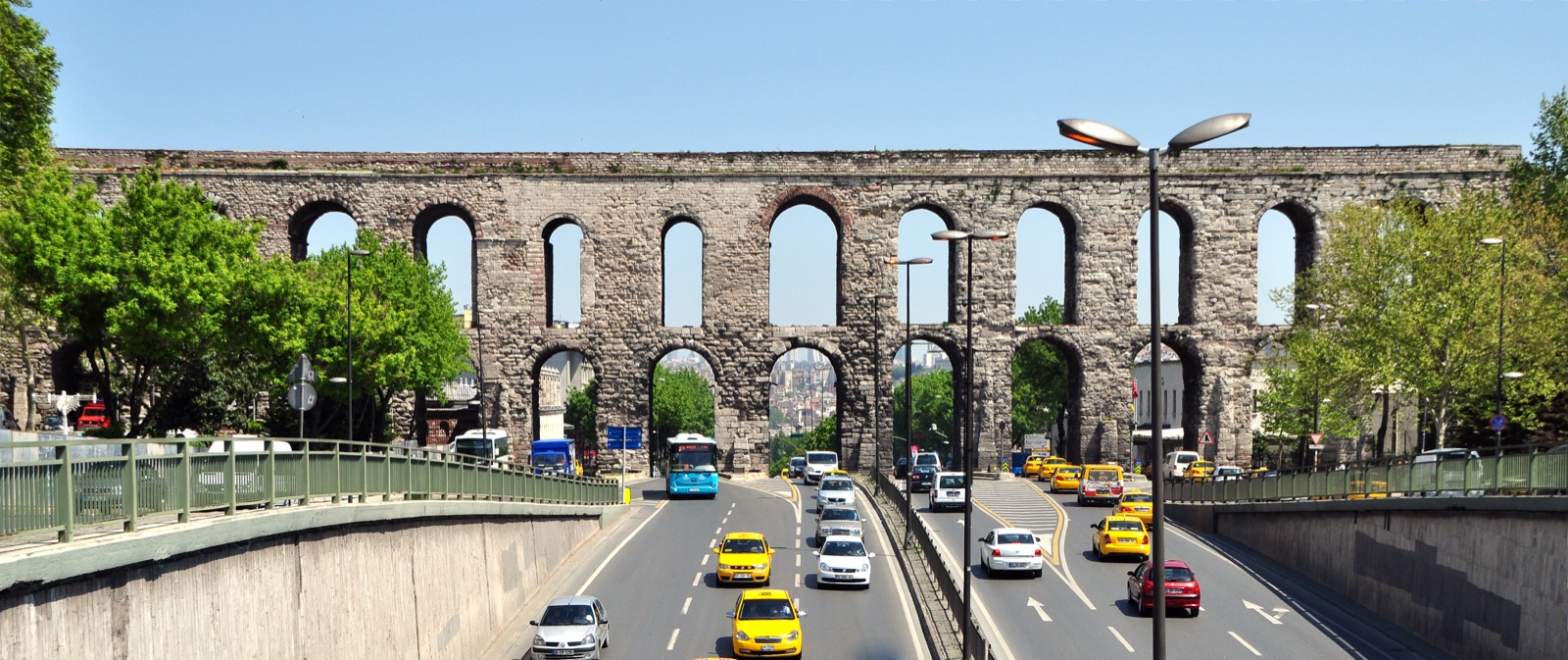
Anyone driving today through the arches of the Bozdoğan Kemeri in Fatih sees only a small visible fragment of a massive engineering system. The so-called Aqueduct of Valens wasn't simply a single water bridge. It belonged to a network of spring intakes, channels, tunnels, aqueducts and cisterns that supplied Constantinople with fresh water across great distances.
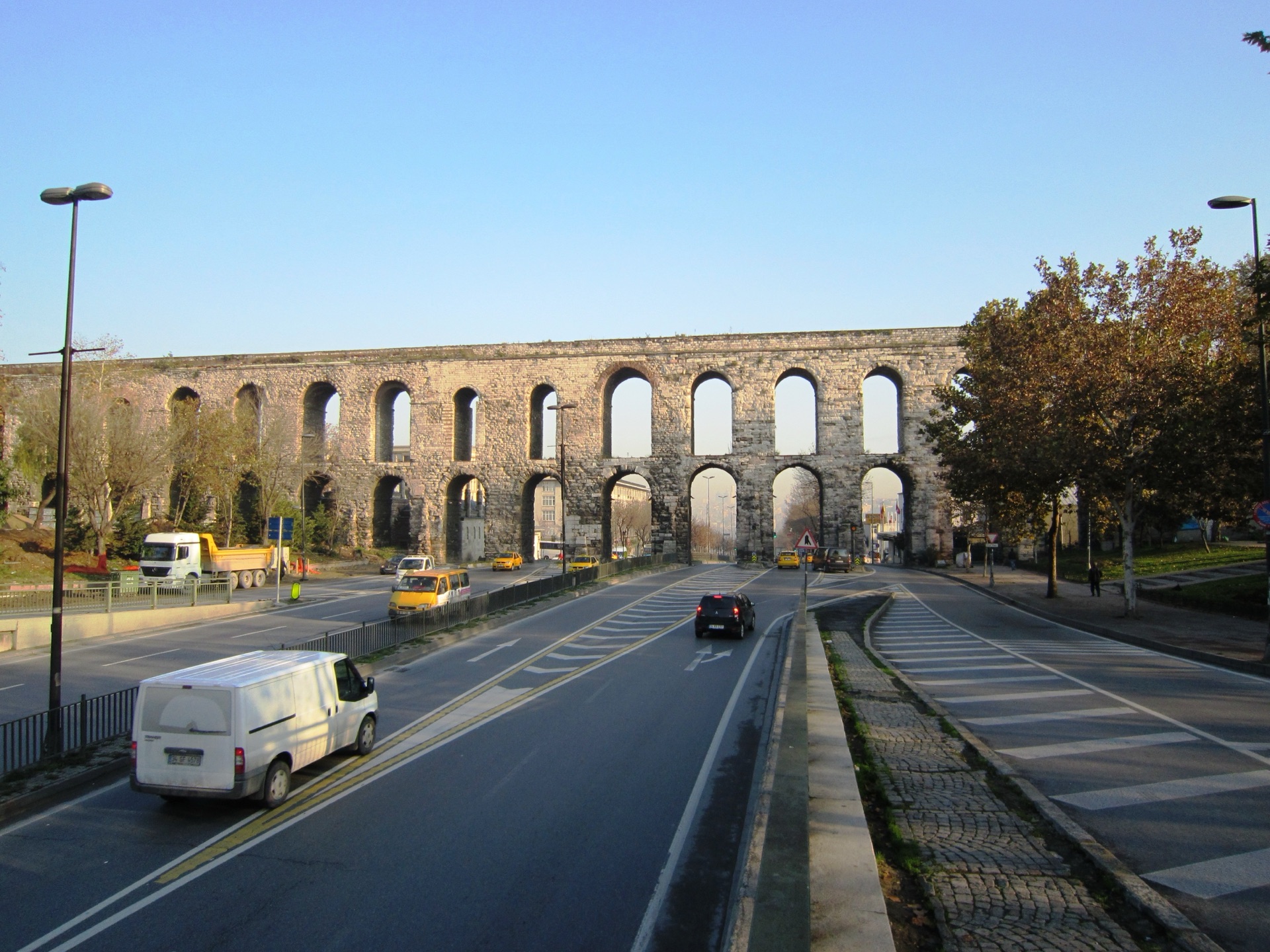
Anyone driving today through the arches of the Bozdoğan Kemeri in Fatih sees only a small visible fragment of a massive engineering system of spring intakes, channels, tunnels and cisterns.
The surviving bridge was completed in the 4th century and named after Emperor Valens. The Turkish cultural heritage portal notes that it was part of a system roughly 250 kilometers long in total, used and repeatedly repaired over about 1,500 years. It's precisely this long continuity that makes the structure special: Romans built it, Byzantines repaired it, Ottomans integrated it into new water systems, and today modern traffic drives beneath it.
- The Aqueduct of Valens was completed in the 4th century.
- It was only a visible part of a much larger water supply system.
- Constantinople had to channel water into the city from distant spring regions.
- The system worked mainly through carefully calculated gradient, not modern pumps.
- Large open and underground cisterns stored water.
- The Ottomans repaired and continued to use parts of the ancient system.
- The Bozdoğan Kemeri was altered across many centuries; not every stone dates from the time of Valens.
Why a city by the sea still had a water shortage
Constantinople lay between the Bosphorus, the Sea of Marmara, and the Golden Horn. So water was everywhere — just mostly salt water. For a large population, the city needed drinkable fresh water for cooking, washing, baths, gardens, fountains, palaces and trades.
There weren't enough strong natural springs within the peninsula itself. The larger Constantinople grew, the further water had to be brought in from outside. That was an enormous engineering and political project. Pipelines had to be run over hills, valleys and vast landscapes, and constantly maintained.
Constantine and Valens: when the aqueduct was built
The start of individual pipeline sections is already associated with the time of Constantine. Under Emperor Valens, who reigned from 364 to 378, the great aqueduct was completed, or put into operation, in the 4th century. That's why the bridge visible today bears his name.
It would be wrong, though, to attribute the entire water system to a single emperor. Successive rulers extended pipelines, built new cisterns, and repaired damaged sections. Water supply was no prestige project finished after a single inauguration. Without constant maintenance, channels clog, walls crack, and sediment reduces capacity.
A water system across enormous distances
Research on the late-antique system shows that water was brought in from very distant spring regions west of the city. The Turkish cultural heritage portal describes the Bozdoğan Kemeri as part of a network roughly 250 kilometers long; scholarly reconstructions of individual long-distance lines from later expansions sometimes arrive at even greater total lengths.
The aqueduct bridge was only needed where a valley had to be crossed. Over many kilometers, water ran in masonry channels just below ground, or along natural contour lines. That's exactly why today you see only small fragments of a system that was much larger across the landscape.
How water flowed through a city of millions without pumps
The decisive technology was gradient. Water flows downhill, but over hundreds of kilometers this slope has to be controlled with extreme precision. If it's too steep, the current damages the channel. If it's too shallow, the water doesn't flow reliably, or sediment settles.
Roman and Byzantine engineers used measuring instruments and knowledge of the terrain to lay pipelines in long, gentle slopes. Valleys were crossed with bridges, mountains bypassed, or tunneled through.
Within the city, water was distributed to reservoirs, palaces, baths and public fountains. Not every household had a private water connection like today. Public supply points were therefore essential.
Cisterns as a safety reserve
Constantinople had hundreds of cisterns. Some were underground, like Yerebatan or Binbirdirek; others were huge open reservoirs. They could store water temporarily and balance out peak demand.
For a besieged city, this was especially important. An attacker could destroy outer pipelines or occupy spring regions. The more water stored within the walls, the longer the city could remain supplied.
Cisterns, however, weren't an infinite reserve. A very large population, animals, baths and service facilities consumed enormous quantities. Hygiene and water quality posed additional challenges.
What happened during sieges
Enemies naturally knew that water pipelines were vulnerable. During various phases of war, external systems were damaged or no longer adequately maintained. Especially in the last centuries of the Byzantine Empire, parts of the great late-antique long-distance supply no longer functioned as reliably as before.
The city relied more heavily on cisterns, wells and shorter pipelines instead. The water system thus also reflects the empire's political condition: a powerful state could maintain hundreds of kilometers of infrastructure. A shrunken state faced considerably greater difficulties in doing so.
The Ottomans take over and expand the system
After 1453, the Ottomans continued to use existing infrastructure, but also repaired pipelines and built new systems. Water projects were expanded especially under Mehmed II, Süleyman I and later sultans.
The great architect Mimar Sinan wasn't just a mosque builder. He also played an important role in water engineering, especially with the 16th-century Kırkçeşme system. Ottoman engineers combined older Roman-Byzantine structures with new pipelines, bridges and distribution points.
The Bozdoğan Kemeri therefore remained functionally relevant. The cultural heritage portal emphasizes that it was repaired and extended in both Roman and Ottoman times and stayed in use for roughly 1,500 years.
What's still original today
The bridge visible today is several hundred meters long, but shorter than in antiquity. Road construction, development and destruction reduced its original course. Different masonry reveals phases of repair.
Part of the stones and arches go back to the late-antique construction, while other sections were renewed in Byzantine or Ottoman times. That's exactly why you shouldn't ask, "is this original or not?" The better question is: which building phases am I looking at at once?
Water as a question of power
Water supply was not merely engineering — it was rule. An emperor who reliably supplied a capital with water demonstrated organizational capability. Public baths, nymphaea, fountains and palaces could only function if a huge maintenance system existed in the background. Workers had to clean channels, repair damaged arches, and control illegal diversions.
Social inequality played a role too. Palaces and large endowments received privileged pipelines, while many residents fetched water at public fountains or used cisterns. In dry periods, access to supply could therefore become immediately political.
In the Ottoman period, this basic problem remained. Sultanic water endowments counted as charity, but were also infrastructure policy at the same time. Anyone who financed a çeşme or sebil placed their name in public space and very concretely improved life in a neighborhood.
The great long-distance line and its maintenance
A long-distance system hundreds of kilometers long could only function if gradient and cross-section were coordinated across vast stretches. Maintenance shafts allowed access to underground channels. Sediment had to be removed, or flow capacity would decrease. Lime deposits on channel walls are today important archaeological sources, since they show how long pipelines were used and cleaned.
It's precisely from these deposits that researchers could reconstruct that individual systems were considerably more complex than older maps suggested. Some pipelines ran in several stacked channels, so that repairs were possible without shutting down the entire supply. This shows the engineers accounted not just for construction, but for long-term maintenance too.
Why open cisterns mattered just as much
Yerebatan is famous, but Constantinople also had huge open storage basins, such as the Aetius, Aspar and Mocius cisterns. These structures today often look like sunken sports fields or green spaces, but were originally central reserves.
Open reservoirs had advantages at large capacity, but were more vulnerable to contamination and evaporation. Underground cisterns kept water cooler and protected it better, but were structurally more elaborate. The city therefore combined different types of storage.
Ottoman water architecture as a second great phase
After 1453, Mehmed II had to supply a city whose late-antique long-distance pipelines were partly damaged or out of operation. The Ottomans repaired older sections and developed new spring regions. Under Süleyman I, a particularly important project was implemented with the Kırkçeşme system.
For it, Mimar Sinan designed not just pipelines, but impressive aqueduct bridges outside the city center. The Mağlova Kemer shows that Ottoman engineers didn't simply copy the Roman-Byzantine tradition, but developed their own technically sophisticated solutions.
The Bozdoğan Kemeri is thus almost a seam between two worlds of infrastructure. Its arches date, at their core, from late antiquity, but its use reaches deep into the Ottoman era. That makes it historically more valuable than a ruin abandoned after a few decades.
What you barely see when driving past
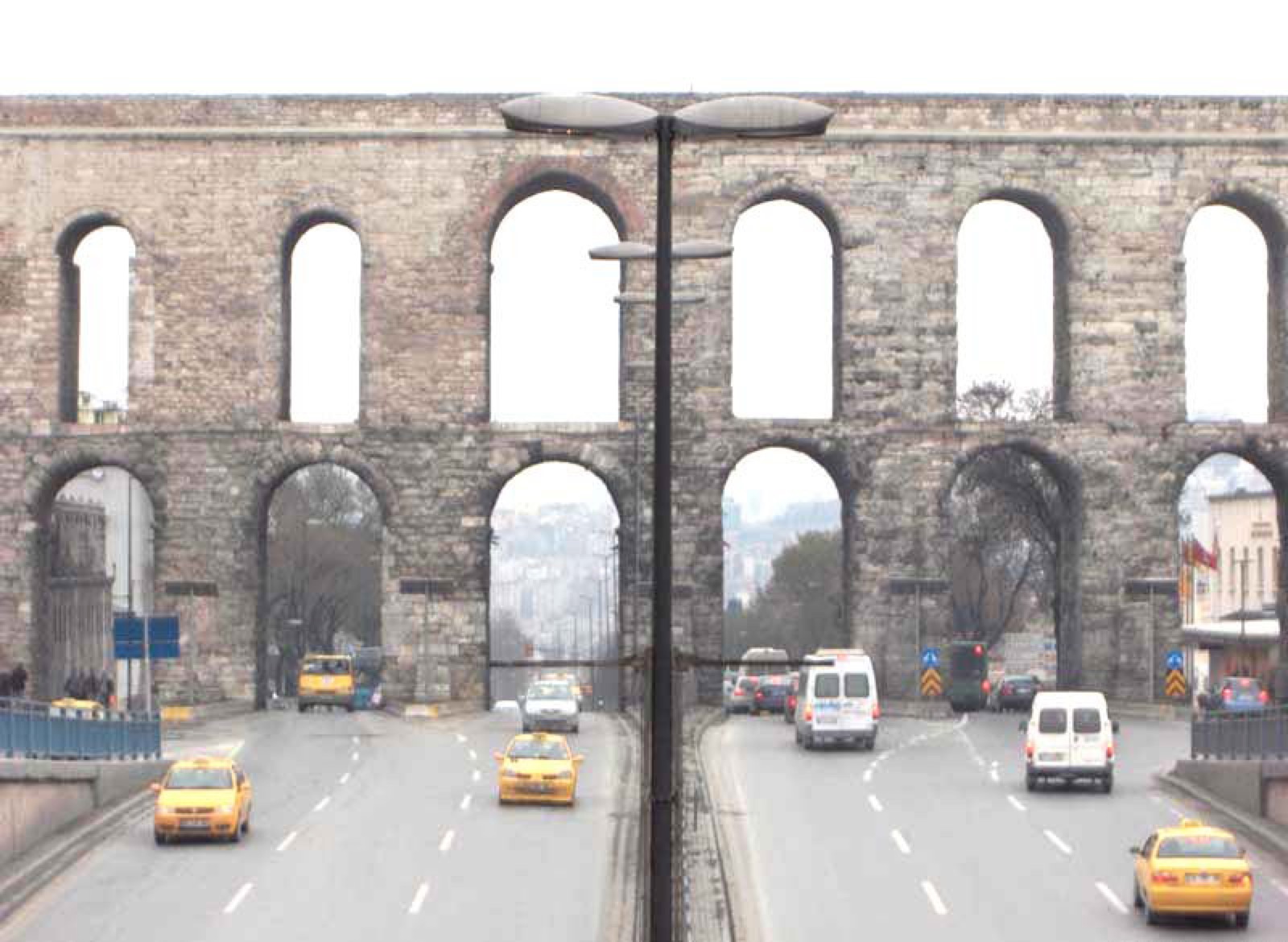
Today's Atatürk Boulevard cuts spectacularly through the arches. This makes the aqueduct look like a single bridge fragment. Anyone who approaches on foot recognizes different sections of stone and brick, walled-in areas, and repairs.
These details show that infrastructure is never "finished." An aqueduct used for 1,500 years eventually consists of many generations of maintenance. That's exactly why, with historic water structures, you shouldn't just look for the oldest stone, but for the continuity of use.
What to look at deliberately at the Bozdoğan Kemeri
The aqueduct is most impressive not from a perfect photo angle, but once you understand how it bridges the valley. Look at how the arches stand at different terrain levels and how thick the piers are. The upper water channel itself isn't visible today as an open conduit, but its position explains the entire geometry of the structure.
Different masonry techniques reveal repairs. Some sections look more uniform, others consist of alternating layers of stone and brick. Such differences aren't flaws, but historical clues. A structure used for centuries simply can't look identical everywhere.
If you've already seen Yerebatan, Bozdoğan is the perfect complement. Yerebatan shows the storage; Bozdoğan shows the transport. Only together do the two make clear that Constantinople's water supply was one interconnected system. A cistern without a pipeline would eventually run dry; an aqueduct without storage, in turn, would be less useful during crises.
Why pipelines also needed political stability
A kilometers-long water system only works if a state can organize routes, land rights, and maintenance. Pipelines had to run across private properties, through forests, and past villages. Damage had to be reported, workers paid, and materials supplied. In politically unstable times, such systems decayed faster, even when the technology itself was excellent.
Constantinople's water supply is thus also a mirror of its political strength. In late antiquity, a wealthy empire could build enormous long-distance pipelines. In later Byzantine centuries, parts became harder to maintain. After 1453, the Ottomans again invested heavily in water, because a growing capital couldn't function without new systems.
The aqueduct as a monument, even though it was never meant as one
Today we photograph Bozdoğan like an ancient monument. Its builders would have viewed it above all as functioning infrastructure. That's exactly where an interesting shift in perspective lies: what is history for us was everyday life for earlier residents. No one had to stand in front of an aqueduct and reverently note its age. What mattered was whether water arrived.
Maybe that's the best reason to take the structure seriously. It's a reminder that civilization doesn't consist only of palaces and battles, but of things that simply have to work — water, roads, sewage, supply. When these systems fail, the most beautiful dome does little good.
"The aqueduct brought water directly from the Belgrade Forest and nowhere else." Too simple. Constantinople's water supply consisted of multiple systems and spring regions from different eras.
"Roman aqueducts needed pumps." Normally, no. Gradient was the decisive source of energy.
"The entire Bozdoğan Kemeri survives unchanged from the 4th century." False. It was repaired and partly renewed across the centuries.
My take on this place
With structures like this, I always think: we photograph palaces, domes and golden rooms — but without water, none of these splendid complexes would have worked.
The aqueduct is really infrastructure. That's exactly why I find it impressive. More than 1,600 years ago, someone had to calculate how to bring water kilometers away, with exactly the right slope, into a huge city. And today cars drive under the very same arches as if that were completely normal.
– Amra