
In the middle of today's city traffic stands a monument that thousands of people walk past every day without realizing how old it actually is. The Column of Constantine, in Turkish Çemberlitaş, was erected in the 4th century, when Constantine the Great inaugurated his new capital, Constantinople. It stood at the center of what was then the Forum of Constantine and was part of a deliberate political staging: a new capital needed new streets, new squares, new monuments — and above all a visible symbol of its founder.
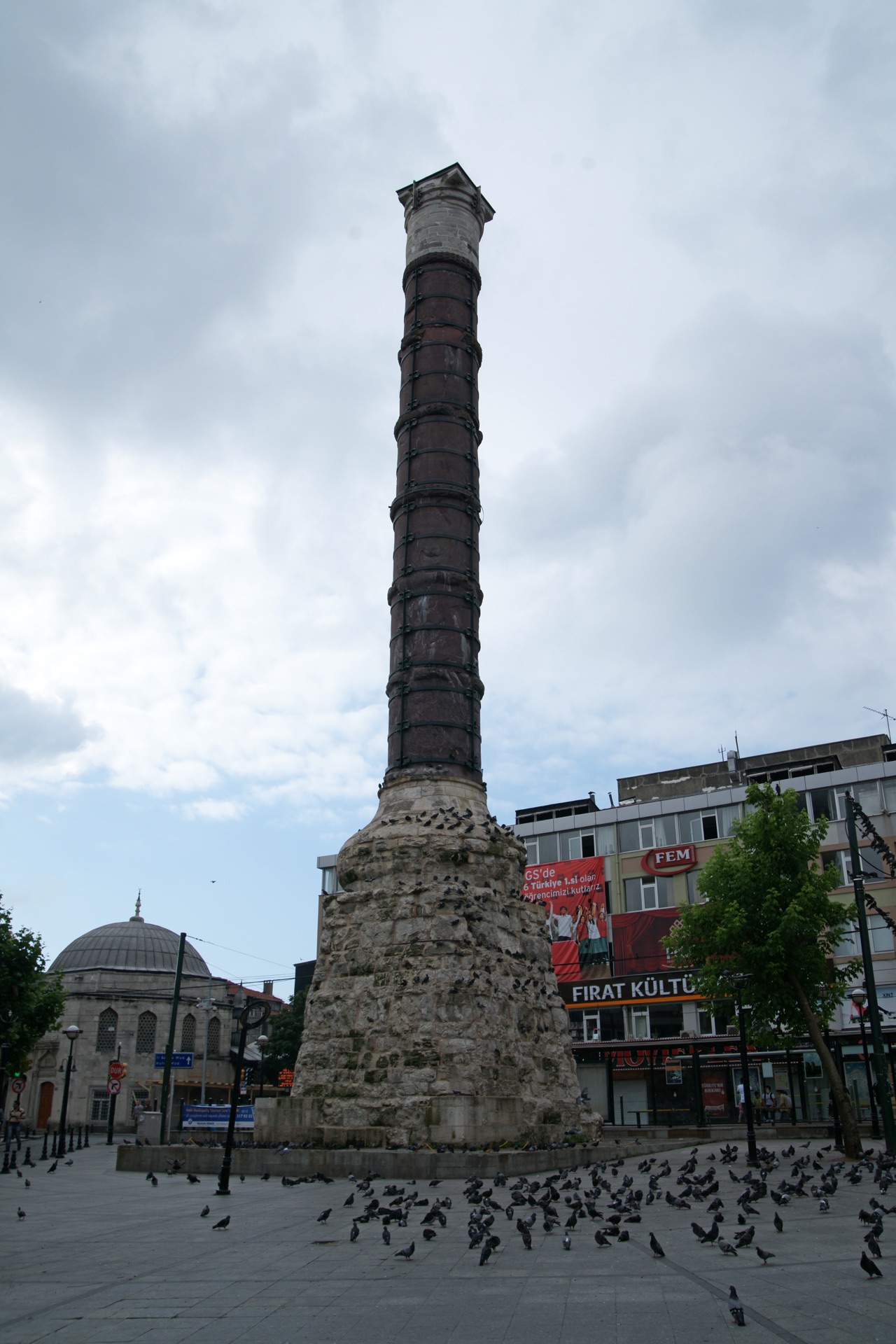
In the middle of today's city traffic stands a monument that thousands of people walk past every day without realizing how old it actually is. The Column of Constantine was erected in the 4th century, when Constantine the Great inaugurated his new capital.
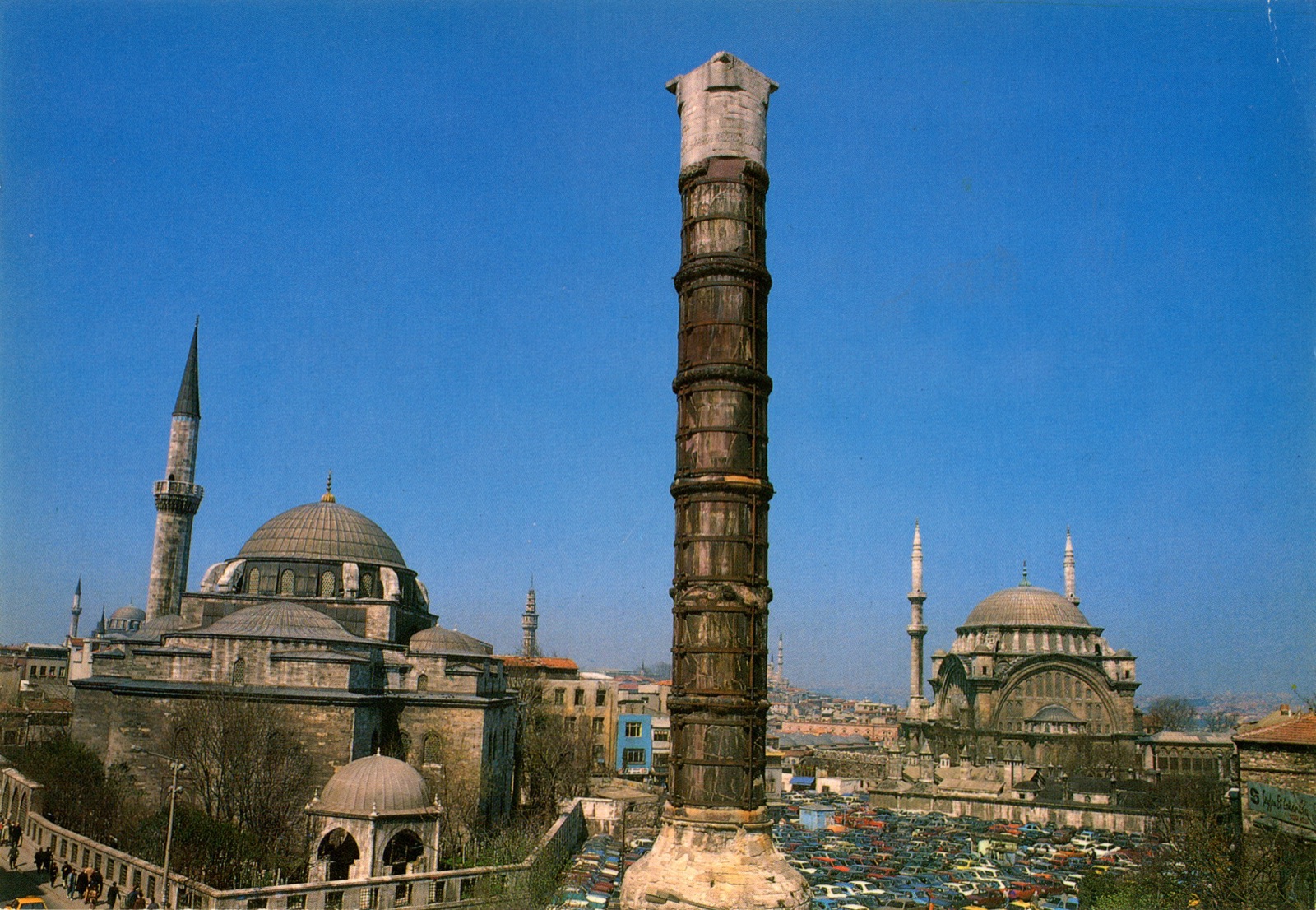
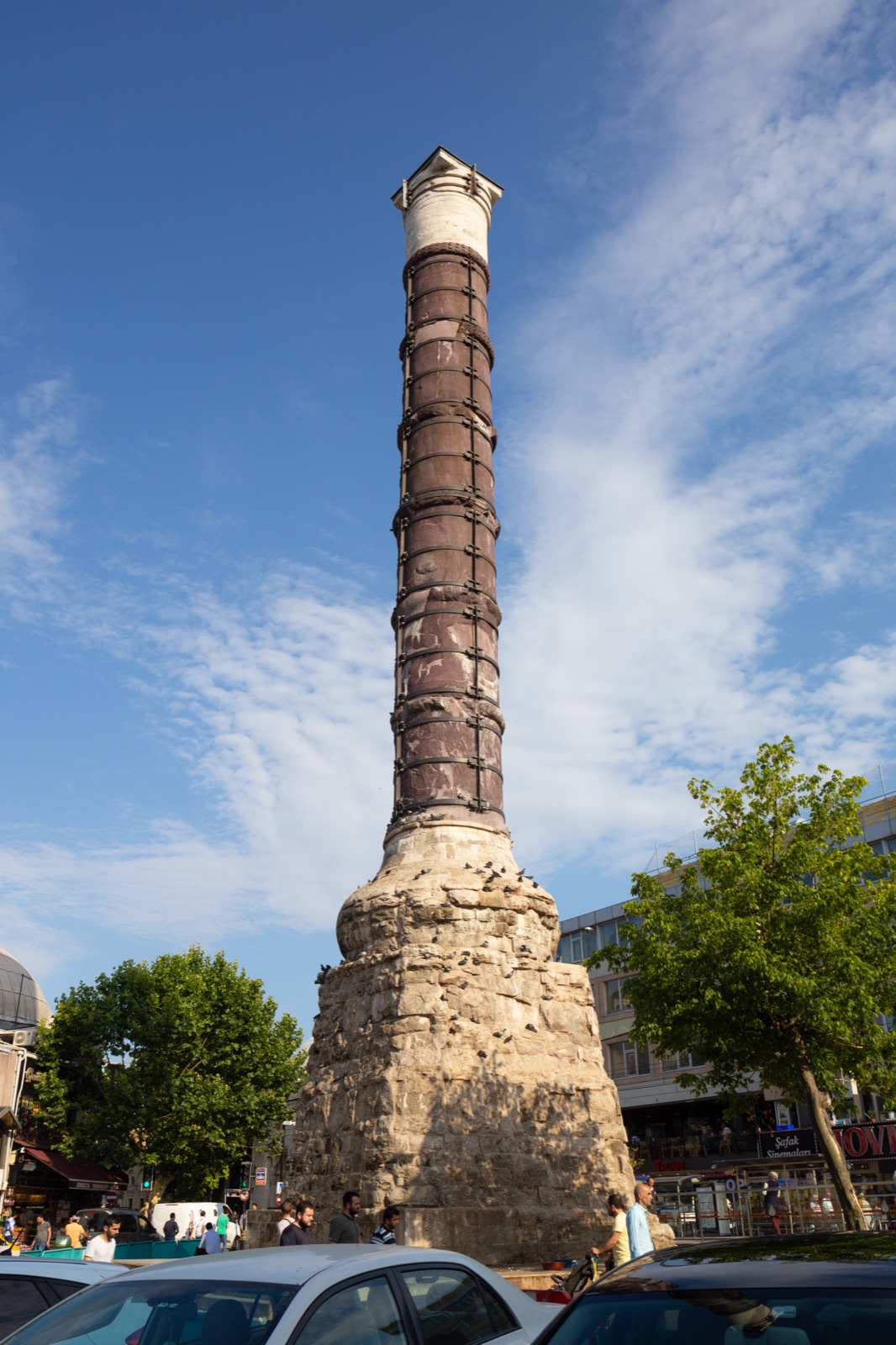
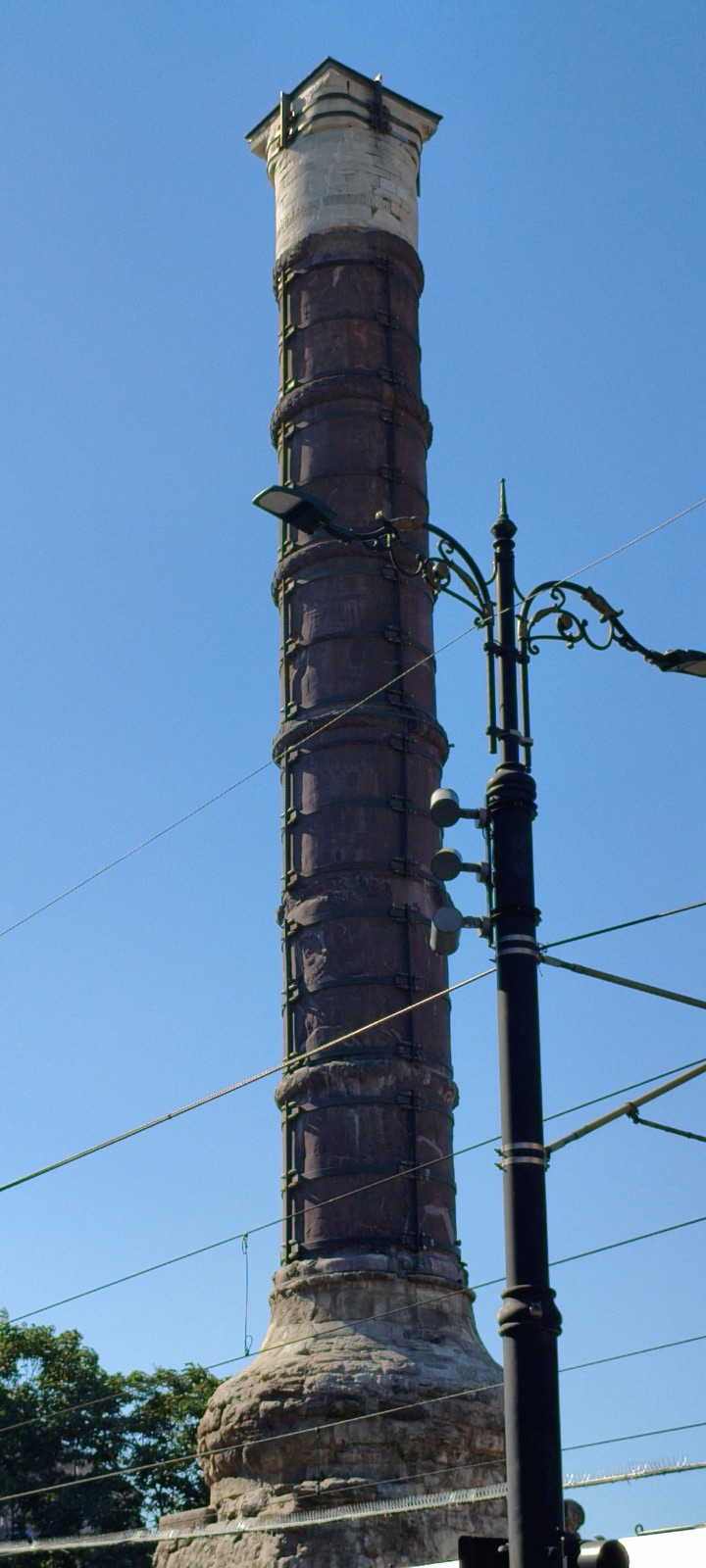
The column we see today, however, is only part of the original structure. Atop it once stood a monumental statue of Constantine, later lost. Fires discolored and damaged the porphyry, earthquakes weakened the construction, metal hoops were added for stabilization, and the base was altered or covered over. That's exactly what makes Çemberlitaş so interesting: the monument no longer looks the way it did in 330, but its damage itself tells the story of having survived nearly seventeen centuries in the middle of a constantly changing city.
- The Column of Constantine was erected in the 4th century in the Forum of Constantine.
- It belonged to the monumental furnishing of the new capital, Constantinople.
- It originally carried a statue of Constantine.
- Its shaft consists of large porphyry drums.
- Fires and earthquakes damaged the monument repeatedly.
- The metal hoops visible today were added for stabilization and gave Çemberlitaş its Turkish name: "the hooped stone."
- Many spectacular stories about relics in its foundation are later traditions and can't be fully proven.
- The monument still stands roughly on its late-antique axis today, even though the city around it has completely changed.
Why Constantine needed a new capital
By the time Constantine stabilized his rule in the early 4th century, the Roman Empire was long past being a state centered exclusively on the old city of Rome. Military and economic weight increasingly lay in the east. Byzantium's position on the Bosphorus offered an enormous strategic advantage: from here, the Balkans, the Black Sea, the Aegean and Asia Minor could be controlled far more directly than from Italy.
Constantine therefore had the older Greco-Roman city massively expanded. New walls, streets, forums, churches and palace areas were built. In 330, Constantinople was ceremonially inaugurated. The city was meant to be both Roman and new at once. It adopted institutions and monument types from Rome, but developed its own Christian-imperial identity.
In this program, the Forum of Constantine played a central role. It lay on the great main street, the Mese, and connected the older city to the new western expansions.
The Forum of Constantine
The forum was a monumental square, likely roughly round or oval in shape, and surrounded by colonnades and public buildings. Anyone walking along the Mese had to pass through this space. The Column of Constantine stood at its center and made immediately clear to whom the new capital owed its monumental transformation.
Today, almost nothing remains visible of this forum as a coherent square. Streets, houses and later Ottoman construction overlaid the late-antique structure. That's exactly why Çemberlitaş sometimes looks almost lost today, amid the tram, shops and traffic. In antiquity, by contrast, it was the center of a grand public space.
What the original column looked like
The shaft consisted of large cylindrical drums of porphyry, a purple-reddish stone closely tied to imperial rule in the Roman era. Porphyry was difficult to quarry and transport, which meant its use was already a political statement in itself.
Between the drums there were originally decorative transitional elements. The column was considerably lighter and smoother than the now dark, fire-scarred and much-repaired shaft suggests. The base and upper sections were also altered over the centuries.
The statue on top
Atop the column stood a huge statue of Constantine. Later sources describe him in a depiction that may have combined elements of Roman imperial iconography with those of the sun god. In its hand, the figure is said to have carried, among other things, an orb.
This is exactly where Constantine's transitional era shows through. He promoted Christianity massively and convened the Council of Nicaea, while imperial visual language continued to draw on older Roman, and partly solar-religious, traditions. The simple idea that Constantine abolished all "pagan" symbolism overnight doesn't match the reality of the 4th century.
The statue toppled in the 12th century during a storm, or a severe wind event. It was not replaced in its original form. Emperor Manuel I Komnenos later had a different crowning element and an inscription added.
Relics beneath the column: legend or history?
Numerous Christian legends grew up around the column's base. Holy relics are said to have been placed beneath the monument — pieces of the True Cross, objects from the Passion narrative, or even objects from Troy that Constantine had symbolically brought to Constantinople.
Such stories served a purpose. They turned a monument originally strongly Roman-imperial in character into a site of Christian salvation history, and linked the new capital to Jerusalem, Rome, and even Troy. That individual relics may have been deposited there can't be completely ruled out; the extensive later lists, however, can't be reliably verified historically.
Fires, earthquakes, and the metal hoops
Constantinople burned again and again. Especially large city fires damaged the forum and the column too. The porphyry became partly discolored, which is why Western travelers later called the monument the "Burnt Column."
Earthquakes further stressed the shaft. Metal hoops were added to stabilize the drums. These rings are the source of the Turkish name Çemberlitaş — "the hooped stone."
These repairs shouldn't be seen as disfigurement. Without repeated reinforcement, a nearly 35-meter-tall ancient monument would likely barely have survived to this day.
1204 and Latin rule
During the conquest of 1204, numerous ancient bronze groups, statues and precious metal objects in Constantinople were destroyed or melted down. The Hippodrome's decoration in particular was hit hard. For the Column of Constantine itself, no comparably clear individual account of crusader looting is documented.
It stood, however, in a city whose public monument landscape was considerably impoverished by the Fourth Crusade. That the porphyry column itself survived is also owed to the fact that its main material had no comparable metal value to bronze statues.
How the Ottomans treated the column
After 1453, the column remained standing and became part of the Ottoman cityscape. It received further repairs, and its surroundings changed considerably. Nearby, the Çemberlitaş Hamam and new commercial structures later arose, among other things.
So the monument was not torn down, even though its original Roman political message had long since become meaningless. The founder's monument turned into a historical landmark, whose name even carried over to the entire neighborhood.
The forum as a stage for a new Roman capital
Constantine's column was never meant to stand in isolation. It stood within a forum that made the new capital politically legible. Anyone moving through Constantinople traveled along the Mese, the great main street, from one monumental square to the next. Forums were traffic hubs, gathering spaces, and backdrops for processions. Statues, triumphal images and inscriptions told residents who ruled and how the empire understood itself.
The Forum of Constantine was therefore part of a larger program. Constantine didn't want a completely new city without a past, but a capital that took over Rome's claim while shifting it eastward. He had artworks and statues brought to Constantinople from older cities. This created a deliberately assembled monument landscape, in which Greek antiquity, Roman imperial tradition, and new Christian symbolism stood side by side.
This mix matters, because later narratives like to portray Constantine's city as immediately and completely Christian. In reality, the transformation of the religious landscape took generations. Pagan temples, classical statues and Christian churches coexisted for a long time. The column itself fits perfectly into this transitional era.
Why porphyry was so political
Porphyry wasn't just a pretty red stone. The most important ancient quarrying area lay in Egypt, and transporting large blocks was a major undertaking. In late antiquity, the material became so closely tied to imperial dignity that "born in the purple" literally took on political meaning. In Constantinople, a porphyry chamber later existed in the Great Palace, where imperial children could be born who carried the title Porphyrogenitus.
That Constantine's column consisted of porphyry drums thus reinforced its message. Color, material and height made the emperor visible even to people who couldn't read an inscription. If the stone looks dark and cracked today, that original luxury is hard to make out anymore.
How medieval residents reinterpreted the column
The older a monument gets, the more stories accumulate around it. In medieval Constantinople, the column was no longer understood merely as the founder's monument. Christian traditions told that relics were hidden in its foundation, and that Constantine had thereby spiritually protected the city.
Such stories served an important function: they integrated a late-antique ruler's monument into the city's Christian identity. A resident of the 10th century saw the column differently than a citizen of 330 did. History doesn't just change buildings — it changes their meaning too.
After 1453, the same thing happened again. For Ottoman Istanbulites, Çemberlitaş wasn't a symbol of their own rule, but it remained a distinctive landmark. Travelers described the column, illustrators recorded it, and its Turkish name referred quite pragmatically to its stabilizing hoops. That's how Constantine's political monument became part of everyday Istanbul.
Why the damage itself is historically valuable
When restoring old monuments, there's always the temptation to make them "beautiful" again. With Çemberlitaş, though, a perfect reconstruction would be problematic. The dark fire scars, metal hoops and irregular repairs show that the column genuinely survived catastrophes.
If it were visually returned to its condition of 330, it might look more impressive, but a large part of its later history would become invisible. Heritage preservation therefore doesn't always have to restore some supposed original state. Sometimes the damaged surface itself is the most honest historical document.
What's still visible today — and what's long gone
Of the original monument complex, mainly the column shaft survives. The statue of Constantine, the forum, the surrounding porticoes and many decorative elements are gone. Even the base lies partly beneath today's street level, or was altered by later interventions. That explains why the column looks smaller in the modern cityscape than it must have looked in antiquity.
Anyone visiting should pay particular attention to the different surfaces. Dark fire scars, metal hoops and uneven repair zones are no accident. They show the long strain from fire and earthquakes. The very rings that gave the monument its Turkish name are visible proof that people kept trying to save it, again and again.
Also fascinating is its location relative to the tram line. The modern main axis partly follows the city's old east-west route. Of course it doesn't correspond exactly to the ancient Mese, but you're still moving roughly along the same historical direction. So Constantine's column still stands on a transport axis today — only the vehicles have changed radically.
"A piece of the True Cross lies beneath the column." That's an old tradition, but it's not archaeologically proven.
"The column is black because it was built from black stone." False. The shaft consists of reddish-purple porphyry and was heavily altered by fires and aging.
"The statue of Constantine still stands on top." No. The ancient statue was already lost in the Middle Ages.
My take on this place
Çemberlitaş is exactly the kind of place you easily walk right past, because everything around it seems louder. Tram, shops, people — and in between, just a column standing there.
But once you know this monument has stood there roughly since the founding of Constantinople, your view of it changes. The houses around it came and went, empires disappeared, the city's religion and language changed, and this damaged old column still stands right in the middle of the traffic. Precisely because it isn't perfectly restored and smooth, I find it impressive.
– Amra