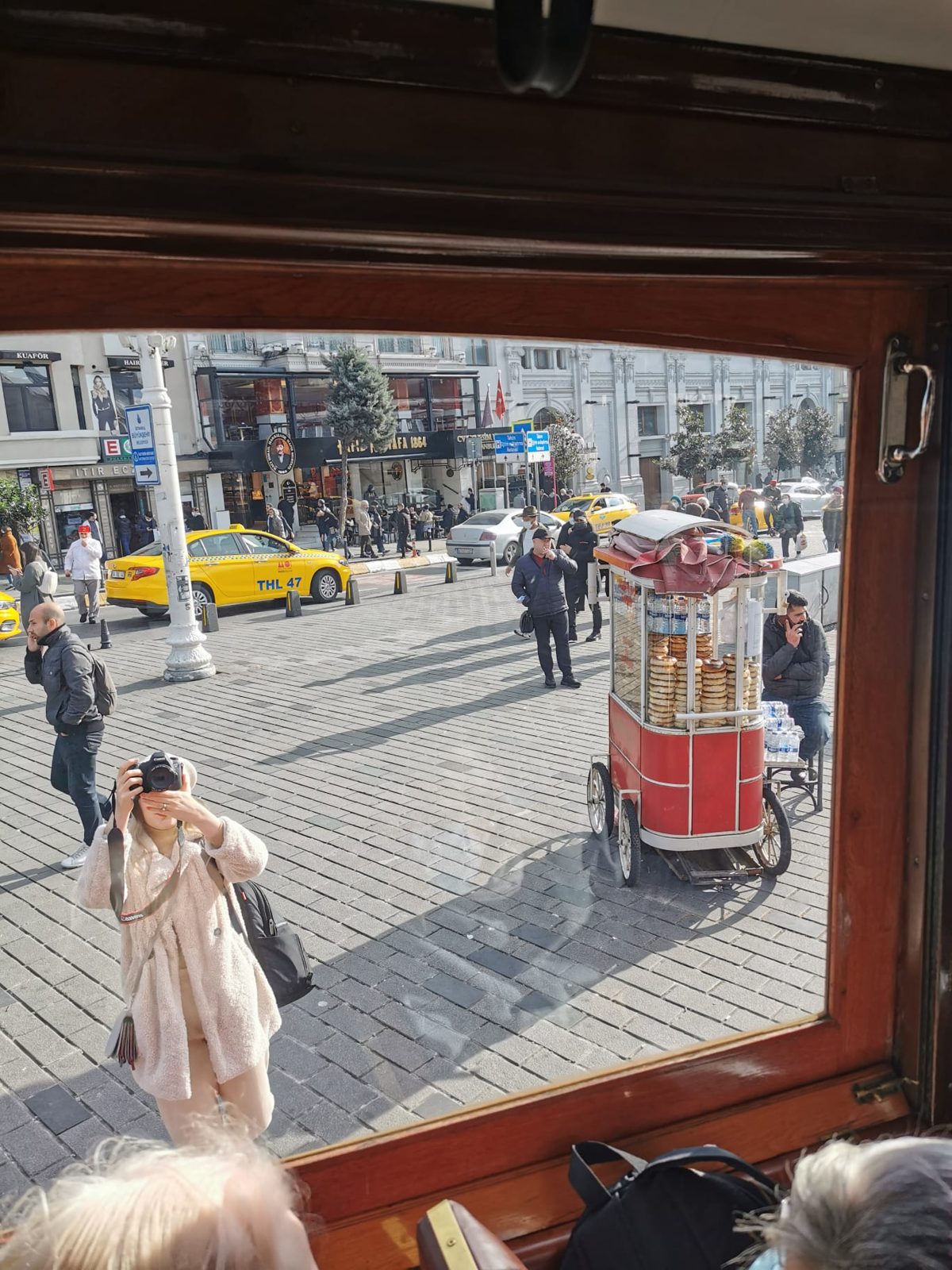
Taksim isn't one of those squares whose significance comes from especially harmonious architecture. Its power comes from something else: several layers of modern Turkish history sit directly next to each other here. An Ottoman water distributor gave the square its name. The Republic Monument turned it into a symbol of the new state. Demonstrations and political violence changed its meaning. Gezi in 2013 made the square famous worldwide. With the new Atatürk Cultural Centre and the Taksim Mosque, opened in 2021, its skyline was fundamentally altered again within just a few years.
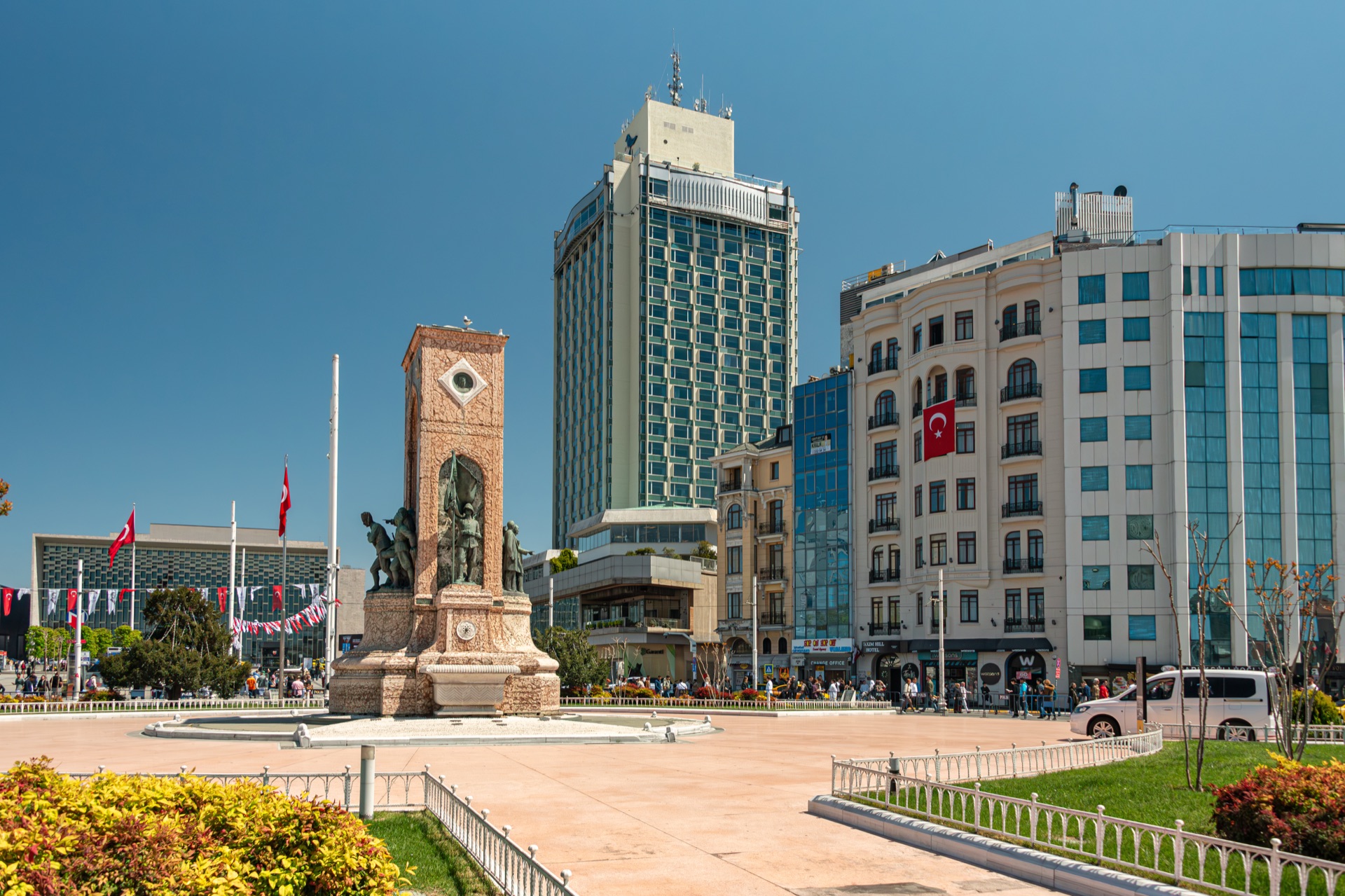
Taksim isn't one of those squares whose significance comes from especially harmonious architecture. Several layers of modern Turkish history sit directly next to each other here.
Anyone who knows Taksim only as "the start of İstiklal" is therefore only seeing the surface. The Republic Monument and the mosque, in particular, show how political and religious symbolism get made visible within one public space.
- "Taksim" means division, or distribution.
- The name comes from the historic water-distribution system.
- The Maksem building still survives today.
- The Republic Monument by Pietro Canonica was unveiled in 1928.
- One side emphasises the war of independence; the other, the new Republic.
- On 1 May 1977, dozens of people died at a mass rally.
- In 2013, protests began in Gezi Park and spread nationwide.
- The new AKM and the Taksim Mosque, opened in 2021, now shape the square together.
Why Is the Square Even Called Taksim?
The name originally has nothing to do with the Republic, protests, or a person. In the 18th century, water from northern springs was channelled toward Beyoğlu. At a distribution point, it was split across different pipelines.
That's exactly where taksim comes from: distribution.
That's actually a fantastic contrast. One of Turkey's most politically famous squares carries a name that originally simply describes a technical function.
The Maksem and the Old Water System
The historic Taksim Maksemi still stands on the square today. Many people walk right past it and barely notice it, even though this building literally explains why the whole place carries this name.
The water-distribution system was expanded in the 18th century under Mahmud I. For the growing Pera/Beyoğlu, a reliable supply was essential.
The Maksem is therefore a rare surviving piece of infrastructure history, sitting in the middle of a square that later took on entirely different political meanings.
The Artillery Barracks
In the early 19th century, a large artillery barracks, the Topçu Kışlası, arose at the edge of today's square. It was altered several times later and shaped the area considerably.
After the founding of the Republic, the French urban planner Henri Prost fundamentally redesigned Taksim. The barracks were torn down in the 1940s, and Gezi Park arose in its place, or in its surroundings.
This backstory suddenly became politically relevant again in 2013, when plans to reinterpret the former barracks became part of the dispute over the park.
How the Republican Square Came to Be
The young Republic needed new public spaces and symbols. Taksim developed into a central site for celebrations and state representation.
In 1928, the Cumhuriyet Anıtı, the Republic Monument, was unveiled.
Its placement was deliberate. The monument placed the new republican state's history at the centre of an urban space that was increasingly becoming the social centre of modern Istanbul.
The Republic Monument in Detail
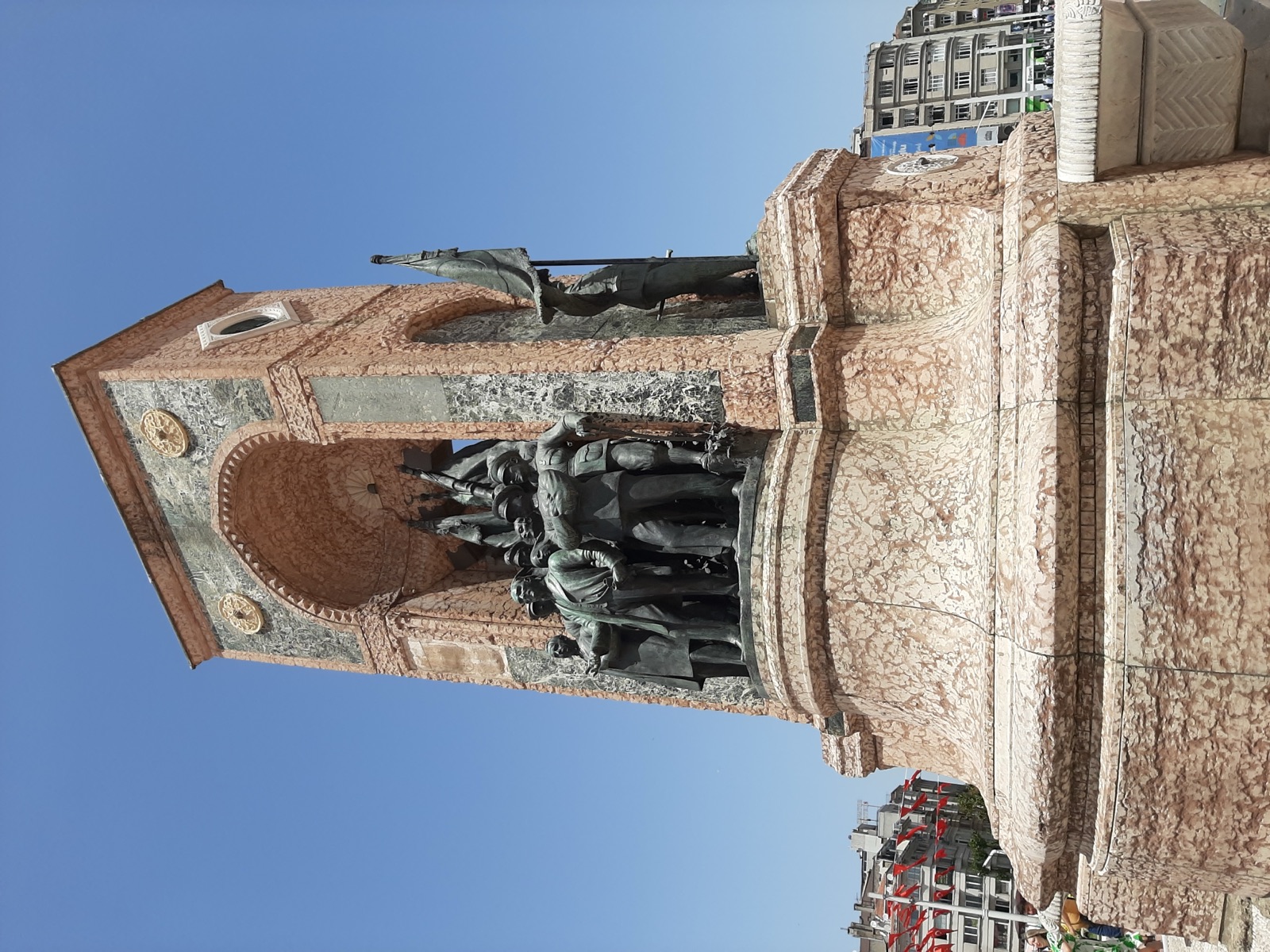
The monument was designed by the Italian sculptor Pietro Canonica. The choice of an internationally known European sculptor alone shows how strongly the young Republic wanted to present itself as a modern state.
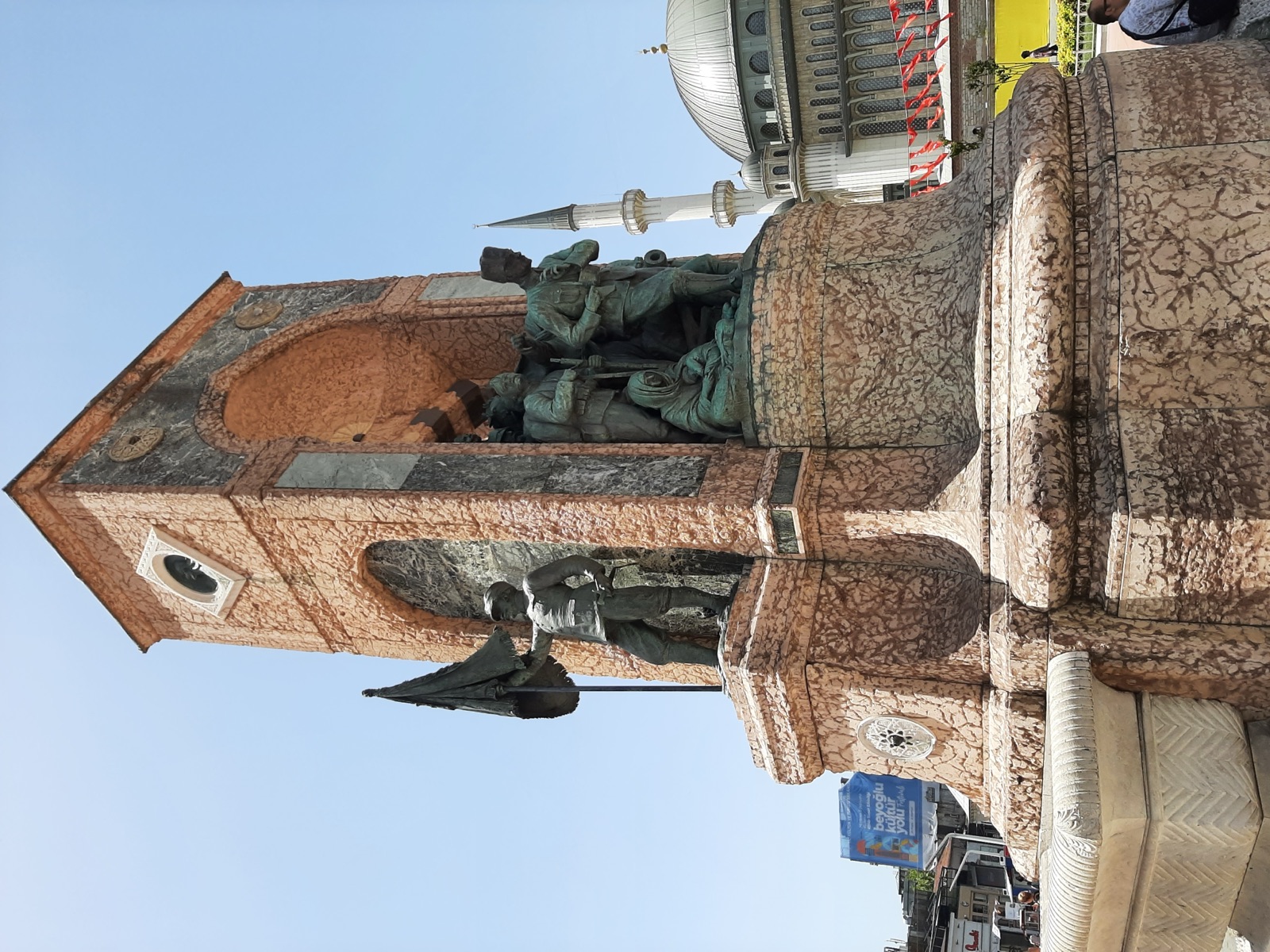
The monument has two main sides carrying different political messages. One side depicts the war of independence more strongly; Atatürk appears in a military context, flanked by comrades. The other side turns its gaze to the new Republic: Atatürk appears as a statesman, alongside İsmet İnönü, Fevzi Çakmak, and other figures.
Clothing is part of the message. Out of the military struggle for liberation, a modern civil state is meant to emerge. The transition from war to Republic is, quite literally, told in bronze.
Especially interesting are the Soviet figures within the group, including Kliment Voroshilov and Mikhail Frunze. They recall Soviet Russia's support for the Turkish national movement during the war of independence. This detail is overlooked by many visitors, but is politically extraordinarily revealing.
The monument is therefore not simply "an Atatürk statue." It's a political programme in monumental form.
Why Taksim Became a Political Square
Central squares attract public gatherings. Taksim became a site for national celebrations, workers' rallies, demonstrations, and political confrontations.
Whoever controls Taksim thereby symbolically controls one of the country's most visible public spaces.
That's exactly why access restrictions, bans on demonstrations, or redevelopments there almost automatically spark political debate.
1 May 1977
On 1 May 1977, hundreds of thousands of people gathered for a great workers' rally. Toward the end of the event, shots were fired; panic broke out. People were shot, trampled, or killed in the chaos. More than thirty people died.
To this day, questions about the perpetrators, the sequence of events, and possible state or intelligence-service responsibility remain the subject of political and historical debate. That's exactly why a serious article shouldn't present an unproven theory of the perpetrators as established fact.
What is certain: 1 May 1977 turned Taksim into a central site of political memory in Turkey.
Gezi Park, 2013
In May 2013, environmental activists initially protested against plans to remove trees in Gezi Park and to build a reinterpretation of the former Topçu barracks on the site.
A harsh police crackdown on the small protest group led to considerably greater outrage. Within a few days, this developed into a nationwide protest movement against the Erdoğan government, bringing together very different social groups.
By some point, the protests were no longer just a dispute about trees or a barracks. Questions about governing style, police violence, public space, freedom of expression, and social development all became intertwined.
Taksim and Gezi thereby became, internationally, a symbol of a broader political struggle.
The Old and New Atatürk Cultural Centre
The Atatürk Kültür Merkezi, or AKM, was for decades one of Turkey's most important cultural venues. Opera, theatre, concerts, and other events took place there.
After a long closure, the old building was demolished. A new cultural centre arose in its place, opening in 2021. The large red sphere of the opera hall behind the glass facade became a new visual landmark of the square.
The new AKM deliberately recalls the cultural function of its predecessor while representing an entirely new building at the same time.
The Taksim Mosque and Its Long Backstory
The idea of a great mosque right on Taksim Square existed for decades before it was actually built in 2017. That's precisely why the project was politically contentious.
For a long time, Taksim was strongly shaped by republican symbols: the Republic Monument, the AKM, and Gezi Park. Supporters of a mosque argued, among other things, that this central area lacked an adequate Muslim prayer space. Critics saw the project as a deliberate alteration of the square's symbolic republican cityscape.
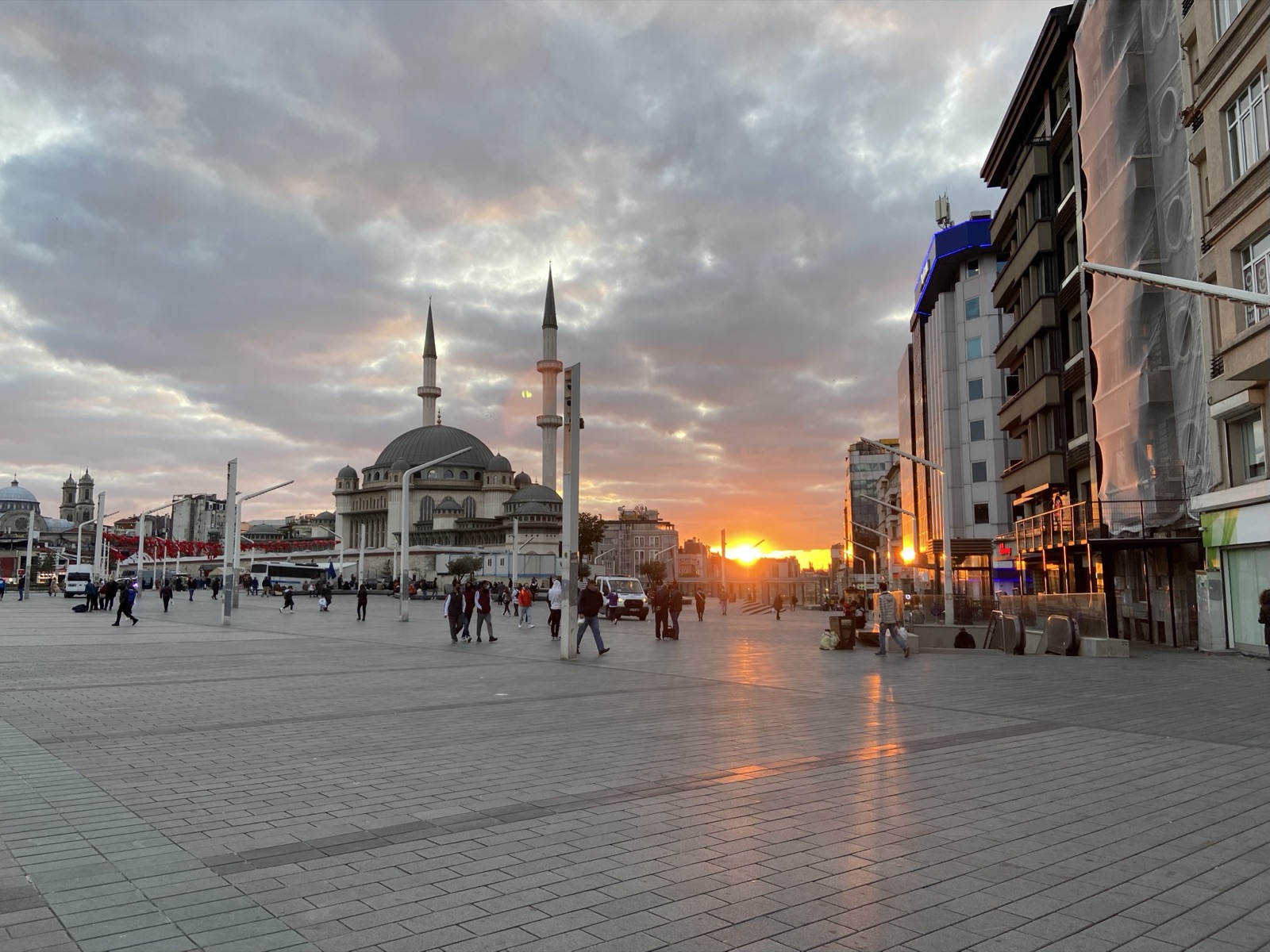
In 2021, the Taksim Mosque opened. Architecturally, with its central dome and two minarets, it draws on traditional mosque forms, but interprets them as a modern building. Cultural and event spaces are also part of the complex.
The mosque is therefore not a historic building that happens to stand on the square. It's a deliberate 21st-century monument, and part of the political history of our own time.
How the AKM, the Monument, and the Mosque Interact Today
Today, two large new buildings practically face each other on the square: the modern AKM and the Taksim Mosque. Between them stands the Republic Monument.
One building stands for state-sponsored culture and republican modernity. The other is a new religious monumental building. The monument, in turn, tells the founding story of the Republic.
Together, these three elements form a kind of visual dialogue about modern Turkey. That's exactly why Taksim feels so politically charged, even on an ordinary day when it's mostly just tourists taking photos and people walking to the metro.
The Monument as an Everyday Stage
Today, the Republic Monument is not just a political symbol, but an everyday meeting point. People arrange to meet there, tourists take photos, demonstrations begin or end nearby.
This everyday use doesn't diminish its meaning — it adds to it. Monuments only truly function within urban space once people integrate them into their everyday lives.
That's exactly why Taksim is so sensitive. Every political intervention affects not just a monument or a park, but a place millions of people actually use.
Traffic Beneath the Square
Taksim is also a major transport hub. The metro, bus connections, and road links make the square a functional centre.
Redevelopments repeatedly tried to reduce surface car traffic and expand pedestrian areas. Such measures changed the square considerably and weren't always received positively.
Taksim's political significance can therefore never be fully separated from its perfectly mundane everyday function.
The Republic Monument Is a Political Programme
Canonica's monument deliberately tells a transition from war to statehood. One side is dominated by the war of independence, the other by the new republican order. Atatürk appears accordingly differently — at times more as a military leader, at times as a civil statesman. Clothing and accompanying figures contribute to the message.
Especially interesting are the Soviet representatives within the figure group. The Turkish national movement received support from Soviet Russia during the war of independence. That this relationship is visible right in the middle of Taksim Square is easily overlooked.
The monument also created a new focal point for state rituals. Wreath-layings, celebrations, and demonstrations could henceforth refer to a concrete republican symbol. Taksim thereby became more politically charged.
1 May 1977: What's Certain, and What Remains Open
The rally was one of the largest workers' events in Turkish history. When shots were fired, panic ensued. Escape routes were partly blocked, people were shot or fatally injured in the crush. More than thirty deaths are undisputed; the exact number varies by source.
To this day, it hasn't been conclusively established who fired all the shots and which actors bore what responsibility. Different political camps developed different explanations. A serious text should name these open questions, without selling any unproven theory as final truth.
For trade unions and left-wing movements, Taksim thereby became a site of memory. Later conflicts over whether May Day could be held there always referred back to 1977 too.
Gezi Grew Far Bigger Than the Original Question About the Park
The first protests were directed against tree felling and the planned project in Gezi Park. The decisive turning point, however, was the police response, perceived as disproportionate. Images spread quickly, and within a few days protests had arisen in many cities.
The participants were politically very diverse. Environmental activists, left-wing groups, secular Kemalists, football fans, liberals, and people with no fixed political affiliation stood side by side for a time. Some protested against the building project, others against the government's style, media policy, or intrusions into personal ways of life. This diversity explains why Gezi is still assessed in completely different ways today.
The Mosque Shifts the Square's Symbolic Balance
That a great mosque on Taksim Square was disputed for decades wasn't because Beyoğlu lacked Muslim houses of worship. It was about this specific site. A great mosque right next to the Republic Monument and facing the AKM would inevitably become part of Taksim's political visual language.
The building that opened in 2021, with its dome and two minarets, draws on historic forms, but is technically a modern building with additional cultural and event spaces. Supporters saw it as closing a religious and urban-planning gap; critics saw a visible symbol of political shifts under Erdoğan. Regardless of one's own assessment, this very debate is part of the building's history.
How Transport Policy Kept Reshaping the Square
For decades, Taksim was an important hub for buses, cars, and public transport. With the expansion of the metro and later projects, roads were partly moved underground and larger areas created for pedestrians. This made the square more open, but also emptier and harder in its design.
These redevelopments were assessed differently. Some welcomed less surface car traffic; others criticised the large stone-paved area and the loss of a finer-grained sense of place. Here too, the pattern holds: Taksim is never just architecture, but almost always political urban planning.
"Taksim is named after the Republic Monument." False. The name is older and comes from the water-distribution system.
"Gezi began as a planned attempt to topple the government." The first protests were specifically directed against interventions in the park. Only after police crackdowns did the movement quickly widen into a broader wave of political protest.
"The Taksim Mosque was decided on spontaneously within a few years." No. The idea and political debate over a mosque on the square go back decades.
My Thought on This Place
Taksim isn't, for me, one of Istanbul's most beautiful squares. But beauty isn't really the point here at all.
Once you know that the name originally just explained that water was distributed here, and then look at everything that was added over the following centuries, you suddenly understand the square better: barracks, Republic Monument, the workers' movement, 1 May 1977, Gezi, the AKM, and the mosque.
Taksim is thereby almost like a discussion about Turkey made out of buildings and memories.
And maybe that's exactly why every redevelopment there triggers so much bigger emotions than it would on any ordinary square.
– Amra