
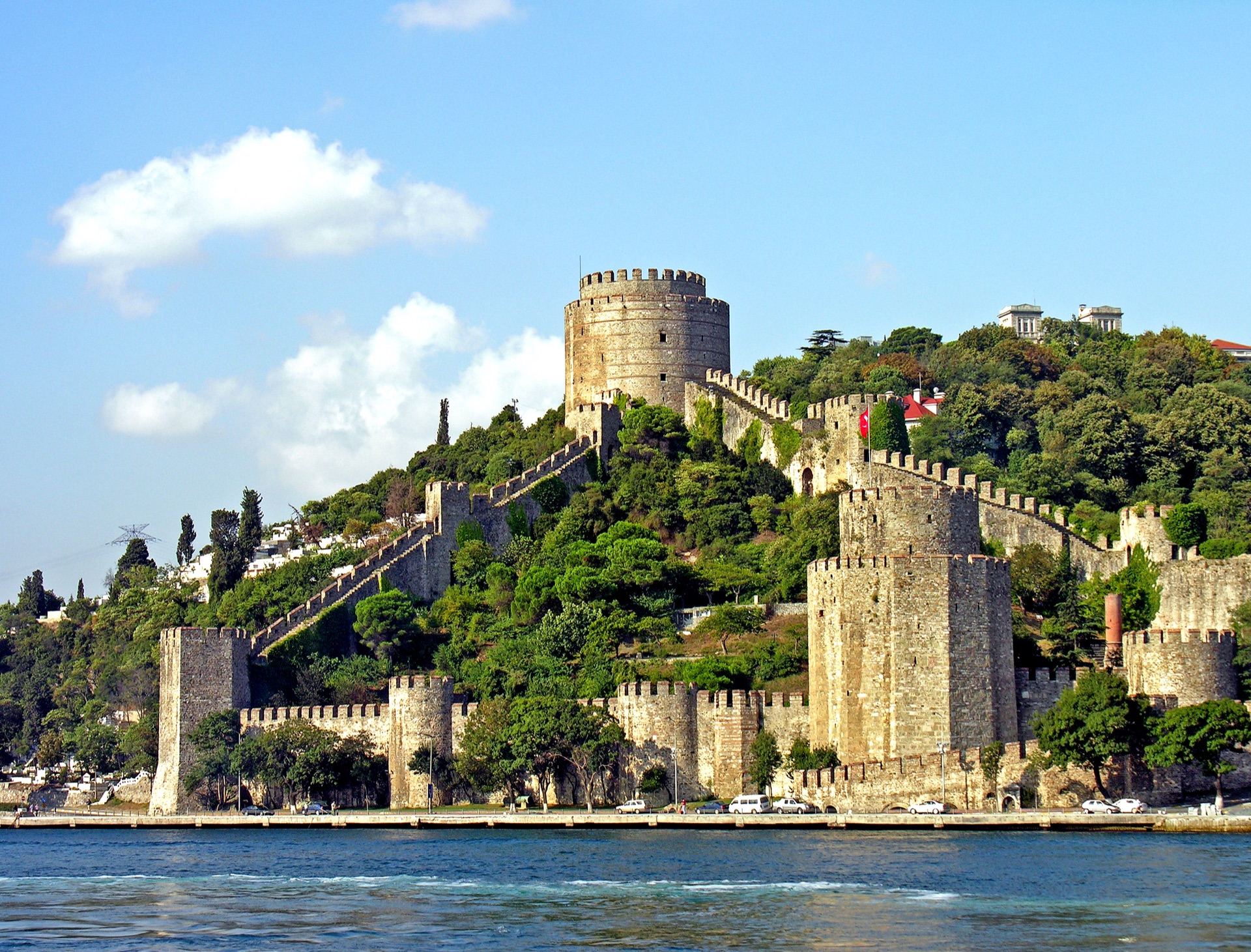
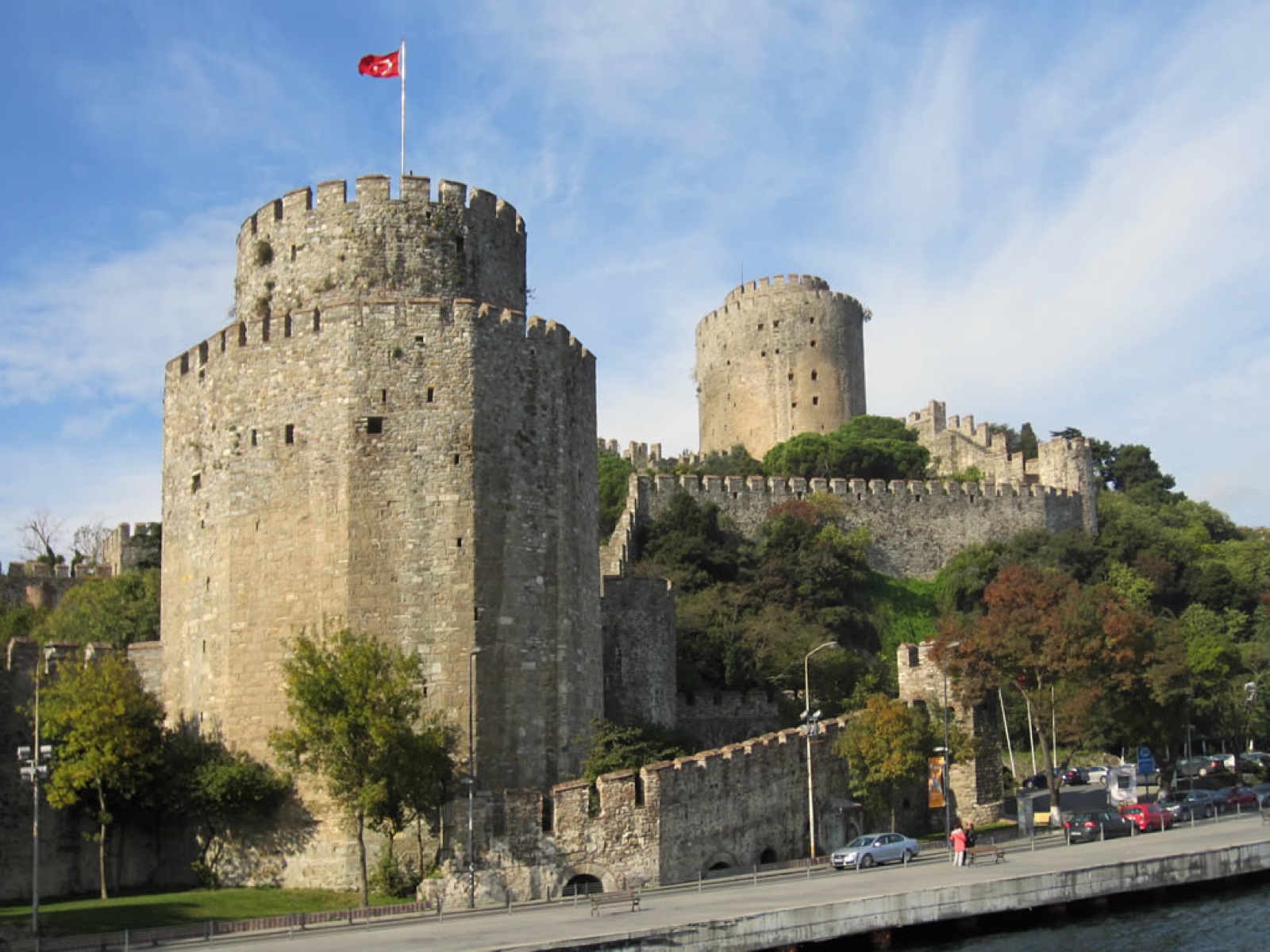
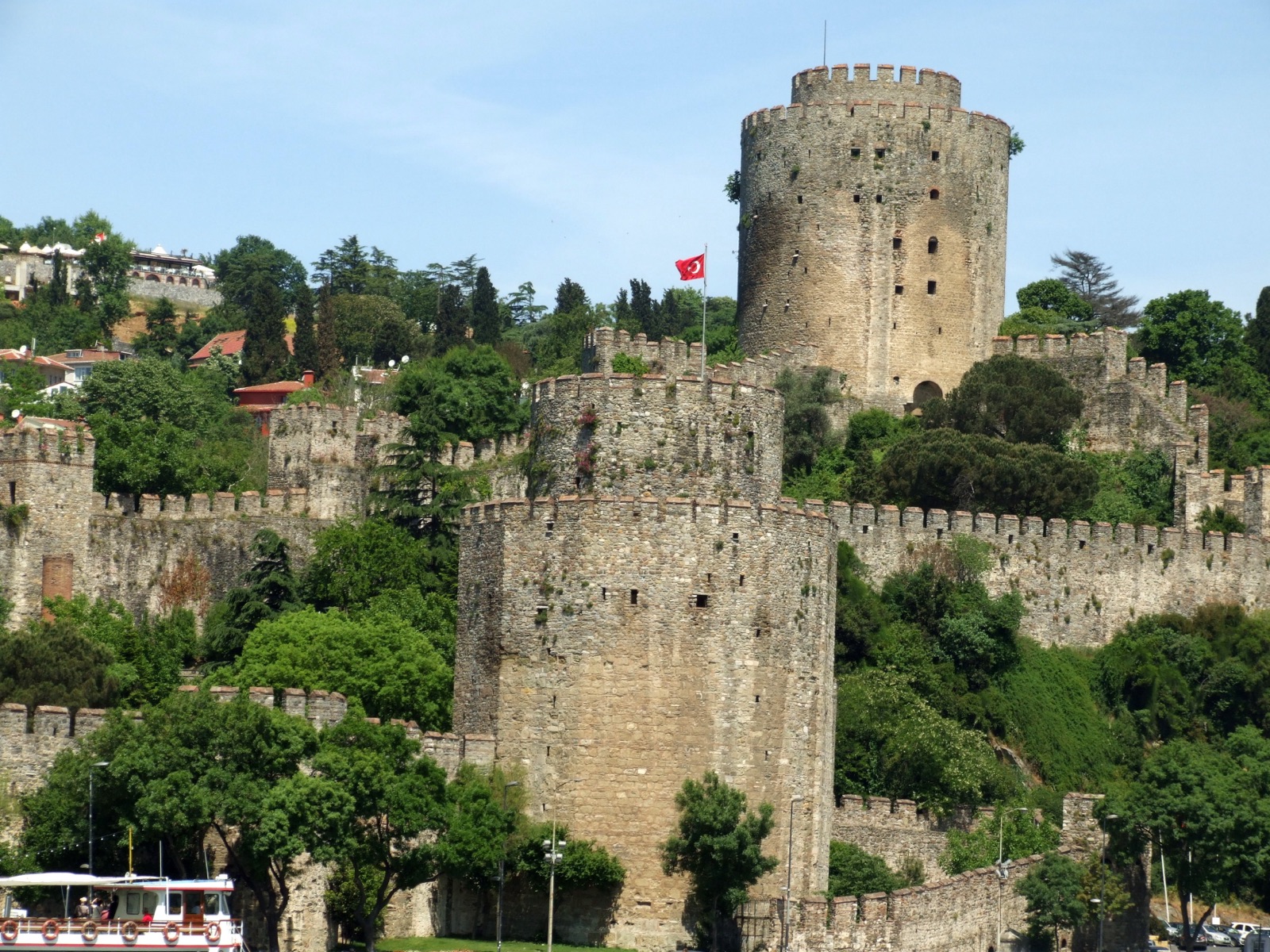
Rumeli Hisarı looks almost too beautiful today. Green hillsides. Stone walls. The Bosphorus. Towers. Boats. But this building wasn't built as a romantic scenic fortress. Its purpose was very concrete: controlling ships.
Advertising: If you book through our links, we may receive a commission – at no extra cost to you.
In March 1452, Mehmed II began building a massive fortress at one of the narrowest points of the Bosphorus. By August it was already finished. A few months later, preparations began for the attack that would end the Byzantine Empire in 1453.
The official museum description dates construction from March to August 1452 and explicitly names control of the Bosphorus as its purpose.
- Mehmed II had Rumeli Hisarı built in 1452.
- Construction time: roughly March to August.
- Its goal was to control shipping through the Bosphorus.
- Anadolu Hisarı already stood on the Asian side.
- The fortress played an important role in Mehmed's preparations for conquering Constantinople.
- After 1453, it lost most of its original significance.
- It was later used, among other things, as a prison.
- In 1746, it was damaged by a fire.
- A comprehensive restoration took place in the 1950s.
Why Did Mehmed Need This Fortress?
In 1451, Mehmed II became sultan again. He had a clear goal: Constantinople. But the city could potentially receive support via the Bosphorus and the Black Sea. Genoese colonies in particular, and other Christian powers in the Black Sea region, were a factor. Mehmed wanted to control the passage more tightly.
A Fortress Already Stood on the Asian Side
Anadolu Hisarı had already been built under Bayezid I. Mehmed added a considerably larger fortress on the European side. Fortifications thereby stood on both sides of an especially narrow point of the Bosphorus.
Why Exactly There?
Because the strait is unusually narrow at this point. Ships had to pass relatively close to the fortifications. That improved the effectiveness of the artillery. From a military standpoint, the site is almost self-explanatory.
Construction Time: About Five Months
This is probably one of the most impressive details. Start of construction: March 1452. Completion: August 1452. Official museum information cites, among other figures, 300 skilled craftsmen, 700–800 labourers, and around 200 people for transport work.
Mehmed Was Clearly in a Hurry
And that's exactly the point. He wasn't building a fortress for someday. The attack on Constantinople was concrete planning. Fortress in 1452. Siege in 1453. The timing isn't a coincidence.
The Great Towers
Three especially massive towers dominate the complex. They're associated with important pashas of Mehmed's: Çandarlı Halil Pasha, Zağanos Pasha, Sarıca Pasha. Responsibility for sections of construction was thereby delegated to high-ranking men.
Boğazkesen
The fortress was also called Boğazkesen. The term allows several linguistic readings. It can refer to "cutting," or sealing, the strait. At the same time, "boğaz" can also mean throat, giving the word a deliberately drastic secondary meaning.
The Venetian Ship
In the autumn of 1452, an incident occurred involving a ship that refused to accept Ottoman control of the passage. It was fired on by the fortress's artillery and sunk, or badly hit. The surviving crew was captured and executed on Mehmed's orders. That was a very clear message: the new control of the Bosphorus was meant seriously.
What Did That Mean for Constantinople?
The city was now more cut off. The fortress reduced the chance of receiving unhindered support and supplies via the Bosphorus. It was thus an important part of Mehmed's preparation.
But the Fortress Did NOT Conquer Constantinople on Its Own
That still needs to be said. Some narratives turn Rumeli Hisarı into the single decisive reason for 1453. That's not how history works. The conquest involved: Ottoman troop superiority, heavy artillery, the siege of the land walls, naval operations, ships in the Golden Horn, limited numbers of Byzantine defenders, insufficient Western support, and the political and economic weakness of the late Byzantine Empire. Rumeli Hisarı was an important part of this system. Not the only one.
1453 — and Suddenly the Fortress Matters Less
After the conquest of Constantinople, its function changed. The Bosphorus now lay within an Ottoman centre of power. The immediate task of preparing for the conquest was done.
Later, a Prison
In the 16th century, Rumeli Hisarı was used, among other things, as a state prison.
The Fire of 1746
A fire severely damaged the complex. Repairs followed later, under Sultan Selim III.
Then the Fortress Fell Into Disrepair
For a long period, the complex was in considerably worse condition than it is today. Houses and other uses arose, in part, within the walls. The image of a "perfectly cleared medieval fortress" is a modern one.
Major Restoration in the 1950s
For the 500th anniversary of the conquest of Constantinople, Rumeli Hisarı was comprehensively restored. Its present museum appearance is largely shaped by this work.
What's Original in All This?
Large parts of the walls and towers go back to the 15th-century construction. But repairs, fire damage, and restorations have naturally left their mark. Again: built in 1452 doesn't mean nobody has touched a stone since 1452.
Why You Should Definitely Look Across to the Asian Side
Because that's where Anadolu Hisarı stands. Only once you see both sides do you really understand the strategy. European side: Rumeli Hisarı. Asian side: Anadolu Hisarı. Between them: ships. Then it suddenly becomes clear why Mehmed built exactly here.
And the Terrain?
The fortress climbs steeply up the hillside. That makes building it within just a few months even more impressive. The site was no comfortable, flat construction plot.
Mehmed Prepared the Conquest Systematically
Rumeli Hisarı shows that 1453 didn't begin as a spontaneous idea. Mehmed analysed supply lines, diplomacy, the fleet, and possible routes for outside help. A siege could fail if enough food, weapons, or soldiers reached the city by sea. Controlling the Bosphorus was meant to reduce that risk.
The site, at one of the narrowest points of the strait, was therefore almost ideal. Anadolu Hisarı already stood on the Asian side. The new fortress on European soil turned two separate shores into one shared system of control.
Building Under Enormous Time Pressure
The short construction time was only possible because labour, material, and transport were mobilised on a massive scale. High-ranking pashas took responsibility for towers and sections of wall. Political pressure was high, since the planned siege wasn't meant to wait for years.
Older stones from the surrounding area were reused too. For Mehmed, archaeological purity didn't matter — speed and function did.
Cannons Changed What Fortresses Meant
The mid-15th century was a transitional period in which gunpowder weapons fundamentally changed fortress-building and siege warfare. Rumeli Hisarı therefore had to do more than have walls — it had to be able to hold artillery. Cannons threatened passing ships and turned the Bosphorus into a controllable field of fire.
The famous giant bombards of the later siege shouldn't obscure the fact that a functioning artillery system consisted of many guns, ammunition, crews, and logistics.
The Venetian Ship Was a Political Demonstration
When a Venetian merchant ship ignored the Ottoman order to stop, it was fired on and sunk. Its captain, Antonio Rizzo, was subsequently executed. Mehmed thereby demonstrated that the new control of the Bosphorus was no empty threat.
For Venetian merchants, this was an alarming signal. The sultan was, in effect, claiming control of a route of enormous importance to international trade.
Even So, the Fortress Guaranteed No Total Blockade
During the actual siege, individual Christian ships still reached Constantinople despite Ottoman efforts. A famous convoy fought its way past the Ottoman fleet in April 1453. Rumeli Hisarı, then, mattered, but it was no magical barrier that made all resupply impossible.
Mehmed's success arose from the interplay of many factors: control of the Bosphorus, artillery, a large army, the fleet, siege works, diplomacy, and finally the manoeuvre of hauling ships into the Golden Horn.
What's Medieval Today, and What's Restored
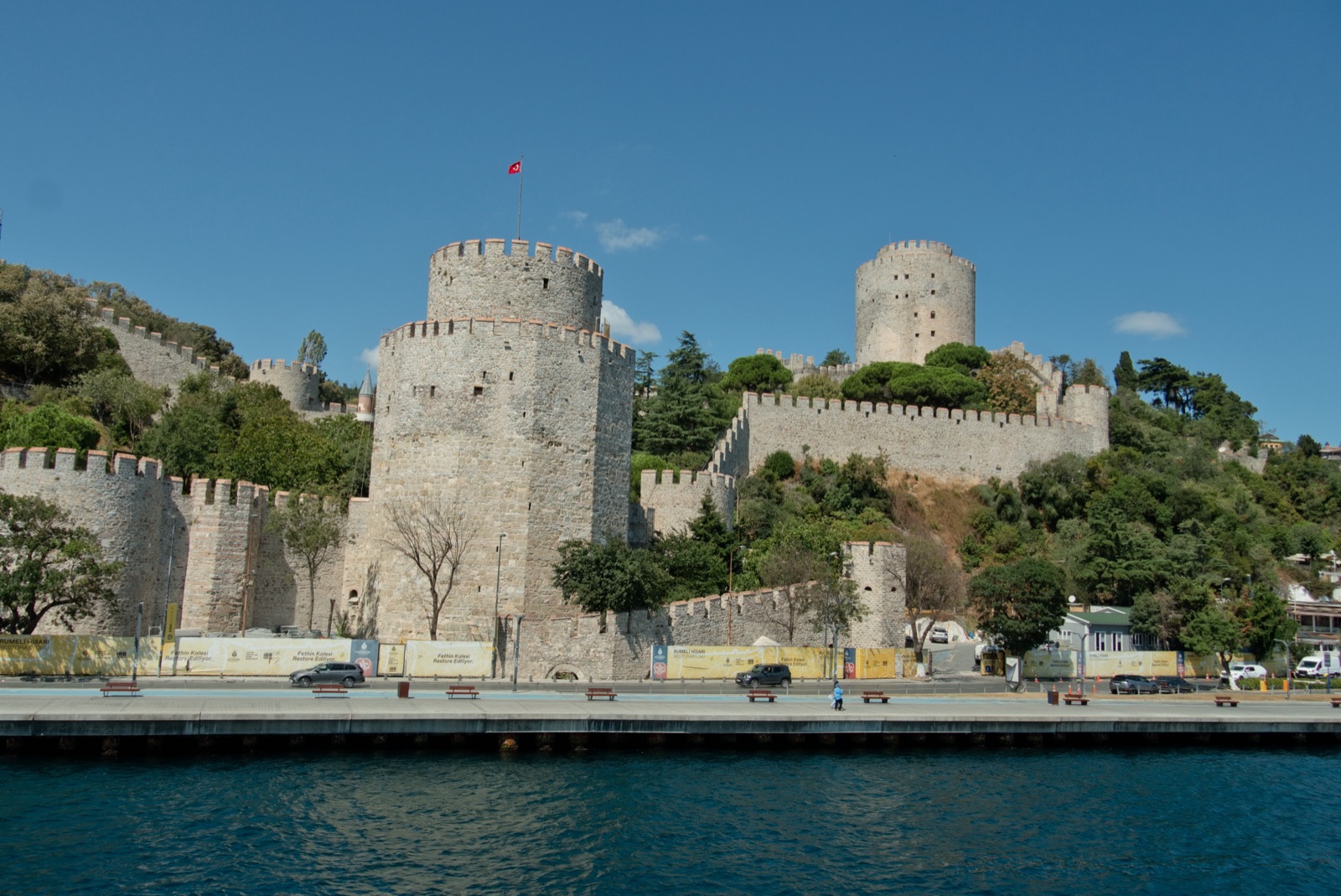
The great walls and towers hold considerable substance from the 15th century. At the same time, the complex was heavily restored in the 20th century. Later houses and other uses inside were removed, walls supplemented, and the impression of a conquest fortress emphasised once more.
Anyone walking through Rumeli Hisarı today therefore sees genuine medieval architecture, but not an entirely untouched state from 1452. Restoration made the complex more legible, while also deciding which era should be especially visible.
The Terrain Itself Made the Fortress Unusual
Rumeli Hisarı sits on a steep hillside. Rather than levelling the terrain completely, its walls follow the natural changes in elevation. That creates steep stairs, different levels, and an irregular floor plan.
For visitors today, that's exhausting; militarily, it made sense. Towers could cover different elevations, and the terrain itself became part of the defence. At the same time, this very hillside makes clear what an achievement the construction was, within just a few months.
The Sightline to Anadolu Hisarı Is the Key
Anyone who looks at the two fortresses separately only understands half the story. Anadolu Hisarı was older and smaller; Rumeli Hisarı, by contrast, was deliberately built as its complement. Together, they could control the narrowest stretch of the Bosphorus.
Mehmed's strategy is therefore best understood from the water. From there, you see how both shores form a kind of military corridor. The fortress isn't there by chance — its location is its real weapon.
"Rumeli Hisarı was built after 1453 as a victory fortress." False. It arose in 1452, in preparation for the siege.
"Boğazkesen exclusively means throat-cutter." Too dramatic. The word also plays on sealing off, or cutting through, the strait.
"The fortress alone brought down Constantinople." No. It was an important part of a far larger military system.
- Here you'll find current Bosphorus cruises, dinner cruises and guided tours.
- View Bosphorus tours & tickets
My Thought on This Place
At Rumeli Hisarı, you don't really need a complicated explanation. You just have to stand there and look at the Bosphorus. Anadolu Hisarı on the other side. The narrow strait between them. Then it becomes immediately clear why Mehmed built exactly here.
And once you know that the fortress was finished within a few months, and shortly afterward really did open fire on ships, it suddenly doesn't look like a pretty castle on the Bosphorus at all anymore. Then you understand: 1453 didn't begin at the walls of Constantinople. The conquest was prepared long before that.
The fortress is especially impressive from the water. Here are suitable Bosphorus tours.
– Amra