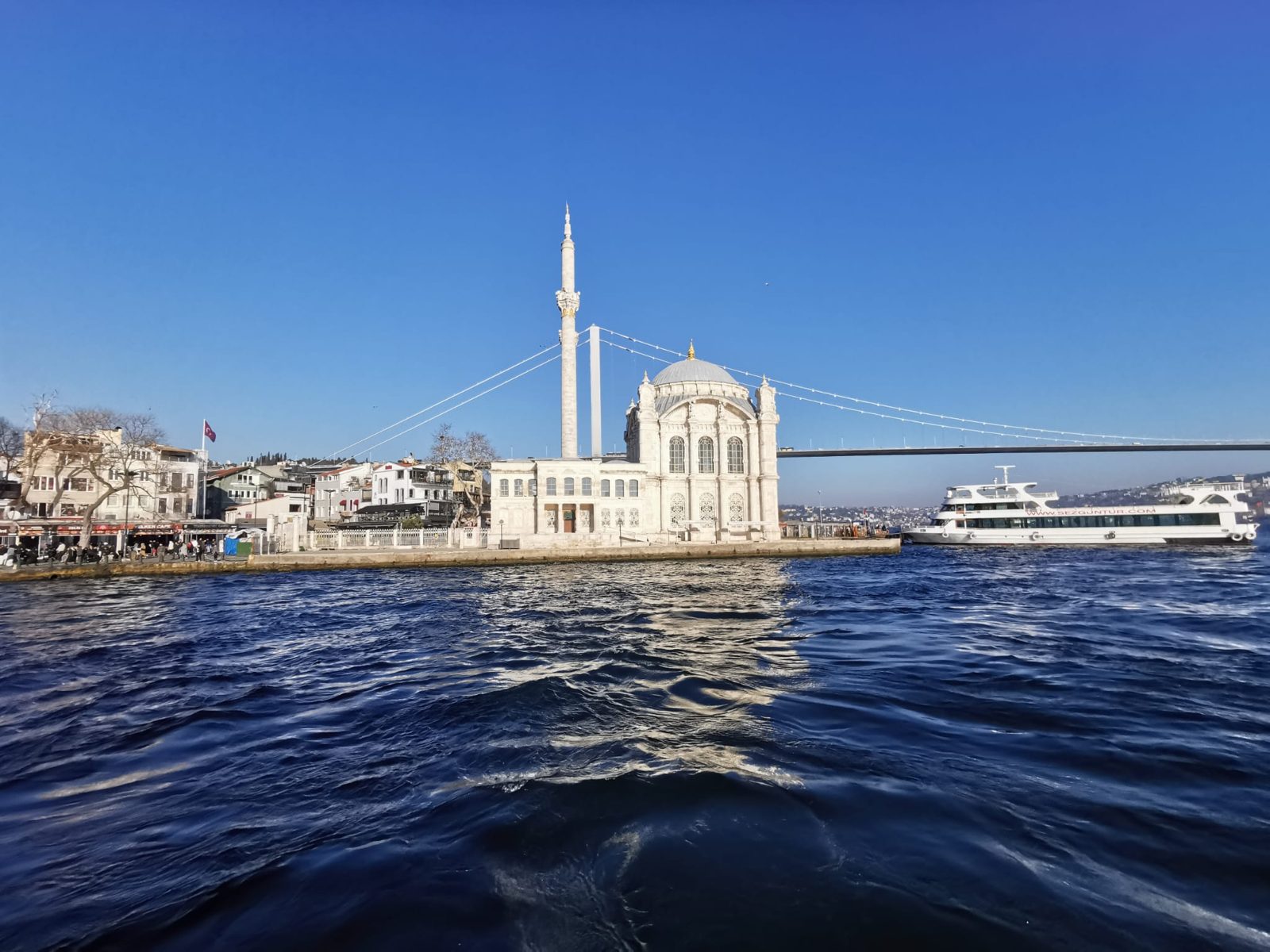
Anyone who's seen an Istanbul photo in a travel catalogue, on Instagram, or in an ad has, in all likelihood, already seen Ortaköy without knowing the name: a white mosque right on the water, with the great suspension bridge over the Bosphorus behind it. This view arises at exactly one spot — İskele Meydanı, the small square by the Ortaköy ferry landing.
Advertising: If you book through our links, we may receive a commission – at no extra cost to you.
İskele Meydanı in Ortaköy is one of the most photographed places in Istanbul — not because of a monument, but because of a view: mosque, water, and bridge in one image. Yet the square itself has its own layered history.
But Ortaköy is more than this one photo motif. The square itself is narrow, lively, and has grown over decades: kumpir stands, a handicraft market, cafés, and a constant coming and going of ferries, strollers, and vendors. The mosque itself — the Büyük Mecidiye Camii — is covered in detail elsewhere on this blog. Here, it's about the waterfront in front of it: the square, the market, and the history of a Bosphorus community that existed long before today's mosque.
- Ortaköy means roughly "middle village" — situated between other Bosphorus towns.
- İskele Meydanı is the small square right at the ferry landing, famous for its view of the mosque and bridge.
- Before today's mosque (19th century), Ortaköy was already a multireligious fishing village with Muslims, Greeks, Armenians, and Jews.
- Kumpir, stuffed baked potatoes, is the square's best-known street food — but not a centuries-old tradition, rather a late-20th-century phenomenon.
- On Sundays, a handicraft market transforms the narrow lanes around the square.
- Proximity to the Bosphorus Bridge (completed 1973) made Ortaköy additionally famous.
A village between other villages
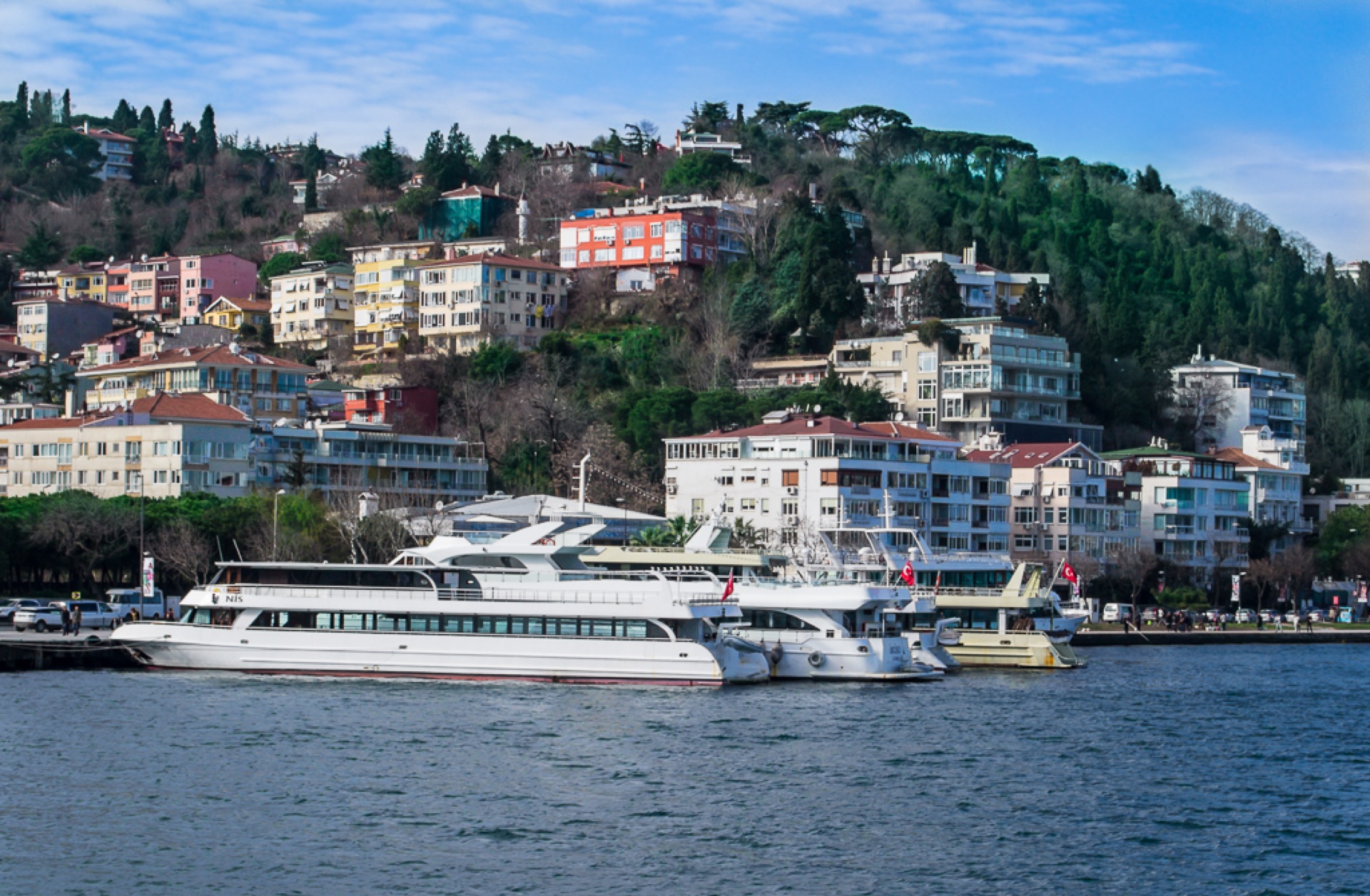
The name "Ortaköy" combines "orta" (middle) and "köy" (village) — a hint that the settlement lay between other Bosphorus towns, such as Kuruçeşme and Beşiktaş. Like many Bosphorus villages, Ortaköy was originally a small fishing and crafts town, long before today's urban development visually merged the individual villages together.
Byzantine and early Ottoman traces are harder to spot here than in Sultanahmet, since today's built fabric mostly dates from the 19th and 20th centuries. That doesn't mean the place is young — only that its visible architecture is more recent than its settlement history.
A village of many communities
Before and alongside today's mosque, Ortaköy had an unusually dense religious diversity in a small space for a long time: a mosque, several Christian churches, and a synagogue stood, and partly still stand, just a few minutes' walk from one another. The Etz Ahayim Synagogue, for instance, is one of Istanbul's better-known Jewish houses of worship.
This proximity was no coincidence, but typical of many Bosphorus towns, where Muslim, Greek Orthodox, Armenian, and Jewish communities lived, worked, and celebrated their respective holidays side by side across generations. Ortaköy thus shows, in miniature, how religiously mixed Istanbul actually was for large stretches of its history — not as an exception, but as the normal case in many Bosphorus neighborhoods.
From fishing village to photo motif
Today's İskele Meydanı is small in area — that's exactly what makes it feel so compact and lively. The ferry landing, the mosque forecourt, and the market practically sit on top of one another. This tightness grew historically: Ortaköy was never planned as a representative palace square, but as a functional village center at a landing point.
Only with the expansion of the Bosphorus shore roads in the 20th century, and the construction of the bridge right beside it, did the village square become a site of international photo fame. The combination of the mosque's silhouette and the bridge's arch in the background is today one of the most frequently reproduced images of Istanbul.
Kumpir: younger than you'd think
Anyone seeing the rows of kumpir stands might assume it's an old Bosphorus tradition. In fact, kumpir — the baked potato stuffed with cheese, corn, olives, sausage salad, and much more — is mainly a phenomenon of the 1980s and 1990s, which spread rapidly through Istanbul and found one of its best-known sales spots in Ortaköy.
Its success is obvious: kumpir is cheap, filling, customizable, and can be eaten on the move — ideal for a square where everyone only lingers briefly anyway, before strolling on or catching the next ferry.
The Sunday market
Around the square and in the adjoining lanes, a handicraft market takes place regularly, especially on Sundays: jewelry, small paintings, handmade accessories, and souvenirs have changed hands here for decades. The market is more informal and small-scale than the Grand Bazaar, and relies heavily on the individual stalls of individual craftspeople.
For many Istanbulites, the Ortaköy market is less a tourist attraction than a familiar Sunday outing — a place to meet friends while browsing the stalls along the way.
The bridge right next door
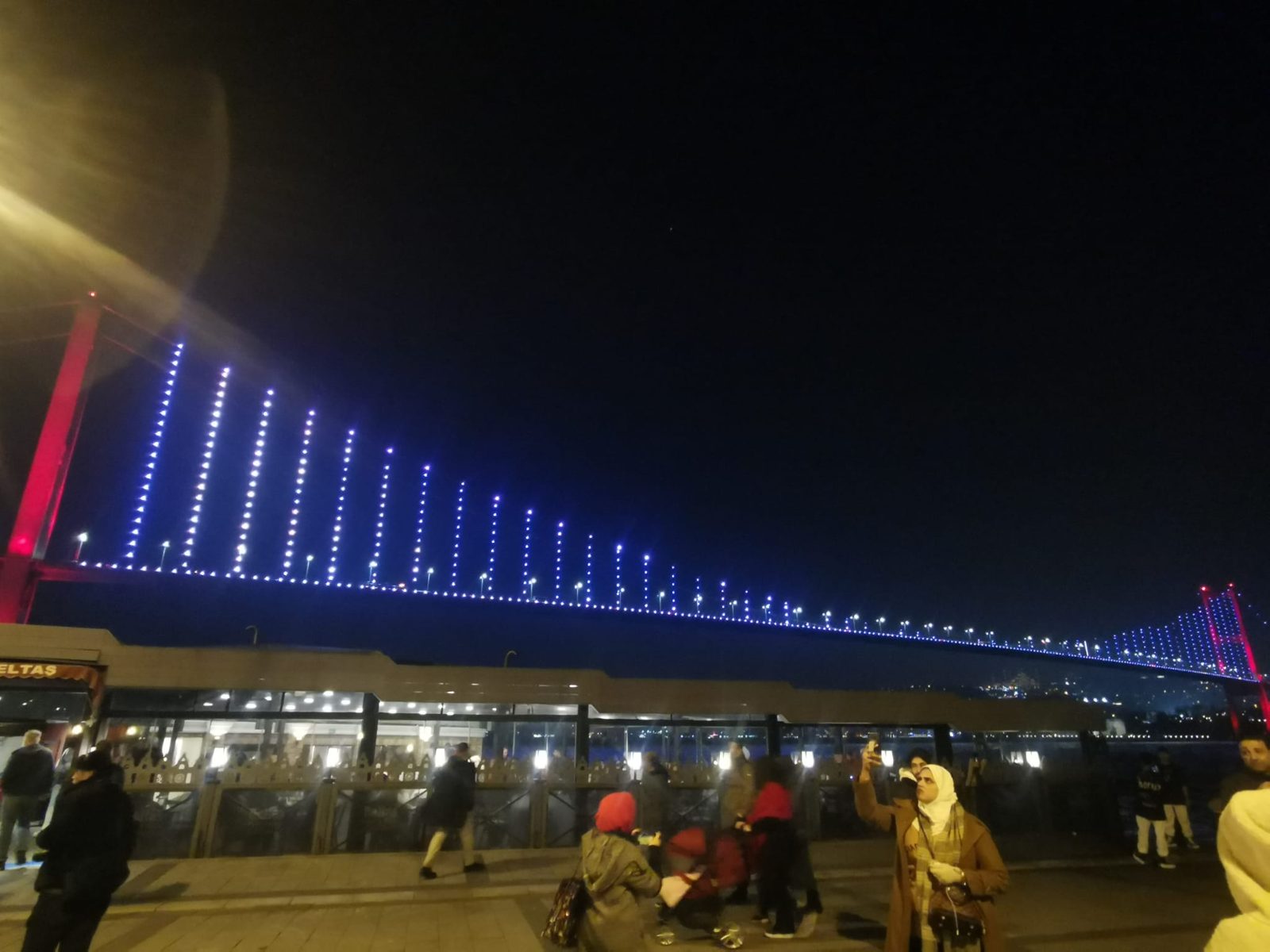
The first Bosphorus Bridge was completed in 1973 — its European approach lies right next to Ortaköy. For the square, that had a double effect: on one hand, additional traffic and noise; on the other, an additional, unmistakable visual motif right on its own doorstep.
Without the bridge in the background, Ortaköy would probably have remained a pretty, but internationally far less known, Bosphorus square. With it, the place became one of those spots where modern infrastructure and historic village structure combine into a single view.
"Kumpir is a centuries-old Ottoman dish." That's a myth. The stuffed baked potato, as known in Ortaköy, only became established as street food in the late 20th century.
"Ortaköy was always a purely Muslim village." False. Historically, Muslim, Greek Orthodox, Armenian, and Jewish communities lived side by side here for a long time — religious diversity is part of the place's actual history, not a contradiction to it.
Why the square is more than a photo motif
It's tempting to reduce Ortaköy to a single image: mosque, water, bridge. But behind it lies a place with its own layered social and religious history, one that existed long before the invention of the smartphone photo.
Precisely because the square is so small, a great deal is concentrated here: commerce, faith, daily life, traffic, and tourism all overlap within a few hundred meters. That makes Ortaköy one of the places where you can experience Istanbul's contradictions and complexity especially concentrated.
- Here you'll find current Bosphorus cruises, dinner cruises and guided tours.
- View Bosphorus tours & tickets
My take on this place
Ortaköy is one of the places where I notice how much a single photo can hide an entire history. Everyone knows that one image with the mosque and the bridge — but hardly anyone automatically thinks of synagogues, churches, and a centuries-old coexistence of different communities on the same small square.
To me, that's exactly what shows why I love Istanbul so much: you can stand on a single small waterfront, kumpir in hand, market at your back, and still be standing right in the middle of centuries of urban history, without it feeling forced.
You can also experience the Ortaköy waterfront on a Bosphorus cruise. Here are suitable tours.
– Amra