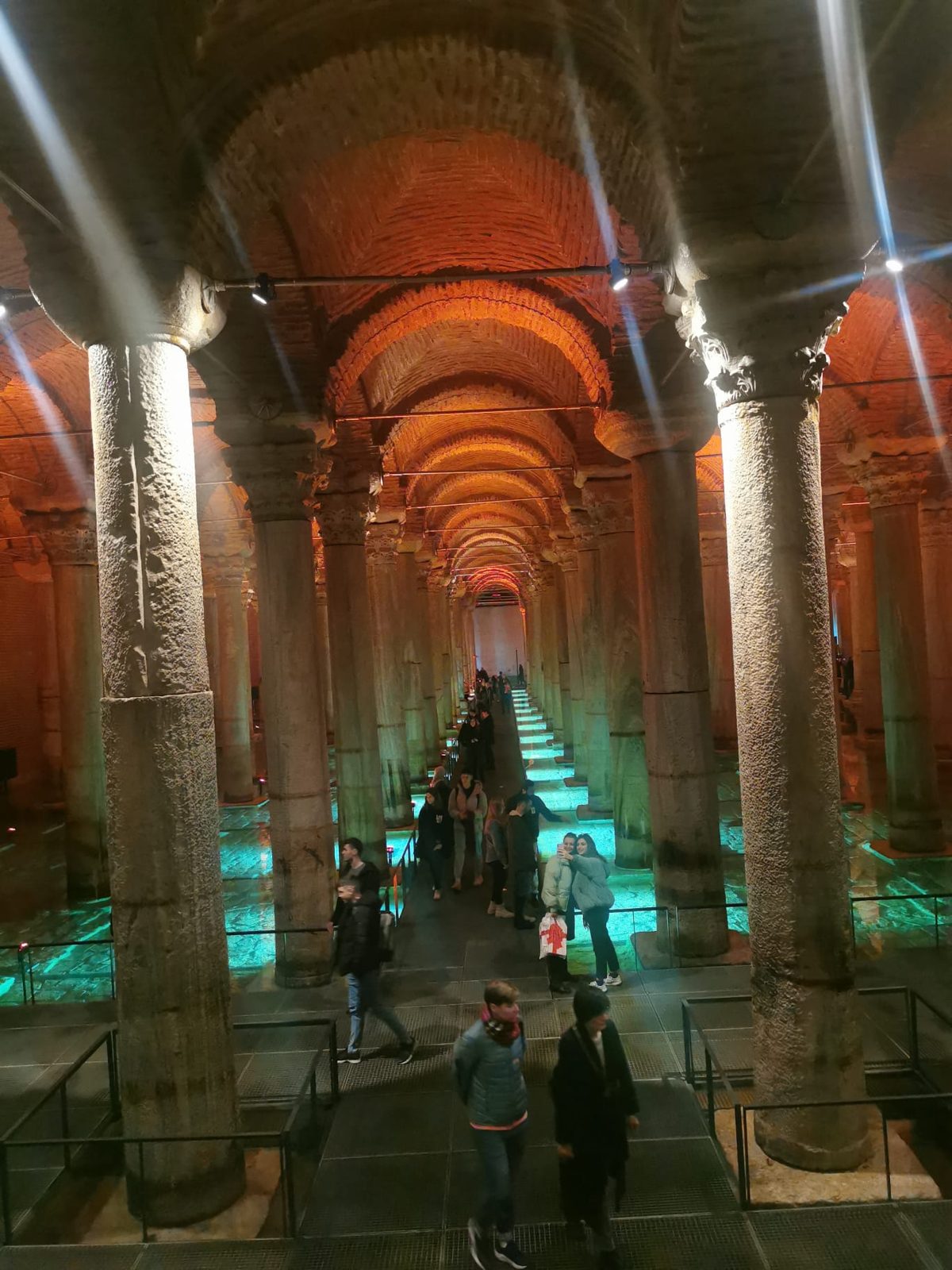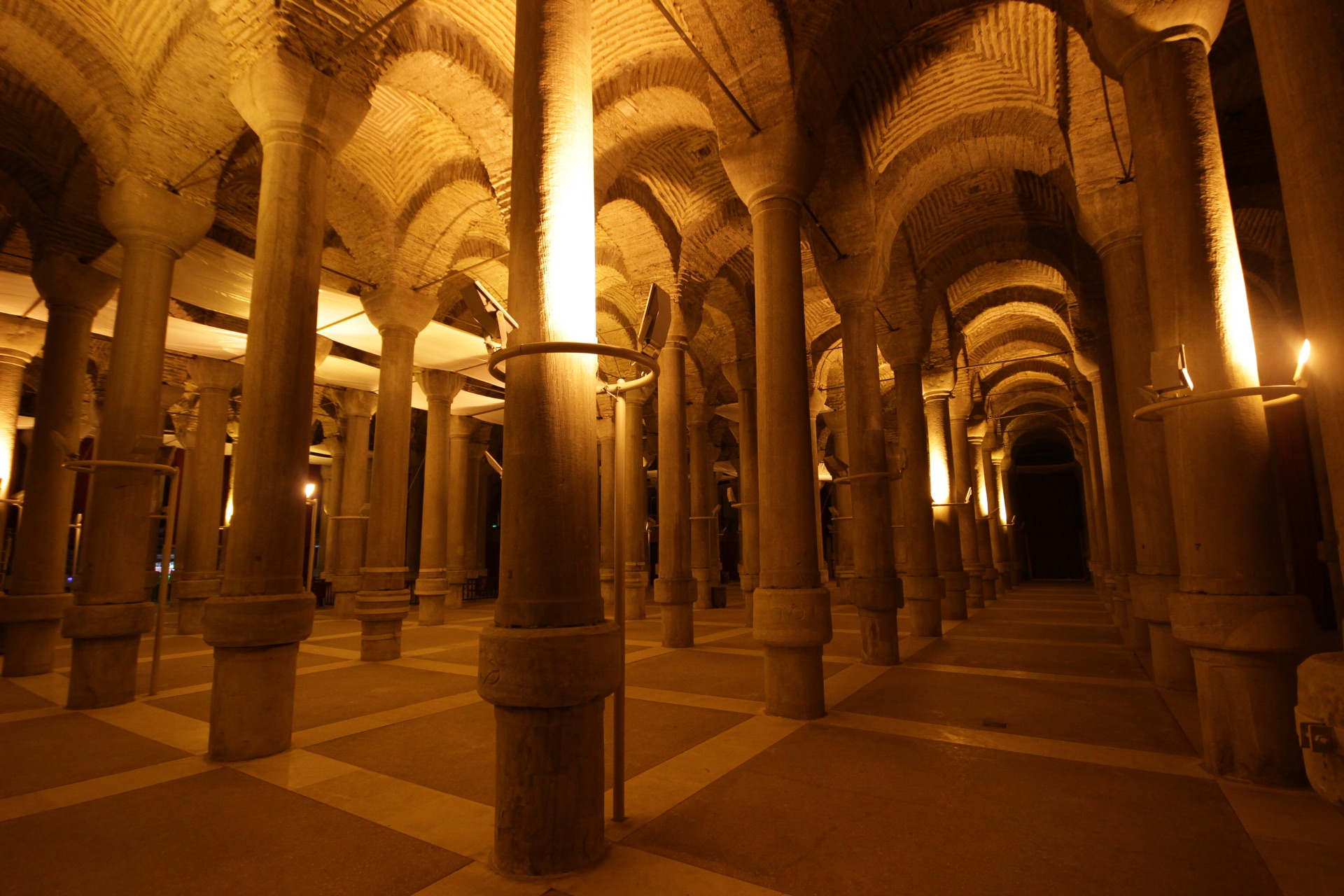

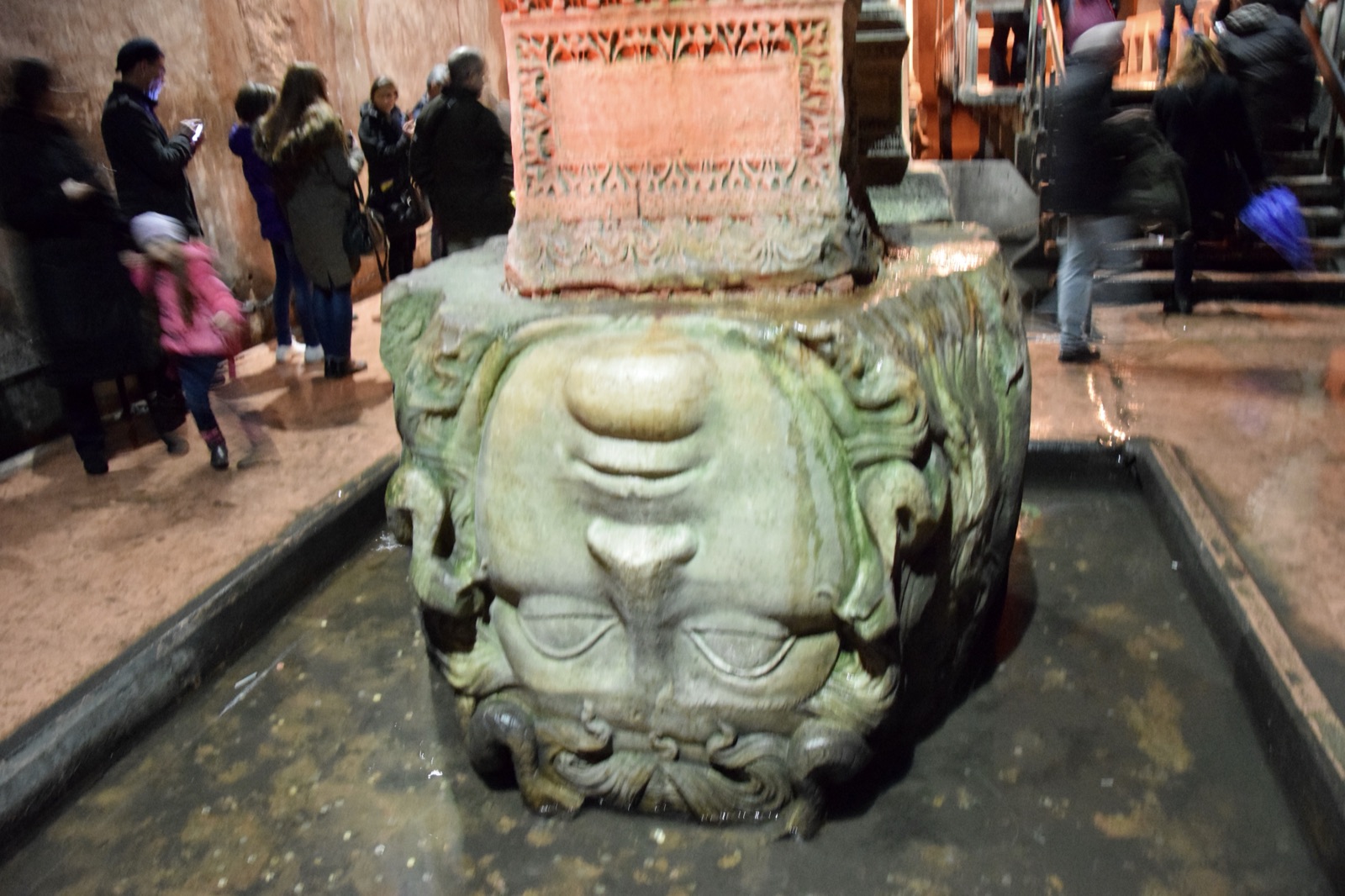
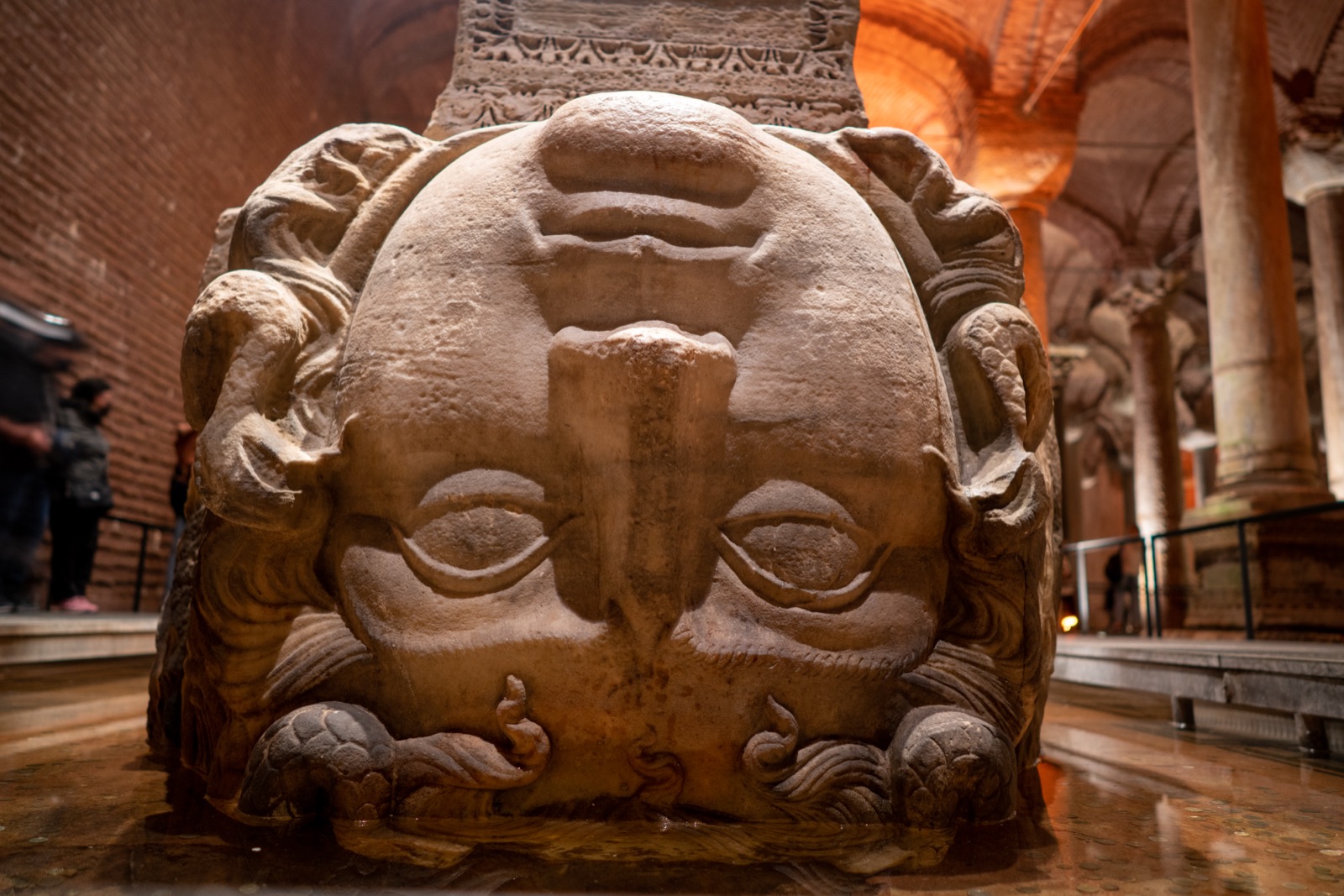
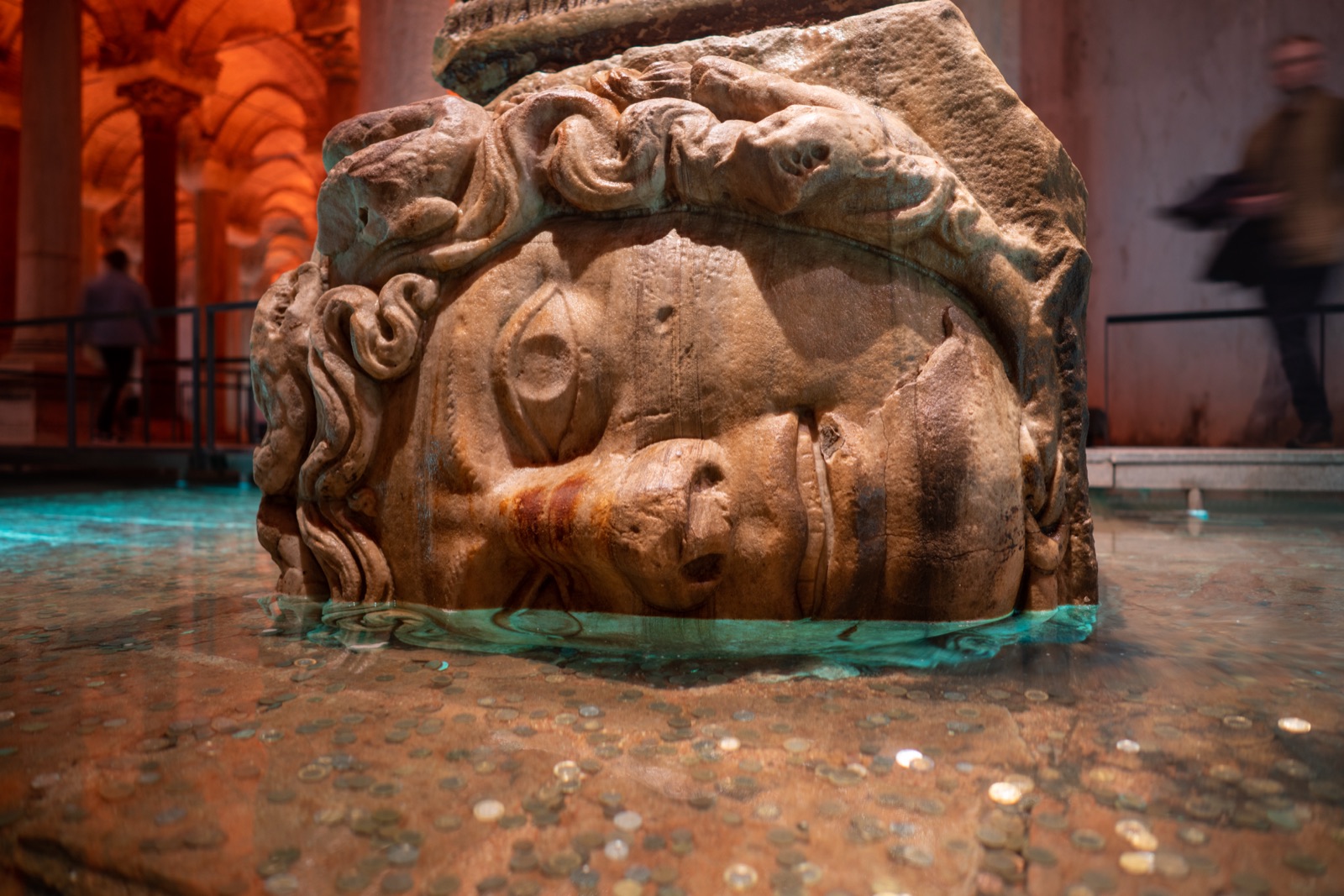
The two Medusa heads in the Basilica Cistern (Yerebatan) are among the best-known details of the underground structure. One lies on its side, the other upside down. Both serve as bases for columns. It's exactly this unusual positioning that has spawned countless stories: that the Byzantines wanted to neutralize Medusa's gaze, that Christians deliberately degraded a pagan symbol, or that the heads were part of a secret protective ritual.
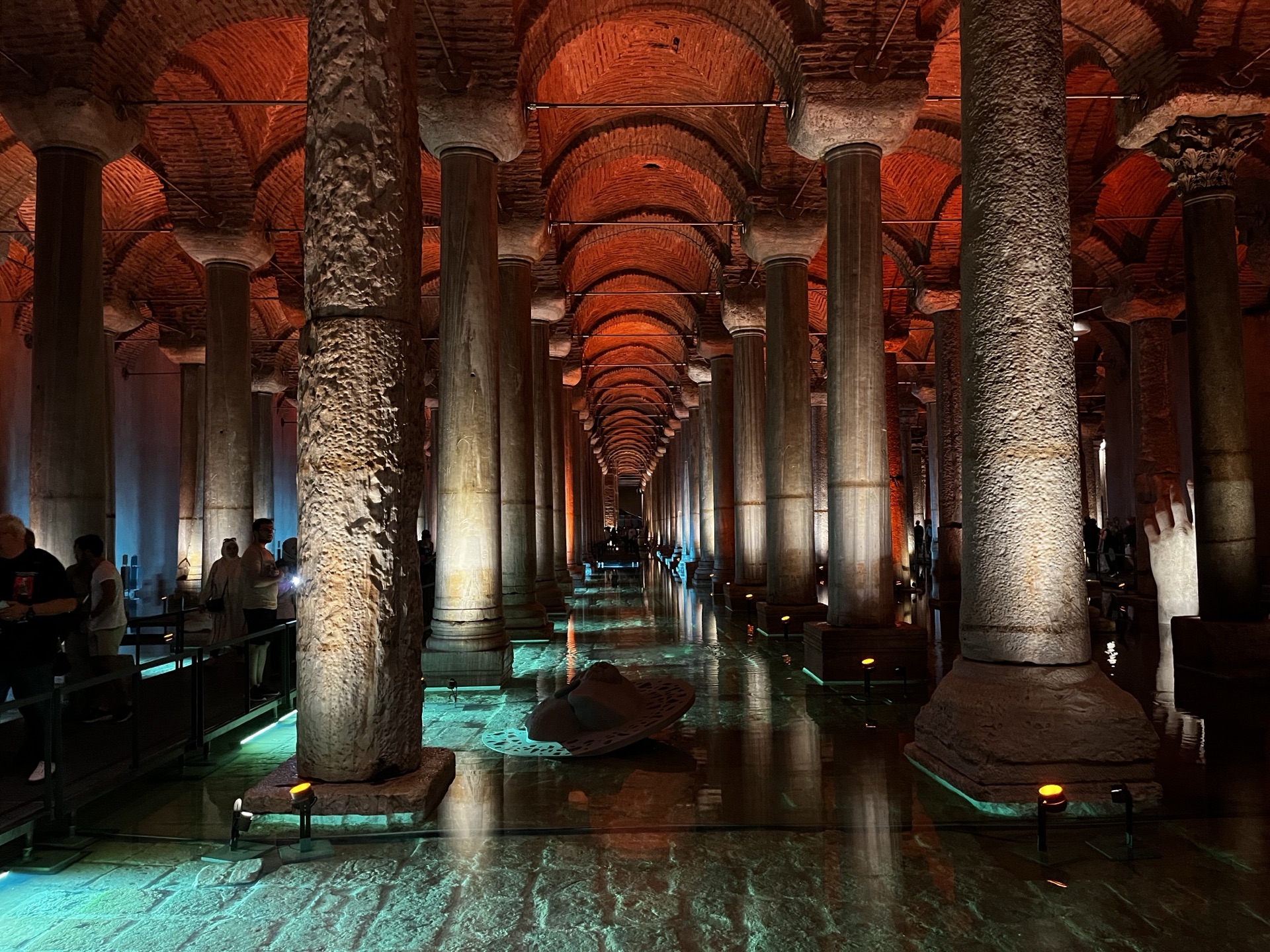
The two Medusa heads in the Basilica Cistern are among the best-known details of the underground structure. One lies on its side, the other upside down — reused building elements from older ancient monuments.
The most likely explanation is less dramatic — and precisely for that reason, historically interesting. The heads were spolia — reused building elements from older ancient monuments. In an underground cistern, what mattered above all was bringing the columns up to the necessary height. The stones' original meaning was secondary. Even so, one important question remains open: which building did these two exceptionally large Medusa heads originally come from?
- Two monumental Medusa heads serve as column bases in Yerebatan.
- They come from older ancient architecture and were reused in the 6th century.
- One lies on its side, the other upside down.
- There is no solid proof that this orientation was meant religiously or magically.
- The right height or shape for the column likely played a major role instead.
- The exact origin of the heads remains unresolved to this day.
Who Medusa was in antiquity
In Greek mythology, Medusa is one of the Gorgons. Her gaze could turn people to stone. Perseus killed her by not looking directly into her eyes and using a reflective shield instead. Her severed head retained its power and was later associated with Athena.
The story existed in various versions and changed over the centuries. In later art, Medusa was often depicted with snake hair and a face that was both beautiful and dangerous at once. The motif was so well known that an ancient viewer would have recognized it instantly.
Why Medusa heads appeared on buildings
The so-called Gorgoneion, the head of the Gorgon, was a widespread protective symbol in antiquity. It could appear on shields, temples, façades, tombs and other objects. The logic was apotropaic: a terrifying image was meant to ward off misfortune. An even more powerful, frightening symbol was set against evil.
It's therefore quite possible that the Yerebatan heads were originally decorative or protective elements of a significant ancient building. Their monumental size, in any case, argues against them having originally been intended as invisible column feet.
How they ended up in the cistern
When Justinian had the great cistern built in the 6th century, numerous older columns and building elements were reused. Constantinople already had several centuries of monumental architecture behind it. Damaged, abandoned or rebuilt structures offered enormous amounts of valuable material.
Stone was expensive. Throwing away an already finished marble block and fetching new stone from a quarry would often have been completely unnecessary. The Medusa heads were therefore probably used as bases in a thoroughly pragmatic way.
Why one lies on its side and the other upside down
This is exactly where the world of legend begins. Some tours claim the Byzantines deliberately turned the heads so Medusa's deadly gaze would lose its power. Others explain the position as a Christian humiliation of a pagan symbol.
That sounds good, but it isn't established fact. If a stone block has a certain height and shape, turning it can simply be the easiest way to bring a column up to the right level. In a dark water reservoir that was never meant as a gallery for visitors, the visual orientation of the image likely mattered far less than it does today.
Spolia as ordinary building material
Today we tend to treat every ancient fragment as an irreplaceable museum piece. People in late antiquity often saw it differently. An old column shaft could simply be a very good new column shaft. Spolia sometimes carried symbolic meaning. In other cases they were pure material economy. The two have to be told apart case by case.
Yerebatan shows this mix especially well: the capitals, columns and bases don't all match perfectly. The structure was assembled functionally out of available high-quality material. That we now admire precisely the reused parts as art treasures would probably have surprised the builders.
Where the heads might come from
Several hypotheses try to connect the Medusa heads to specific ancient monuments of Constantinople. There is, however, no definitive identification. That's logical too. The city was repeatedly transformed by fires, earthquakes, new construction and looting. No documents survive that state precisely, "these two heads were taken from building X."
This uncertainty isn't a flaw. It's part of serious historiography. Sometimes "we don't know" is the scientifically stronger answer than a perfect legend.
What restoration work has changed
Today the heads stand visibly in relatively shallow water, or at a visitor level that makes viewing them easy. Originally they were technical building components in a water cistern. Modern lighting makes every snake and facial line dramatically visible. That's effective for a museum display, but it isn't historically authentic lighting.
It's worth distinguishing, then, between the ancient object and its current staging. Both can be impressive without pretending that Byzantine visitors stood there 1,500 years ago in front of a light show.
"The heads were deliberately turned to break Medusa's power." Possible as a later interpretation, but not documented.
"They were made specifically for the cistern." False. They are older spolia.
"We know exactly which temple they came from." No. Their origin isn't reliably established.
Medusa between monster and protective symbol
Today Medusa is often told simply as a monster with snake hair. In the ancient visual world, her meaning was more complex. Precisely because her face was meant to inspire terror, it worked well as a protective sign. The Gorgoneion head appears on shields, temple façades, coins and tomb monuments. It was meant to ward off misfortune by symbolically frightening the attacker himself.
That the heads in Yerebatan originally came from a representative context is therefore very likely. They weren't created as simple building blocks. At some point, though, their original site lost its function, and the monumental marble heads became available.
Why spolia turned up everywhere in Constantinople
For centuries, Constantinople was a permanent building site. Emperors built new churches, baths, palaces and cisterns, while older structures decayed or were remodeled. Columns, capitals and marble blocks were precious material. Reusing them made economic sense.
Spolia could also carry symbolic messages at the same time. A new ruler could show, by incorporating parts of older monuments, that he had taken over the past. In a purely technical structure like a cistern, though, practical availability was usually the more important factor.
So the Medusa heads may simply have been just the right size.
The difference between the modern effect and the original function
Today the visitor route is designed so that people deliberately seek out the heads. Light falls dramatically on the faces, people wait for photos, and the Medusas become almost the highlight of the tour.
In the 6th century it was the opposite. The cistern was meant to store water. The heads sat in a dark, damp space and weren't intended as an attraction. Perhaps almost no one saw them up close for centuries.
That a functional recycled part has become a world-famous art object today says at least as much about modern tourism and museum culture as it does about Byzantium.
Why the origin is so hard to pin down
Several ancient sites in Constantinople could plausibly be the source. Large Medusa heads might have belonged to a nymphaeum, a forum, a temple, or some other representative building. Without clear excavation documentation, that remains speculation.
Archaeology normally relies heavily on context: where did an object lie? In which layer? Next to which other finds? With late-antique reuse, this original context is lost. The head doesn't lie where it was created, but where builders needed it centuries later.
That's exactly why even the most modern research can't reconstruct every origin.
What you can observe on the heads themselves
The two heads aren't completely identical. Hairstyle, facial expression and workmanship show differences that might point to different workshops or periods of creation. Their state of preservation also varies.
Anyone who just snaps a quick photo misses such details. It's worth comparing the surface, the hair structure and the proportions. Doing so makes clear that there was never "the Medusa decor of the cistern," but two older, individual objects that at some point ended up together in a technical structure.
Why Medusa still has such a strong effect today
Medusa is one of those ancient motifs that has never quite lost its impact. Even people who only vaguely know the mythological story recognize the snake hair instantly. That's what makes the two heads in Yerebatan so powerful: they connect a familiar myth to a completely unexpected place.
The contrast is almost absurd. A figure that originally symbolized terror and protection at once now lies as a foundation beneath a column. An image full of power became a technical component. It's exactly this reversal that creates the appeal.
What the heads reveal about how we treat the past
Today we often automatically treat age as value. In the 6th century, though, an older stone wasn't necessarily "museum material." It could simply be useful material. That the heads survived may be precisely because no one needed them anymore as standalone artworks.
That's an odd kind of luck: they were preserved through being repurposed.
Had they stayed at their original building, later fires, rebuildings or lootings might have destroyed them.
My take on this place
I like these two heads precisely because we don't know everything. Today we want a perfect answer to every question, instantly: who? when? why? where from?
With Medusa, the honest answer at several points is simply: we don't know for sure. Maybe their position was entirely mundane. Maybe symbolism did play a role after all. It's exactly this open question that makes them more interesting to me than an invented, hundred-percent-certain explanation.
– Amra