Leather goods belong to Istanbul like the bazaar. Instead of buying a bag, you can design and stitch a small wallet in a workshop, and end up with a souvenir you made yourself.
Advertising: If you book through our links, we may receive a commission – at no extra cost to you.
Stitch a small leather wallet yourself: handcraft instead of a souvenir shop. What the offer includes and who it suits.
Leatherwork in Anatolia
Leatherworking has a long craft tradition in Anatolia. Leather became clothing, shoes, bags, belts, saddles and many everyday objects. In Ottoman and Anatolian bookbinding, leather was the main material for covers, stamped and sometimes decorated with gold leaf. The knowledge was passed on through master–apprentice relationships: you did not learn from books but through years of watching and working alongside.
Craft with rules: Ahilik
In 13th-century Anatolia the Ahi brotherhood (Ahilik) emerged, a craft and solidarity community. Ahi Evran is regarded as the founder of Ahilik in Anatolia and is also named as patron (pir) of the tanners' guild. Tanners and leatherworkers belonged to this organised craft world: there were masters, journeymen and apprentices, and anyone who wanted to advance had to master the trade. The guilds regulated quality and prices and limited the number of workshops. It should not be romanticised: it was about work, order and economic arrangements, not only ideals. The exact origins and organisation are partly disputed in research.
Istanbul and leather
In Istanbul, too, leatherworking was an important branch of the economy. In the 17th century Evliya Çelebi counted around 700 tanneries, mainly in Kazlıçeşme, Kasımpaşa and Üsküdar. Because of smell and waste, a regulation of 1838 already demanded that they be greened or moved out of the city. Later the tanning industry was relocated to modern facilities on the eastern edge of the city; Kazlıçeşme today is a park and recreation area. Today's workshop does not continue an unchanged Ottoman technique; it offers an introduction to a craft with a long history in this region.
What the offer includes
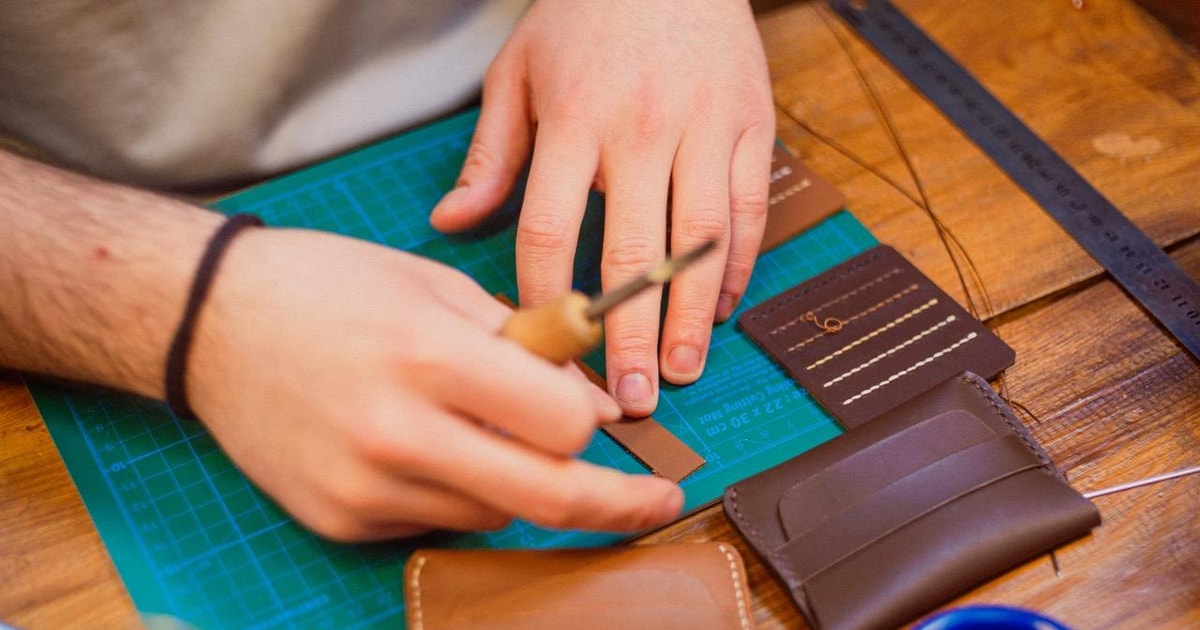
According to the offer description, you choose leather and thread and hand-stitch your wallet with the saddle stitch. Personalisation is also described; whether it is currently included is on the offer page. The provider states about three hours. The group is small: the offer page says a maximum of 8 people. Materials and leather are included according to the provider; snacks and Turkish coffee or tea are mentioned in reviews.
If you would like to stitch your own wallet, you can find current dates and availability here.
From animal hide to leather
A raw animal hide rots if left lying. Only tanning makes it durable, flexible and the material we know as leather. Tanning uses plant-based or mineral substances; the workshop of course starts with already tanned leather, cut for the wallet.
Why sew by hand?
In the saddle stitch, two needles with one thread are passed through the same pre-punched holes. If one stitch breaks, the seam does not unravel as quickly as a machine seam. In return, handwork takes time: every stitch is a separate movement. Whether the specific offer uses exactly this stitch is confirmed by the provider's description.
More than a souvenir
The appeal is not only the wallet you take home. For a few hours you work yourself with a craft that has had meaning in Anatolia for centuries, and afterwards you understand why a hand-sewn piece feels different from a mass-produced one.
What guests highlight
Reviews often mention the patient instruction, suitability for beginners and the finished piece as a personal keepsake, in our own summary.
Who is it for?
For anyone who likes working with their hands, even without experience; for couples, friends and solo travellers. Less suitable for very short stays where every hour is planned.
In short
- About 3 hours according to the provider
- Afterwards, take some time for the Grand Bazaar if you want to see leather goods once more in the original
More creative experiences in Istanbul
Like handcraft? Then the carpet weaving workshop and the glass painting workshop also fit.
All experiences, tickets and tours are collected on our activities page.
– Amra