
Kösem Sultan is one of those figures where TV series and popular retellings have almost buried the real history. She was Ahmed I's partner, mother of the sultans Murad IV and İbrahim, grandmother of Mehmed IV, and at times regent of the Ottoman Empire. In doing so, she reached a political standing that only a few women of the dynasty ever held.

She was Ahmed I's partner, mother of the sultans Murad IV and İbrahim, grandmother of Mehmed IV, and at times regent of the Ottoman Empire. In 1651 she was murdered at Topkapı Palace.
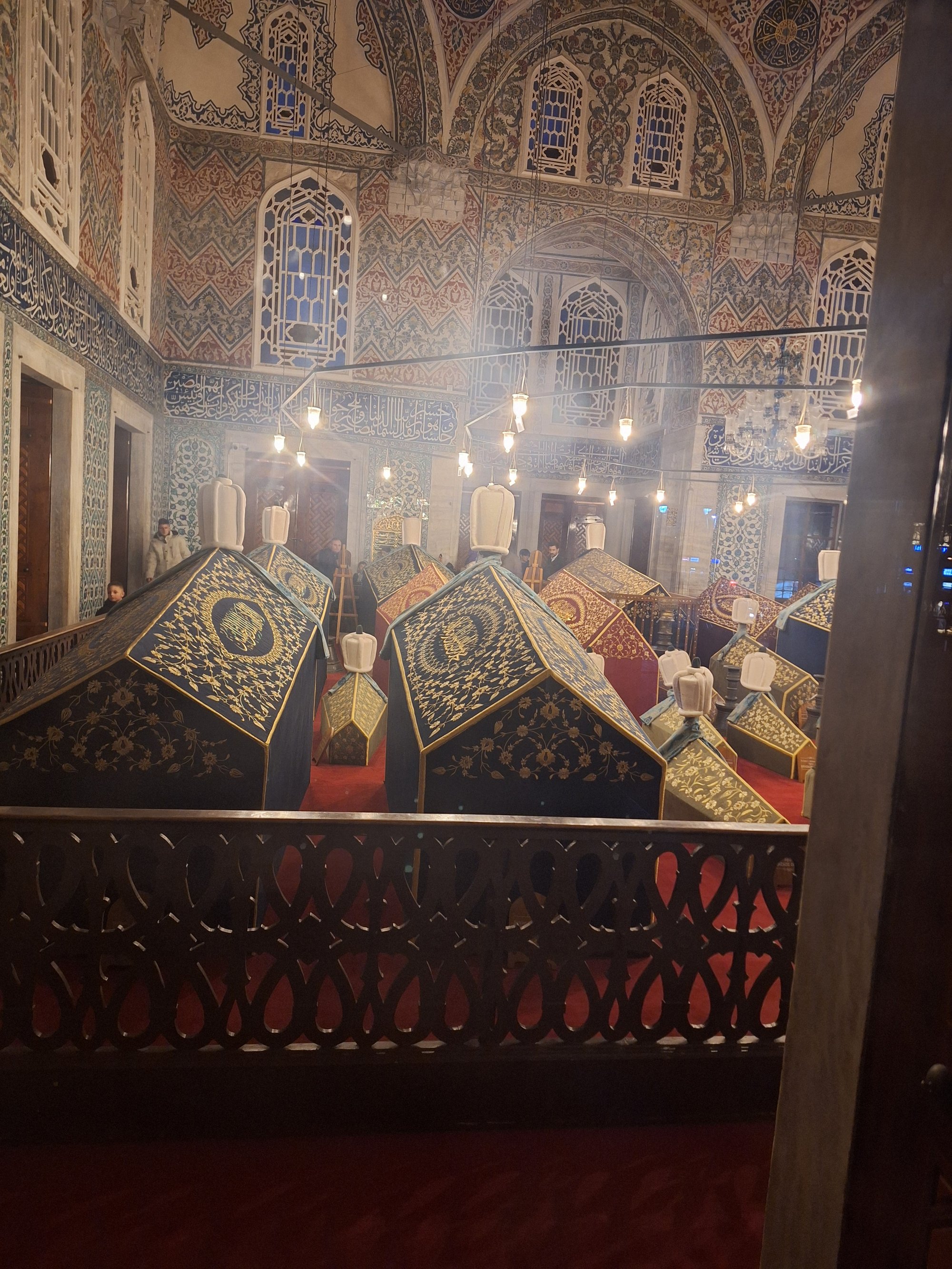
Her story, however, doesn't end with a peaceful retirement. In 1651, Kösem was murdered at Topkapı Palace, after the power struggle between her own network and the faction of her daughter-in-law Turhan Sultan came to a head. She was buried in the mausoleum of Ahmed I beside the Blue Mosque. So anyone standing before her grave there is standing before the end of a woman who shaped several generations of Ottoman politics.
- Kösem Sultan came to the Ottoman court as a young woman and became Ahmed I's partner.
- She was the mother of Murad IV and İbrahim.
- As Valide Sultan and regent, she wielded considerable political influence.
- During Murad's minority, she effectively held regency for a time.
- After İbrahim's deposition and death, she remained powerful as Mehmed IV's grandmother.
- In 1651 the conflict with Turhan Sultan escalated.
- Kösem was strangled at Topkapı Palace.
- Her grave lies in the mausoleum of Ahmed I in Sultanahmet.
Where Kösem came from
Her early biography isn't fully established. As with many women of the Ottoman court, later stories about her origin, name and the circumstances of her arrival were embellished. She likely came from a Christian background and arrived at court as an enslaved young woman. There she received a court name and rose within Ahmed's household.
That she later attained enormous power shouldn't obscure the fact that her path began with personal unfreedom. That tension is exactly part of her biography: a woman who entered the system as property later became one of the most powerful people within that same system.
Ahmed I and her rise
Ahmed I became sultan in 1603 at the age of thirteen. Kösem became one of his most important partners and the mother of several children. Her position initially depended on the sultan and on her sons. In a dynasty without fixed primogeniture, the mother of a possible heir was automatically part of the empire's political future.
Ahmed also made a decision with long-term consequences: he let his brother Mustafa live. That was the start of succession shifting from systematic fratricide toward seniority and the Kafes system. For Kösem, this new order was decisive, because it gave her sons a greater chance of surviving a period of succession.
After Ahmed's death
When Ahmed died in 1617, it wasn't automatically one of his sons who succeeded him. First his brother Mustafa I ascended the throne. Then came Osman II, Ahmed's son from a different union. For Kösem, this meant an uncertain phase. Her own sons were potential heirs to the throne, and therefore endangered figures at the same time.
Only in 1623 did her son Murad IV ascend the throne as a child. That fundamentally changed Kösem's standing.
Kösem as Valide Sultan
With Murad's accession, Kösem became Valide Sultan. Since her son was underage, she gained extraordinary influence and effectively took on regency-like functions in the early years of his reign. She took part in appointments, patronage and court politics, and commanded a large network of her own.
Kösem thus shows that the Ottoman system of government, while formally male-dynastic, could also see political power exercised in times of crisis by the mother of an underage sultan. Her standing rested not just on family, but also on experience, money, endowments, and loyal clients.
Regent for Murad IV
As Murad grew older, he took control himself and developed a distinctly authoritarian style of rule. Kösem's direct regency ended, but her standing as the sultan's mother remained important.
Murad had several brothers killed, drastically reducing the number of possible heirs. When he died childless in 1640, only his brother İbrahim remained as the dynasty's male line.
İbrahim and the next crisis
İbrahim had spent many years in the Kafes and ascended the throne under difficult psychological conditions. His reign was marked by court conflicts, economic strain, and political crises.
Kösem again held great influence as Valide Sultan. The relationship between mother and son, however, was by no means always harmonious. In 1648, İbrahim was deposed and shortly afterward executed. That Kösem at least accepted this change of power shows how harsh dynastic politics had become.

Mehmed IV and Turhan Sultan
İbrahim's young son Mehmed IV became sultan. This created an unusual situation: his mother, Turhan Sultan, was still young and less politically experienced, while grandmother Kösem already had decades of court practice behind her.
Kösem initially retained a leading position. This created a conflict between two women's networks within the court. Reports claim Kösem considered replacing Mehmed with a different grandson, whose mother would be easier to control. How concrete this plan actually was is historically disputed.
The assassination of 1651
The conflict escalated. Turhan's supporters acted first. On the night of September 2, 1651, Kösem was killed at Topkapı Palace. Accounts describe a violent search of her rooms and, finally, her strangulation. Details differ between sources, but the murder itself is established fact.
With it ended one of the longest-standing female power centers of the Ottoman dynasty. Turhan Sultan afterward became the most important woman at court herself.
The grave at Sultanahmet
Kösem was buried in the mausoleum of Ahmed I. There she lies close to the man with whom her rise at court had begun, and among members of a dynasty whose survival she had helped shape for decades.
This space becomes especially heavy emotionally once you know the biographies. Resting here are not just rulers, but people who had one another protected, sidelined, or killed.
"Kösem ruled the Ottoman Empire alone for thirty years." Too sweeping. She wielded great influence for decades and was regent at times, but not continuously the sole ruler.
"Turhan Sultan personally strangled Kösem." There's no solid evidence for that. Supporters of Turhan were involved in the killing.
Kösem's endowments and economic power
Political influence at the Ottoman court was often closely tied to money. Kösem Sultan commanded considerable income and founded, or supported, endowments. Such vakıfs financed mosques, fountains, social institutions and other public services.
Endowments were, at the same time, religious charity and lasting political memory. A building bearing the name of a sultana figure made her presence in the city visible, even though she herself rarely left the palace publicly.
In this way, a woman of the harem could exert influence far beyond the palace walls.
Why Kösem stayed powerful for so long
Her extraordinary career didn't rest on a single title. She survived several changes of ruler, remained the mother or grandmother of sultans, and understood the court's networks exceptionally well.
While a grand vizier could be dismissed or executed at any time, Kösem had a biological connection to the dynasty that couldn't simply be dissolved. That very position made her valuable and dangerous at once.
With every new generation, though, she had to renegotiate her role. What counted as legitimate regency under an underage son could quickly look like excessive interference under a grandson.
Kösem and care for the poor
Contemporary and later sources also emphasize her charitable activities. She is said to have paid off prisoners' debts, supported young women's marriages, and regularly distributed alms.


Such acts were religiously meritorious, but they also built loyalty and public standing. Charity and politics weren't separate from one another.
That's exactly why the simple label "good benefactress" or "evil schemer" falls short. She could be both at once: generous toward certain groups and ruthless in the political power struggle.
The conflict with Turhan was also a generational conflict
Turhan Sultan was the mother of the reigning Mehmed IV. By Ottoman court logic, she should, as Valide, have been able to claim the leading female position. Kösem, however, was more experienced and, as grandmother, still held enormous power.
This was institutionally unusual. Two women simultaneously held strong dynastic legitimacy, but only one could control the crucial access to the young sultan.
The conflict was therefore not merely personal jealousy. It arose out of an unresolved distribution of power.
The night of her murder
Accounts of Kösem's final hours are dramatic. She is said to have been warned, to have tried to hide, and to have finally been found by men of the opposing faction. Jewelry and clothing were looted during the search, or after her death.
As with many palace narratives, details differ. That she was violently strangled, however, is established.
Her funeral sparked public mourning. That shows Kösem was known beyond the palace walls alone.
What her grave means today
In the mausoleum of Ahmed I, Kösem doesn't lie as a regent on a throne, but as one of many dynastic dead. That makes the place especially haunting.
Anyone looking at the rows of sarcophagi realizes how closely family history and state history were intertwined. The very same people who fought each other politically now rest a few meters apart.
The mausoleum is thus almost a silent archive of dynastic conflict.
My take on this place
At graves like this, I always think about how absurd it is to tell history only through titles. "Valide Sultan," "regent," "sultan" — it all sounds very distant.
Then you read that a woman had to steer her sons through a system for decades in which brothers were killed, and that in the end she herself was strangled in a palace because the next generation was fighting over power. I can explain this era historically. But it doesn't leave me cold.
– Amra