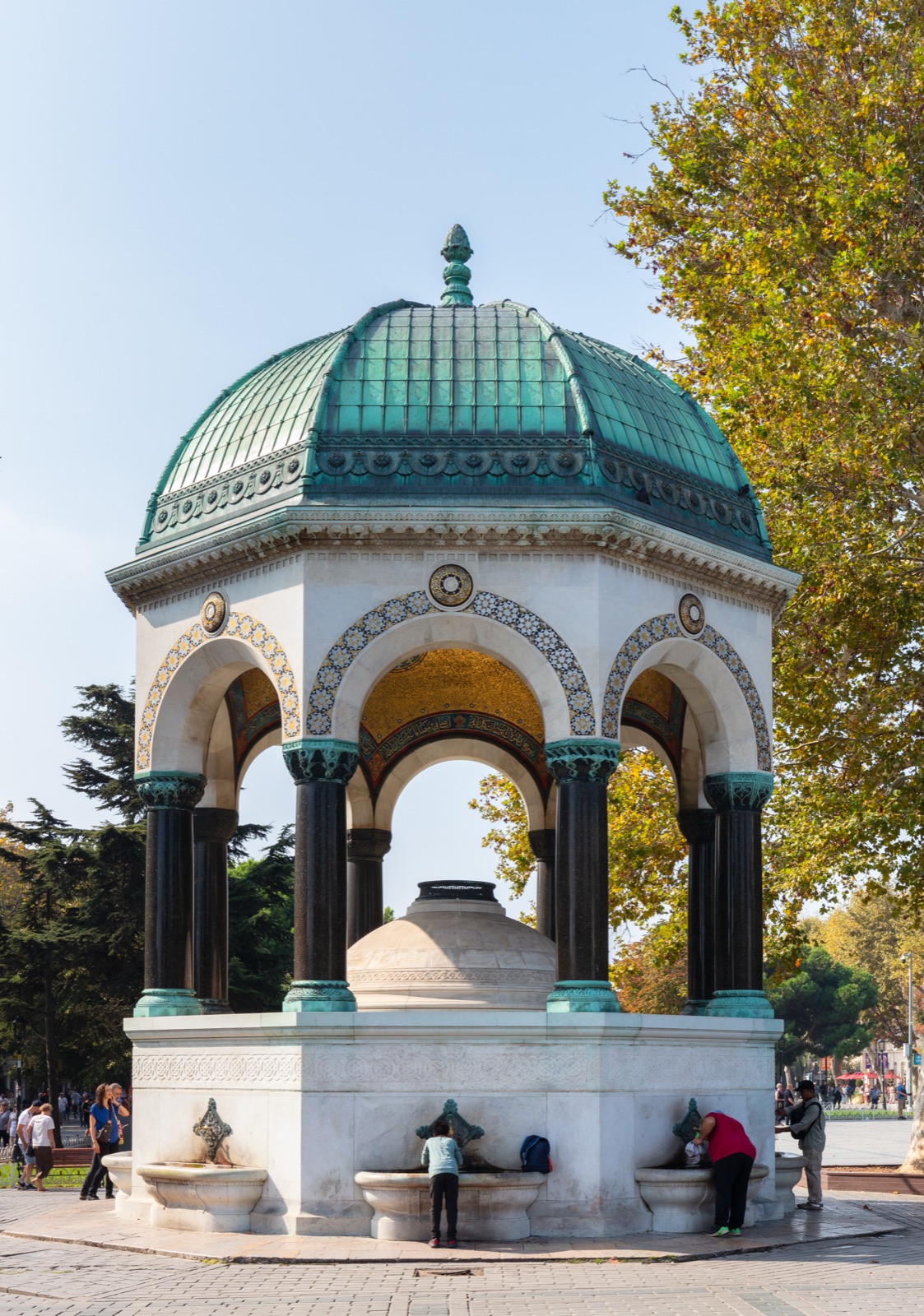
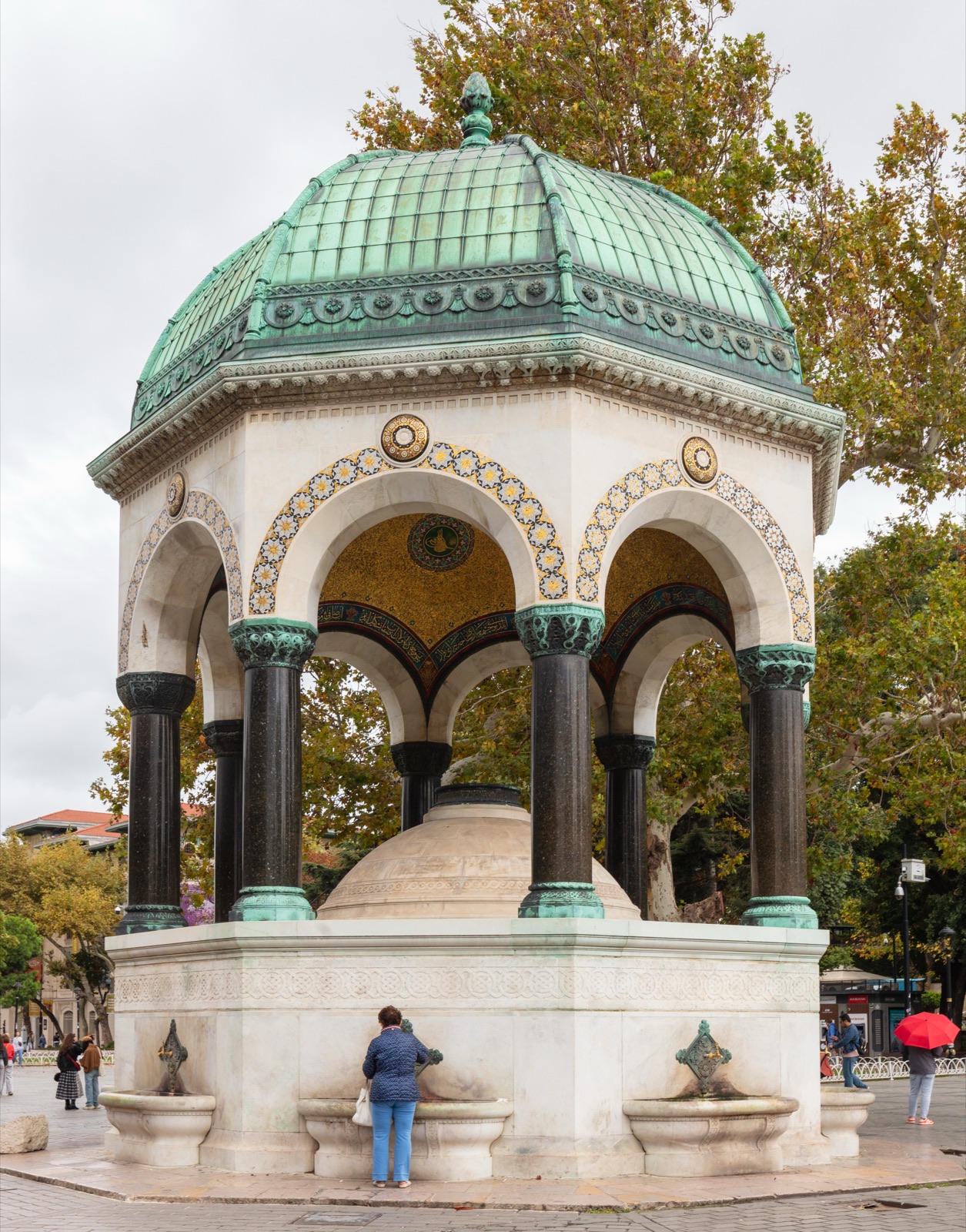
In the middle of Sultanahmet Square stands a small octagonal pavilion that, between the Hagia Sophia, the Blue Mosque, and the ancient monuments of the Hippodrome, looks almost too dainty to be politically significant. That's exactly the Alman Çeşmesi, the German Fountain. It commemorates the visit of German Emperor Wilhelm II to the Ottoman Empire in 1898 and was ceremonially opened in 1901.
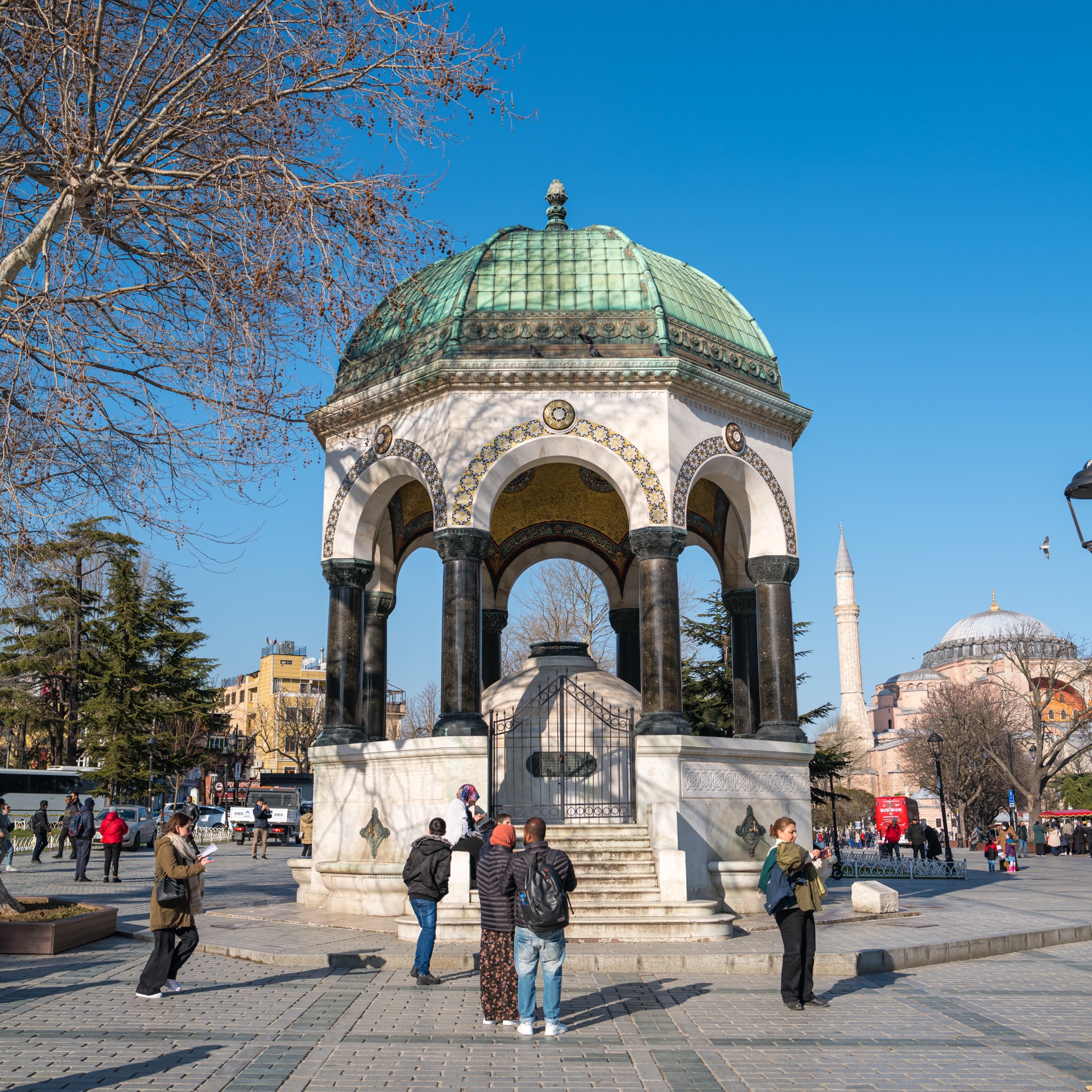
In the middle of Sultanahmet Square stands a small octagonal pavilion that, between the Hagia Sophia, the Blue Mosque, and the ancient monuments of the Hippodrome, looks almost too dainty to be politically significant.
The structure was far more than a friendly travel souvenir. At the end of the 19th century, the German Empire and the Ottoman Empire drew closer together politically and economically. Railway projects, arms deliveries, military advising, and diplomacy connected both states. The fountain gave this relationship a visible monument, of all places, on the former Hippodrome.
- The German Fountain commemorates Kaiser Wilhelm II's visit to Istanbul in 1898.
- It was manufactured in Germany, or from German-made components, and assembled in Istanbul.
- Its official opening took place in 1901.
- Its architect was Max Spitta; other German architects and artists were involved.
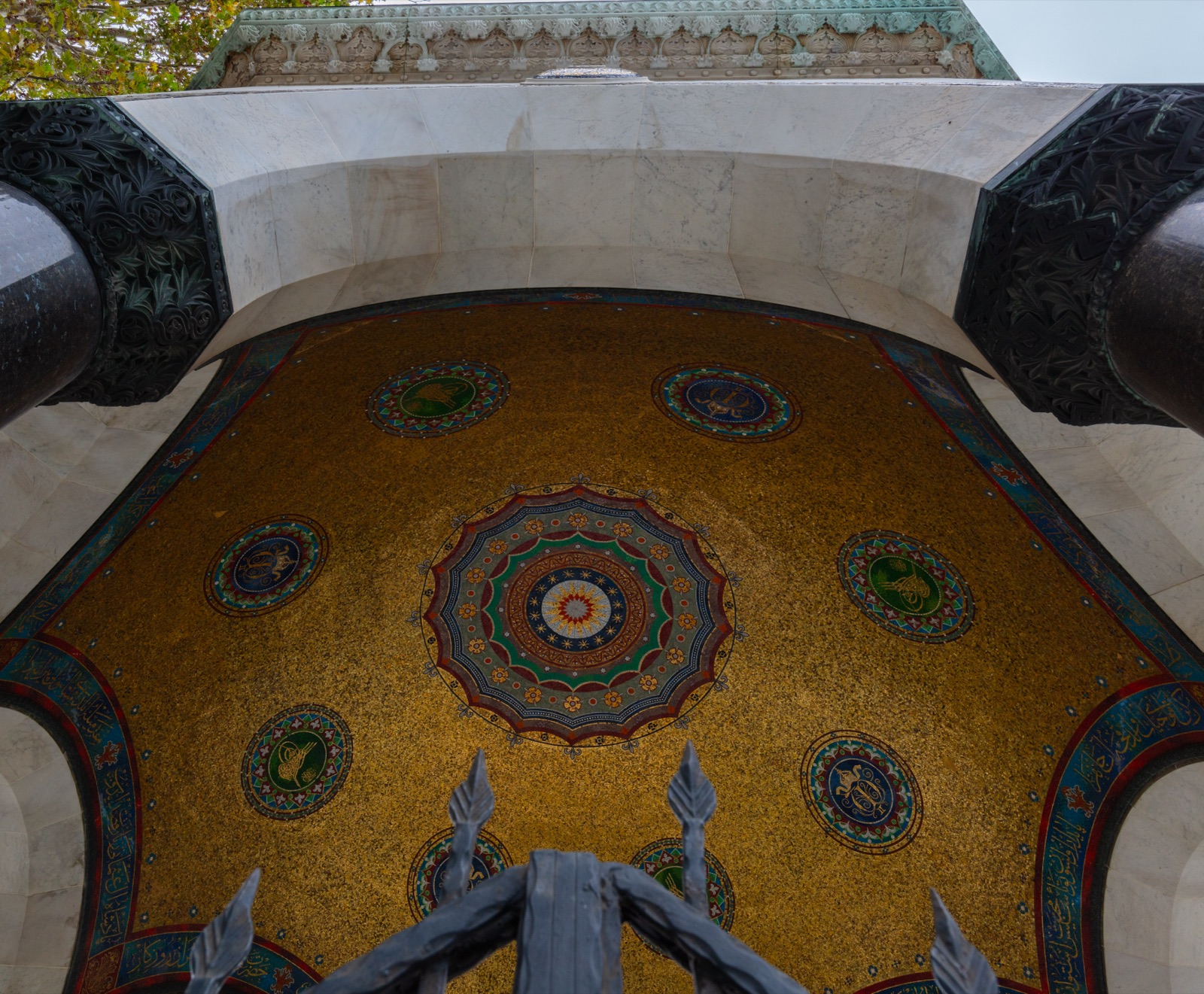
- The inside of the dome is decorated with gold-colored mosaics.
- The initials, or monograms, of Wilhelm II and Abdülhamid II point to the political relationship between the two rulers.
- The fountain arose during a phase of close German-Ottoman cooperation.
Why Wilhelm II came to Istanbul at all
The German Empire had only become a unified nation-state in 1871 and, in the late 19th century, increasingly sought global influence. Great Britain, France, and Russia already held enormous colonial empires and far-reaching economic networks. Germany tried to build up its own political and economic relationships.
The Ottoman Empire, meanwhile, was under heavy pressure. Russia threatened its territories, while Britain and France had their own interests in the Mediterranean and the Near East. Sultan Abdülhamid II therefore tried to balance the great powers against each other.
Germany appeared, for a time, as a useful partner, since compared to Russia, France, and Britain, it initially made fewer direct territorial claims on Ottoman core territory.
Abdülhamid II and the German rapprochement
Under Abdülhamid, German military advisors worked in the Ottoman Empire. German companies sold weapons, built infrastructure, and took part in railway projects. The sultan, in turn, wanted to use modern technology and expertise without becoming fully dependent on a traditional great power.
Personal encounters between monarchs were especially important in this diplomacy. Wilhelm II first visited Istanbul in 1889 and again in 1898. The second trip was much larger in scale and took him further, to Palestine and Syria.
1898: the journey to the Orient
Wilhelm and Empress Auguste Viktoria were received lavishly in Istanbul. The visit staged friendship between the two monarchies. Afterward, the emperor traveled on, among other places, to Jerusalem and Damascus.
In Damascus, Wilhelm gave a speech that became famous, in which he demonstratively presented himself as a friend of the Muslim world and of the sultan. Such gestures weren't mere courtesy. Germany wanted to gain political influence and position itself as a partner of the Ottoman Empire.
How the fountain came to be
The German Fountain was planned as a memorial to the visit. The Turkish cultural heritage portal names the German architect M. Spitta, that is, Max Spitta, and gives 1901 as the opening date. The individual parts were largely manufactured in Germany and then transported to Istanbul, or assembled on site.
The octagonal structure looks more like a small pavilion than a classic Ottoman street fountain. Columns support a dome, beneath which sit taps, or basins.
Its form combines neo-Byzantine echoes with German historicist representational architecture. At the former Hippodrome in particular, this deliberate reference back to the Byzantine past fits its surroundings.
Gold mosaic, monograms, and political symbolism
Inside the dome lies the actual visual highlight: gold-ground mosaic panels recalling Byzantine church art. Within them, symbols, or monograms, of the German emperor and the Ottoman sultan appear alternately.
The political message thus sits literally above visitors' heads. Wilhelm and Abdülhamid are staged as equal-ranking ruling partners. The monument celebrates no battle and no victory, but diplomatic closeness.
That's exactly what makes it so interesting. A fountain, from which people fetch water, simultaneously becomes a piece of foreign policy.
The Baghdad Railway and economic interests
The German-Ottoman rapprochement is often linked to the Baghdad Railway. German banks and companies received important concessions for railway lines meant to connect Anatolia with Mesopotamia. Economic interests, raw materials, transport routes, and geopolitical influence all played together here.
It would still be wrong to say Wilhelm built the fountain only "to get the Baghdad Railway." Diplomacy rarely works through a single exchange deal. The fountain instead stands for a broader phase of growing cooperation.
This closeness continued until the First World War, in which the Ottoman Empire and Germany ultimately became allies. That this alliance ended catastrophically for both empires gives the friendship monument, in hindsight, an additional historical layer.
From friendship monument to historical object
After 1918, both the German Empire and the Ottoman Empire disappeared. Abdülhamid had already been deposed in 1909; Wilhelm II went into exile in 1918.
The fountain remained standing. Its political message lost its immediate relevance and became history. Today, visitors often photograph the golden dome without knowing they're standing beneath a monument to a concrete diplomatic alliance.
Wilhelm II and the staging of personal friendship
Monarchic diplomacy in the 19th century relied heavily on images of personal closeness. Shared carriage rides, medals, gifts, and ceremonial receptions were meant to make political relationships publicly visible. Wilhelm II was especially talented at staging such trips theatrically. He liked to present himself as a modern world statesman and sought direct contact with other rulers.
Abdülhamid II, in turn, used this closeness strategically. He distrusted the traditional European great powers, which claimed Ottoman territories or supported separatist movements. Germany seemed to him a possible partner for military reform and infrastructure. Personal sympathy and state interest could hardly be cleanly separated here.
The fountain translates exactly this diplomacy into architecture. It doesn't stand within a palace, where only dignitaries could see it, but on a public square. The message was meant to be visible: the German emperor and the Ottoman sultan understand each other.
Why Sultanahmet specifically was chosen as the location
The former Hippodrome square remained a significant public space in the Ottoman Empire. The Hagia Sophia, the Sultan Ahmed Mosque, Topkapı, and numerous state institutions lay in its immediate vicinity. A diplomatic gift at this spot automatically gained maximum symbolic visibility.
At the same time, its neo-Byzantine design could respond to the square's late-antique past. Gold mosaics in a small dome inevitably recall Byzantine sacred spaces. A German monument thus quoted an era that both Europe and Ottoman Istanbul could read as part of a shared imperial past.
The Baghdad Railway in closer detail
The rail projects between Anatolia and Mesopotamia were enormously important economically and strategically. The Anatolian Railway already connected Istanbul, via Anatolia, to important cities. Later, the Baghdad Railway was meant to extend further toward Mesopotamia. German banks, especially Deutsche Bank, played a central role in financing and concessions.
For the Ottoman Empire, the railway promised faster troop movement, economic development, and stronger control over distant provinces. For Germany, it opened up investment and political influence. Britain and Russia watched the project with corresponding suspicion.
The fountain isn't "the monument to the Baghdad Railway," but it belongs exactly to this political climate. Behind the golden dome, then, stand railway tracks, arms deliveries, and a shifting European balance of power.
From alliance to world war
When the First World War began in 1914, the Ottoman Empire joined the Central Powers around Germany and Austria-Hungary. The backstory to this alliance reaches back into the decades of rapprochement the fountain symbolizes.
That doesn't mean the 1898 visit had to inevitably lead to the world war. Foreign policy could have developed differently. Still, the later alliance shows that the friendship of that time was more than courtly decoration.
After 1918, both monarchies were history. Wilhelm II lived in exile in the Netherlands; the Ottoman sultanate was abolished a few years later. The fountain, though, remained standing in the same spot, outliving the political systems that had created it.
How to read the monument today
Today the German Fountain looks peaceful and almost decorative. Tourists rest beside it, wedding photos are taken, and many know nothing about German world politics around 1900. That's exactly what makes the monument interesting: political propaganda can, over time, become so ordinary that no one recognizes its original message anymore.
Anyone looking up into the dome shouldn't just photograph the gold. The alternating ruler symbols explain why this structure exists in the first place.
The architecture in closer detail: why the fountain looks so "Byzantine"
The octagonal floor plan, the dome, and above all the gold mosaic deliberately evoke associations with late antique and Byzantine architecture. That was no coincidence around 1900. Historicism meant architects selected older styles and recombined them for modern political messages. A neo-Gothic city hall, a neo-Romanesque train station, or a neo-Byzantine fountain could all be built in the same decade.
For the German Fountain, the Byzantine allusion was especially fitting, since it stood on the former Hippodrome of Constantinople. Germany thus presented its gift not as a foreign object with no connection to the city, but as a monument that picked up on a historic visual language of the place.
At the same time, the structure is, technically and materially, a product of the industrial age. Components could be manufactured in Germany, transported, and assembled in Istanbul. The monument therefore combines an antiquity-evoking look with modern international logistics — just as German-Ottoman policy itself combined traditional monarchical symbols with railways, telegraphy, and industry.
The inscription inside
Inside the fountain, a German inscription explicitly commemorates Wilhelm II's visit in the autumn of 1898. Such texts matter, because they don't leave the political intent to be read in only later by historians. The monument explains, itself, why it was built: as a memorial to the rulers' encounter.
Anyone who connects the inscription with the monograms in the dome gets, as a result, a small diplomatic narrative in stone and mosaic. Visitors don't need to read a long exhibition; architecture, text, and symbolism together provide the explanation.
Why the fountain looks almost harmless today, compared to its history
Political monuments lose their immediate edge over time. A monument to a ruler no one has personally experienced anymore eventually becomes part of the backdrop. That's exactly what happened to the German Fountain. Today it's more a photo subject than a foreign-policy message.
That doesn't make it apolitical, though. On the contrary: precisely because we barely notice its original propaganda today, it shows how quickly political symbolism can become normal. What was, in 1901, a very deliberate message between two empires is today a pretty shady spot in Sultanahmet.
"Wilhelm II simply gave the fountain out of gratitude for a nice vacation." Far too harmless. The visit sat within a larger diplomatic and economic context.
"The fountain is an Ottoman work that's just called the German Fountain." No. Its design and essential manufacture were German; it was erected as a gift in Istanbul.
"It opened in 1898." No. It commemorates the 1898 visit, but its dedication took place in 1901.
My take on this place
The German Fountain is, to me, a perfect example of how easily you can photograph right past history. You see a gold mosaic, think "pretty," and walk on toward the Blue Mosque.
Yet this small pavilion tells the story of two rulers, two empires, and a political friendship that ended, a few years later, in a world war. For such a small structure, it carries an astonishing amount of world politics across its eight sides.
– Amra