
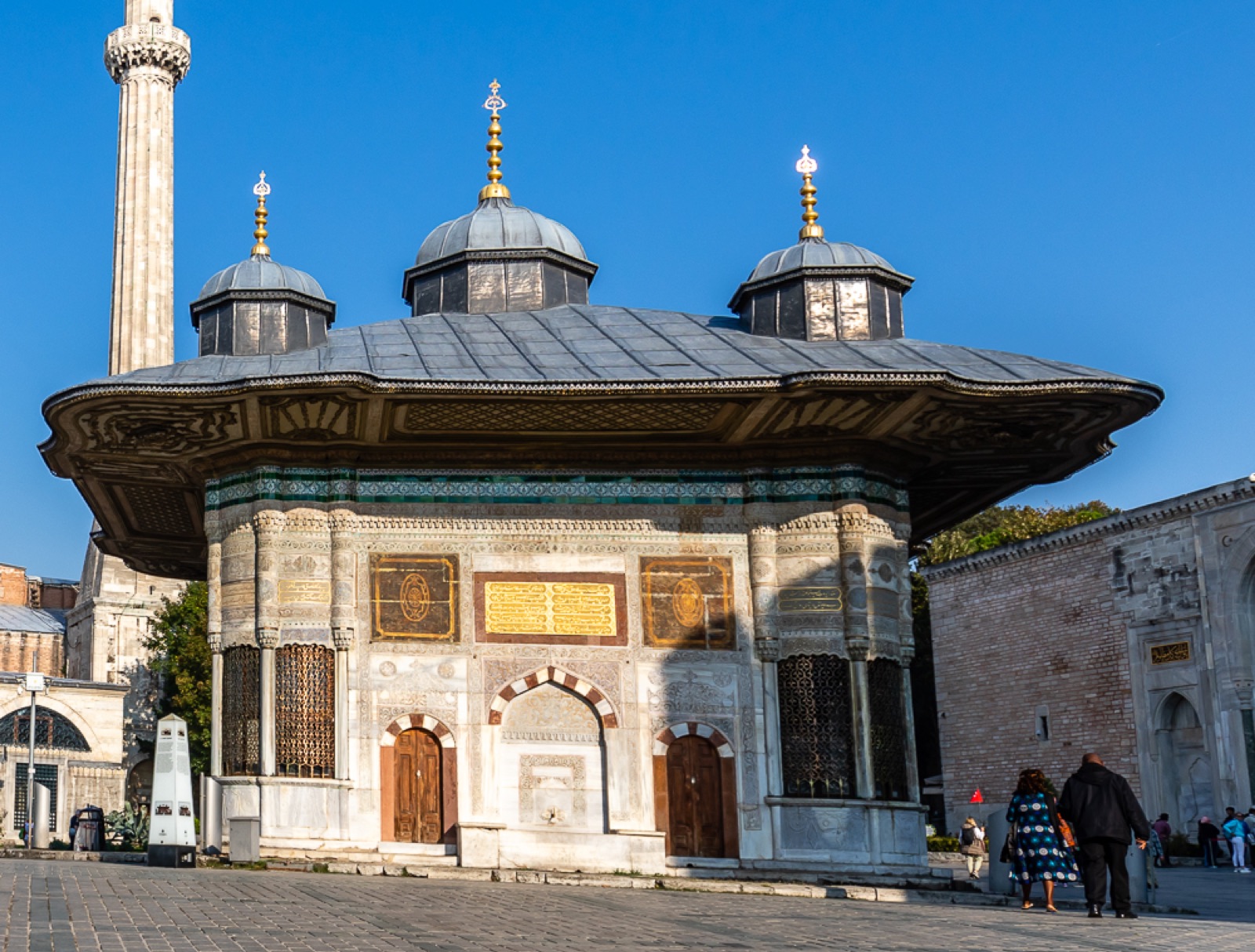
Right in front of the Imperial Gate of Topkapı Palace stands one of the most beautiful Ottoman fountains in Istanbul. The III. Ahmet Çeşmesi was built in 1728/29 under Sultan Ahmed III and looks almost like a small jewel box made of stone. Wide overhanging eaves, floral decoration, calligraphic inscriptions and small sebil windows make it clear that a public waterworks in the 18th century could be far more than a functional tap on a wall.
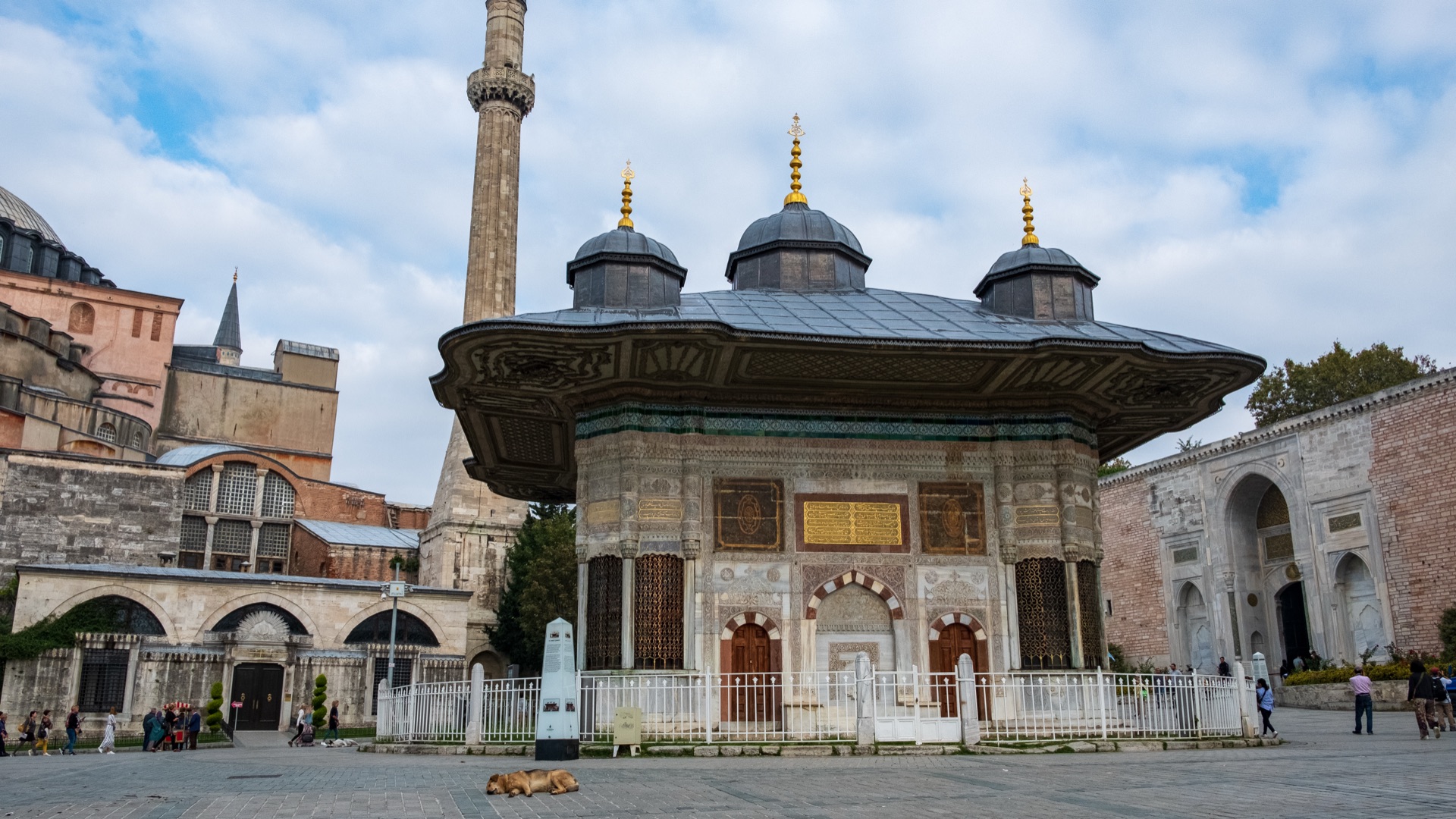
Right in front of the Imperial Gate of Topkapı Palace stands one of the most beautiful Ottoman fountains in Istanbul. Wide overhanging eaves, floral decoration and calligraphic inscriptions turn it into a small jewel box made of stone.
The fountain belongs to the so-called Tulip Era, a period under Ahmed III and his grand vizier Nevşehirli Damat İbrahim Pasha associated with courtly garden culture, festivals, literature, new printing techniques, and a growing interest in European forms. This era is often portrayed as a carefree luxury party. In reality it was culturally innovative, but by no means free of social conflict. It ended abruptly in 1730 with the Patrona Halil revolt.
- The fountain was built in 1728/29 under Sultan Ahmed III.
- It stands directly in front of the outer gate of Topkapı Palace.
- Four main sides have fountains, and the corners hold sebils for dispensing drinking water or drinks.
- The long calligraphic inscriptions contain a poem by Seyyid Vehbi.
- The structure belongs stylistically to the Tulip Era.
- Its decoration already shows new European influences while remaining clearly Ottoman.
- The Tulip Era ended in 1730 with the Patrona Halil revolt.
Why fountains mattered so much in Istanbul
Before households had widespread modern plumbing, fountains were part of daily infrastructure. People fetched water there for drinking, cooking and washing. Anyone who endowed a fountain was financing a concrete public service.
In the Islamic context, providing water was also considered a meritorious act of charity. That's why sultans, members of the dynasty, viziers and wealthy citizens endowed numerous fountains and sebils.
Such a structure could also display status at the same time. The more prominent the location, the more strongly charity became linked to public memory of the donor.
Ahmed III and the Tulip Era
Ahmed III reigned from 1703 to 1730. The years following the Peace of Passarowitz in 1718 in particular are known as Lâle Devri, the Tulip Era. The court invested in gardens, pavilions, festivals and new cultural forms.
Tulips became a status symbol. New varieties received poetic names, and flower culture played a major role at court. At the same time, new diplomatic contacts with Europe developed. Ottoman envoys reported back from Paris and other capitals about architecture, technology and social customs.
The era wasn't merely about luxury, though. In 1727, İbrahim Müteferrika began, with state approval, a Turkish-language printing press for non-religious works — an important step in Ottoman intellectual history.
1728/29: the new fountain in front of Topkapı
The fountain was built in an extremely prominent spot in front of the Bâb-ı Hümâyun. Cultural heritage records date it, based on its inscription, to 1728/29.
The structure stands freely and is roughly square. Each main side holds a fountain with a basin, while the beveled corners are designed as sebils. A widely overhanging roof shields the façades and reinforces the pavilion-like impression.
Compared to older, more austerely structured fountains, the surface appears almost entirely decorated. Flowers, vases, tendrils, geometric fields and inscriptions leave hardly any undesigned surface.
What a sebil is
A sebil was a facility for the free distribution of drinking water, and at times of sweetened drinks on special occasions. Attendants passed liquid to passersby through latticed windows.
This distinguishes a sebil from an ordinary fountain, where people filled their own vessel. At the Fountain of Ahmed III, both functions were combined in a single monumental structure.
Poetry and calligraphy in stone
A long poetic inscription runs across the façades. The text is by Seyyid Vehbi, a significant poet of the era. The verses praise the sultan, the endowment and the water.
The calligraphy here is not mere labeling. Writing itself becomes ornament. Different layers of text, plant motifs and architecture merge together.
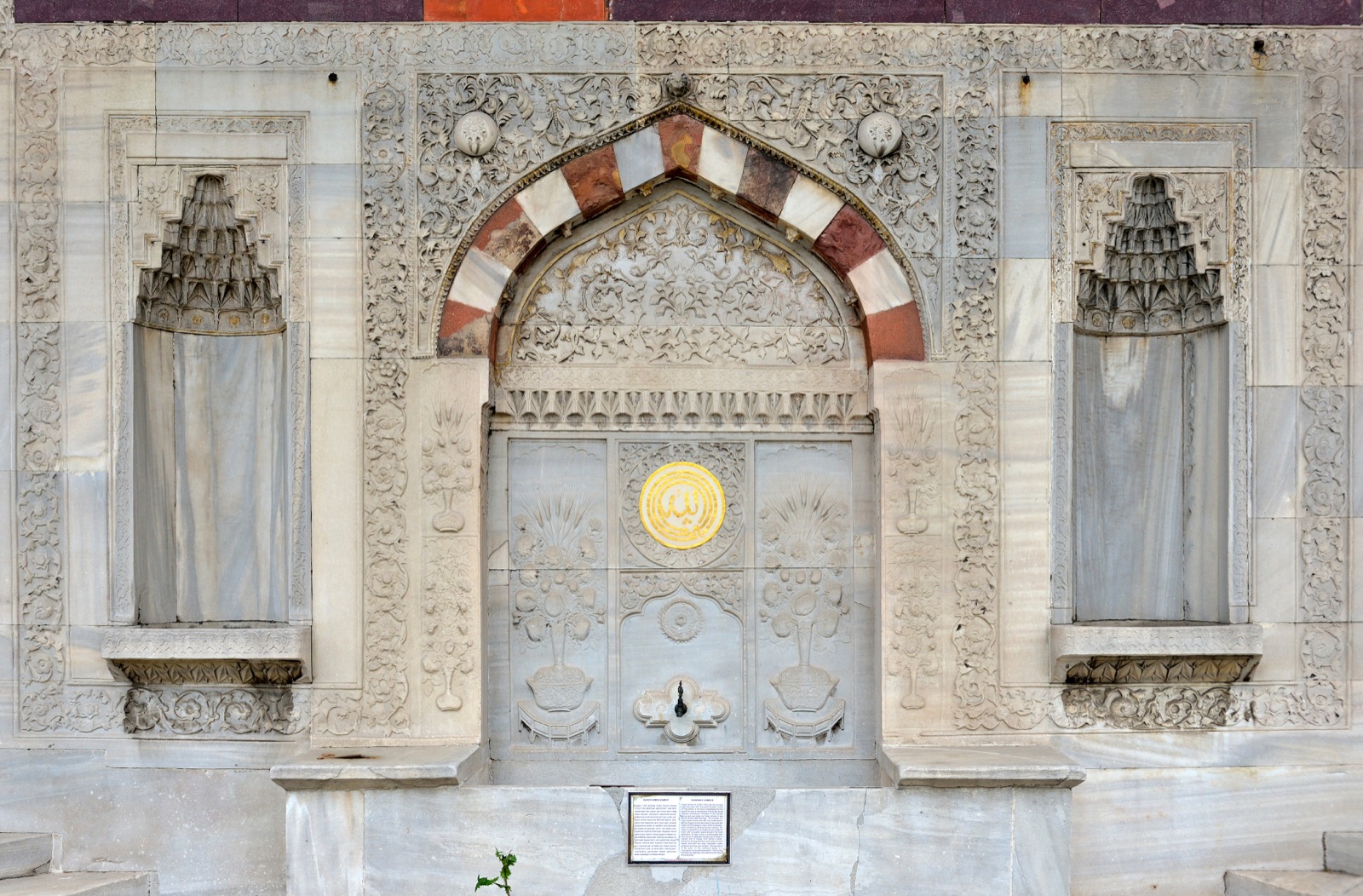
Especially well known is a chronogram, in which the numerical values of letters add up to a construction year. Such playful links between poetry and number were popular in Ottoman inscriptions.
European influences without a European break in style
In the early 18th century, decorative forms influenced by European Baroque and Rococo increasingly appear. At the Fountain of Ahmed III, this shift shows up in more animated ornament and a greater density of decoration.
Still, it would be wrong to view it as a "French fountain in Istanbul." Its roof form, calligraphy, sebil function and overall structure remain firmly in Ottoman tradition. What's new emerges through blending and further development.
1730: how the Tulip Era ended
The cultural elegance of the Tulip Era easily obscures the social tensions beneath it. Parts of the population criticized luxury spending, economic burdens and the power of the grand vizier.
In 1730, Patrona Halil, a former Janissary, led a revolt. Resistance spread quickly. Sultan Ahmed III had to sacrifice Nevşehirli Damat İbrahim Pasha and ultimately abdicate himself.
Pavilions and symbols of the hated court culture were partly destroyed. The fountain survived. As a result, of all things, one of the most decorative monuments of this era still stands right in front of Topkapı today.
The Tulip Era beyond the cliché
The label "Tulip Era" was coined only later and bundles together an era that was far more complex than its pretty flower. After the Peace of Passarowitz in 1718, the Ottoman Empire experienced a phase of relative relaxation toward parts of Europe. Grand Vizier Nevşehirli Damat İbrahim Pasha used this situation for court projects, diplomacy and cultural experimentation.
Delegations were sent to Europe. Especially famous is Yirmisekiz Mehmed Çelebi's report from Paris. He described gardens, palaces, social events and technical facilities. Such reports influenced the Ottoman court without immediately producing total "Westernization."
New pavilions were built along the Golden Horn and the Bosphorus in Istanbul. The Sadabad Gardens near Kağıthane became a symbol of courtly leisure culture. Tulip varieties received poetic names, and evening festivals with lamps set among the flowers later became legendary.
Who actually paid for all this splendor
Luxury at court never exists independently of the economy. Splendid buildings, gardens and festivals were financed through state and private income. At the same time, parts of the population suffered from rising prices and economic problems. Janissaries, craftsmen and other groups were politically discontented.
So the Patrona Halil revolt shouldn't simply be explained as an outburst of "conservative people against tulips." Social and political tensions combined with rejection of certain court elites. In hindsight, the tulip became the symbol of an era whose real conflicts ran much deeper.
The fountain as a public counter-image to palace luxury
That's exactly what makes the Fountain of Ahmed III interesting. It's magnificent, yet it also fulfills a public function at the same time. Water and sebil distribution made the structure a charitable endowment. A sultan could thus combine luxury and public service in the same monument.
This combination was politically clever. Anyone who came to fetch water encountered the ruler's name and calligraphy every day. The endowment reminded the population that the sultan acted as a benefactor.
Reading the calligraphy, even without knowing Ottoman
Even without knowledge of Ottoman script, you can look at the inscriptions deliberately. The lines of text are distributed rhythmically across the façades, shift in size and density, and together with the floral motifs form an overall composition. The text wasn't written onto a finished wall afterward; it's part of the design itself.
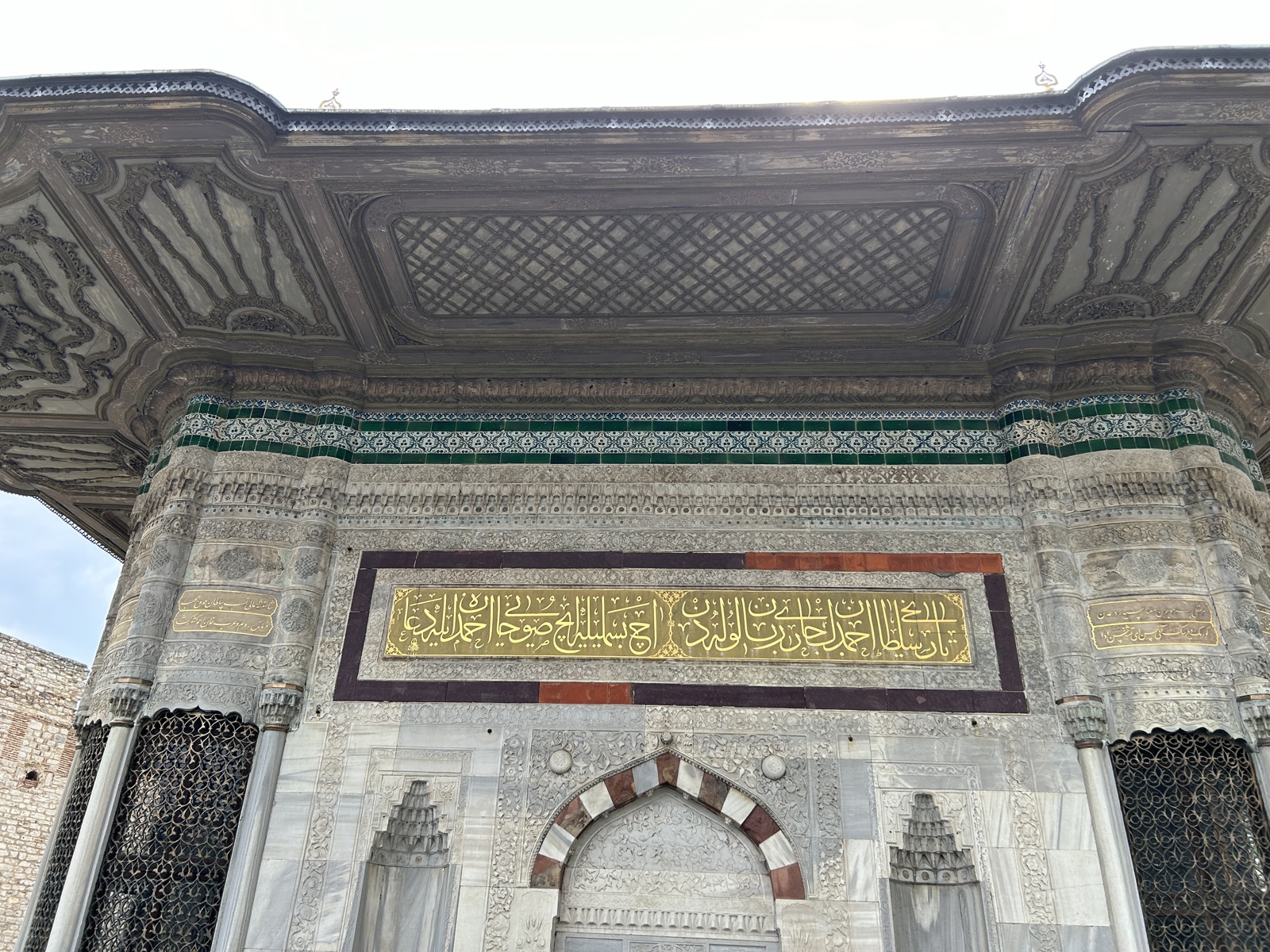
The famous line "Aç besmeleyle iç suyu Han Ahmed'e eyle dua" can be understood, roughly, as an instruction to drink the water in God's name and to pray for Sultan Ahmed. Exactly there, use, religion and the memory of the ruler come together.
Fountains as the city's social network
Istanbul had thousands of fountains. Some stood at mosques, others at street corners or palace walls. Fetching water was a daily routine and, with it, a social encounter. People waited, talked, exchanged news.
A monumental public fountain like that of Ahmed III was therefore not just an artwork. It was a hub. Its function today is largely symbolic, since modern plumbing has replaced the original necessity. That explains why visitors perceive it differently today than people did in the 18th century.
A location between two worlds of rule
On one side lies Topkapı, for centuries the center of the Ottoman court. Just a few steps away stands the Hagia Sophia, whose history reaches back another thousand years further still. The fountain of 1728/29 thus sits between monuments from completely different eras.
It's precisely this location that makes it a good yardstick for time. It looks "old," yet it's more than a thousand years younger than the Hagia Sophia and almost three centuries younger than Mehmed II's early Topkapı complex. Istanbul constantly forces you to recalibrate your own sense of age.
Why the inscriptions are more than decoration
Seyyid Vehbi's long poem stretches across several façades. Such donor inscriptions served several functions at once: they named the patron and the date, praised the charitable gift of water, and turned the structure into a public memory of the sultan. Anyone fetching water thus encountered the name of Ahmed III every single time.
Especially interesting is the connection between text and architecture. The inscription panels are proportioned so they work together with windows, niches and floral ornament. Calligraphy here is therefore not an information plaque bolted on after completion, but a structural part of the aesthetic design.
For visitors who can't read Ottoman script, plenty is still recognizable: the shifts in size, the rhythm, the flow of the lines, and the way letters almost turn into plant ornament. Anyone who looks up a translation of a few verses before visiting discovers much more afterward than just "pretty Arabic script."
The roof as an artwork in its own right
The fountain's wide overhanging roof is not merely weather protection. Its underside and shape belong to the overall effect and recall Ottoman pavilion architecture. Thanks to its strong overhang, the structure looks almost lighter than its massive stone body would suggest.
The roof also protects the calligraphy and decoration from direct rain. For a structure with so much fine surface work, that makes technical sense. Beauty and function coincide here.
A fountain in a place full of water architecture
Sultanahmet and Topkapı depended on numerous fountains, cisterns and pipelines. Just a few hundred meters away lies Yerebatan, a gigantic Byzantine water reservoir. The Fountain of Ahmed III shows a completely different era grappling with the same basic problem: water has to be collected, transported and distributed.
Anyone who sees both places on the same day gets a lovely historical throughline out of it. Under Justinian, water sat in enormous cisterns beneath the city. In the 18th century, its public distribution became a decorative artwork. The technology changed; the need did not.
"During the Tulip Era, the court cared about nothing but flowers and parties." False. The era was culturally innovative and politically complex; diplomacy, printing and reform efforts were just as much a part of it.
"The sebils permanently dispensed free şerbet." Water was the main function. Sweet drinks could be handed out on specific occasions, but not as an eternal free drinks machine.
"The fountain belonged to Mehmed II's original Topkapı." No. It was built almost three centuries later.
My take on this place
What I like about this fountain is that such an everyday need — water — was given such beautiful design. Today we'd probably just install a functional metal tap somewhere and call it done.
Here, water got poetry, calligraphy, a grand roof and practically its own little architecture. At the same time, the fountain is a reminder that even an era later named after a flower could be politically tense enough to end in a revolt.
– Amra