
Kariye is one of those places where you can easily form the wrong first impression. From outside, the building looks comparatively small. But anyone who knows the mosaics and frescoes inside quickly understands why the former Chora Church ranks among the most significant surviving works of late Byzantine art. This place's true scale lies not in its mass, but in images created in the 14th century that render religious stories with astonishing spatial, emotional, and narrative power.
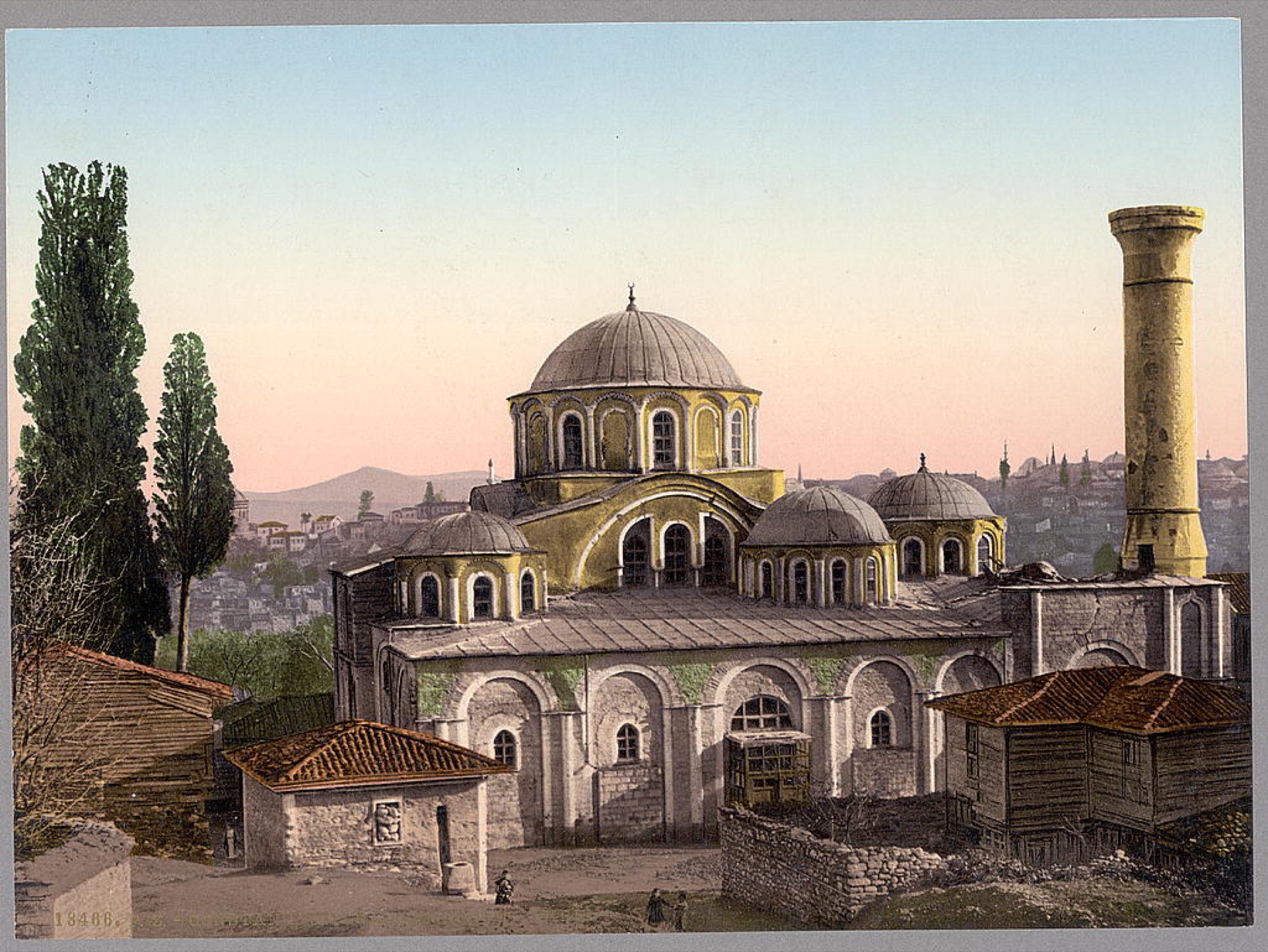
From outside, the building looks comparatively small. But anyone who knows the mosaics and frescoes inside quickly understands why the former Chora Church ranks among the most significant surviving works of late Byzantine art.
The building's history is complicated. Earlier churches existed on the same site. The structure that defines it today was renewed several times, elaborately decorated in the early 14th century under Theodoros Metochites, converted into a mosque after the Ottoman conquest, restored as a museum in the 20th century, and, since 2024, back in regular use as a mosque. The images, in particular, tell not just Byzantine art history, but also how religious spaces get altered, plastered over, rediscovered, and reinterpreted across the centuries.
- "Chora" roughly means land, or an area outside; the name refers to its early location outside Constantine's city wall.
- Today's building arose on older predecessors and was substantially renewed in the 11th and 12th centuries.
- Its famous mosaics and frescoes mostly date from the early 14th century.
- Its main patron was the scholar and statesman Theodoros Metochites.
- After the Ottoman conquest, the church was later converted into a mosque.
- Many figurative images were covered up; some were lost, others survived beneath layers of plaster.
- In the 20th century, restorers uncovered large parts of the decoration once more.
- After a long period as a museum, the building is now used again as a mosque.
Why Is the Church Called "Chora"?
The Greek name en tē Chōra roughly means "in the countryside," or "outside." When an early church arose on this site, the ground lay outside the older wall of Constantine the Great. Constantinople was later expanded westward under Theodosius II, so the church ended up within the new city walls. The old name stuck anyway.
This seemingly small piece of naming history tells you a lot about Constantinople's growth. A building can keep a name from a topography that has long since ceased to exist. Centuries later, Chora sat inside one of the greatest cities of the medieval world, and yet was still, roughly, called "out in the countryside."
Earlier Buildings and Today's Complex
Several building phases existed on this site. An early monastery, or church, is attested at the latest from Byzantine times. The core of today's building goes back mainly to an 11th-century rebuild, substantially altered again in the 12th century after damage and structural problems.
This matters, because visitors sometimes assume the entire visible building arose alongside its famous mosaics. In fact, the most splendid decorations only came about roughly two centuries later. Chora, then, is an older structure that received a spectacular artistic re-decoration in the early 14th century.
Theodoros Metochites and the Great Decoration Around 1320
The man behind this phase was Theodoros Metochites, one of the most learned and powerful officials of his time. He served Emperor Andronikos II Palaiologos, and was a diplomat, scholar, writer, and eventually Grand Logothete — one of the empire's highest offices.
Metochites invested considerable resources into restoring and decorating the monastery. Between roughly 1315 and 1321, the famous mosaic cycles and frescoes arose. In one mosaic, Metochites himself is depicted: he kneels before Christ, presenting him with a model of the church. His huge turban and magnificent clothing make him instantly recognisable.
This depiction is no modest footnote. It shows how patrons in the Byzantine Empire tied together their piety, social standing, and memory. Metochites presents his building project to Christ — and, in doing so, permanently inscribes himself into the church's visual world.
His political career, though, ended dramatically. After a change of power in 1328, he lost his fortune, was exiled, and later returned to Chora as a monk. He died there in 1332. The church that documents his wealth and standing thus became, in the end, his place of retreat too.
What the Mosaics Tell
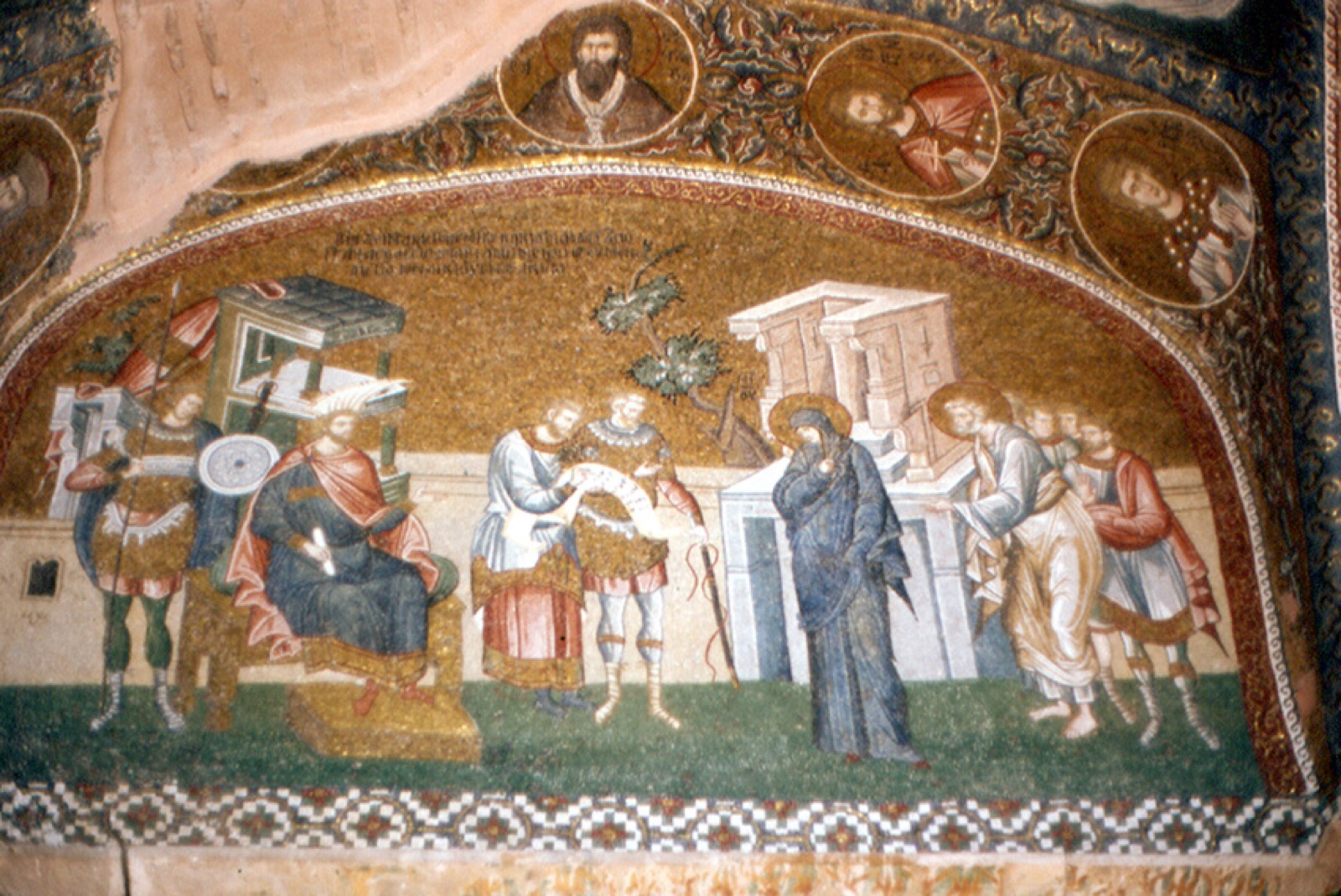
The mosaics are concentrated especially in the two outer halls. They tell, at length, from the life of Christ and the Virgin Mary. Many scenes draw not only on the canonical Gospels, but also on apocryphal traditions widespread in Byzantine Christianity.
Their manner of storytelling is remarkable. Figures react to one another, architecture creates depth, gestures and facial expressions carry emotion. These images are therefore not merely decorative. They function almost like a visual book for a religious community in which images, liturgy, and texts were interwoven.
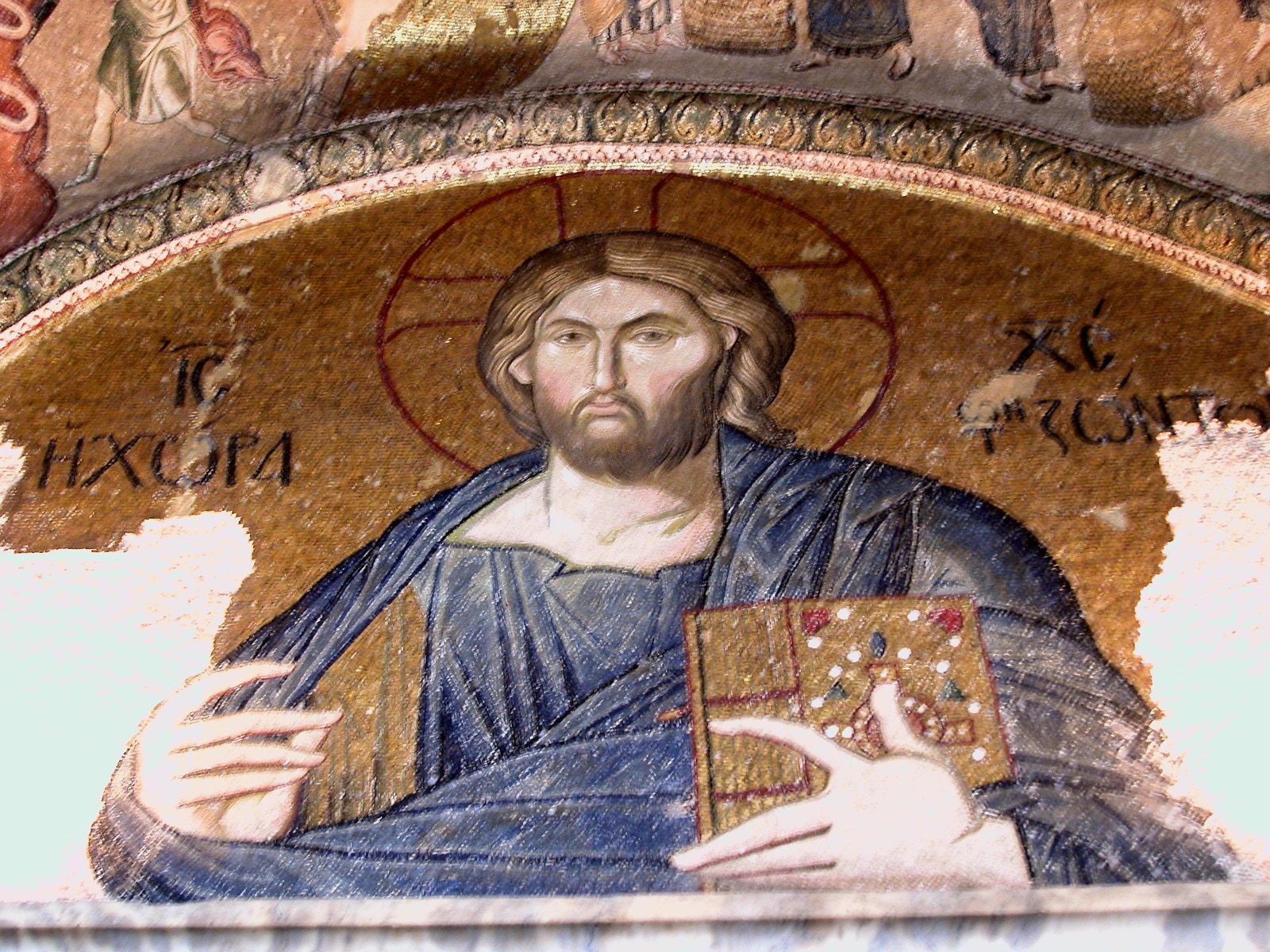
Especially well known is the mosaic of Christ Pantokrator, but so are the extensive Marian cycles and the depiction of Metochites as patron. Anyone who just walks through quickly misses that the scenes follow one another like chapters.
The Parekklesion and the Frescoes
For many visitors, even more impressive are the frescoes in the southern side chapel, the Parekklesion. This area served as a funerary chapel, and its visual world is therefore strongly oriented toward death, resurrection, and salvation.
The most famous depiction is the Anastasis, Christ's Harrowing of Hell, or resurrection. Christ stands dynamically within a bright mandorla, pulling Adam and Eve from their graves. Beneath his feet lie the broken gates and locks of the underworld. The image doesn't show a calm Christ, but an almost explosive triumph over death.
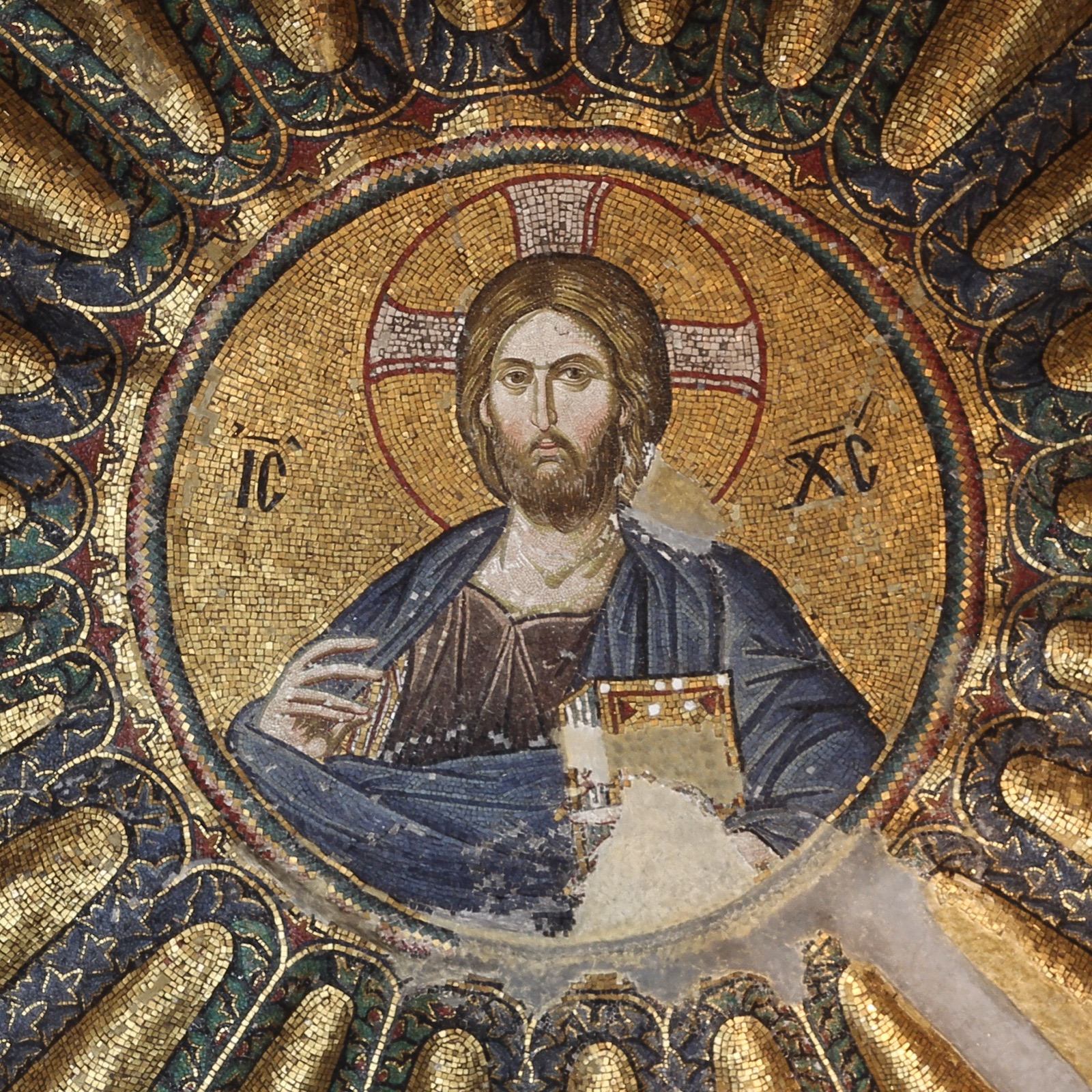
Alongside it appear Old Testament figures, judgment scenes, and further depictions. In a burial space especially, these images carried an immediate function: to convey hope of resurrection and salvation.
1453 and the Conversion Into a Mosque
After the Ottoman conquest of Constantinople in 1453, the church initially remained Christian. Only around the turn of the 16th century was it converted into a mosque under Atik Ali Pasha and became known as Kariye Camii.
This matters, because the often-told idea that "the Ottomans arrived in 1453 and every church immediately became a mosque" isn't true. Some churches were converted immediately; others remained Christian for decades or longer. Kariye belongs to the second group.
What Really Happened to the Christian Images
With Kariye especially, you have to be more precise than at almost any other site, because simplified narratives quickly create a completely false picture. When the church was converted into a mosque in the early 16th century, the Christian images didn't vanish in a single dramatic act. Figurative depictions, however, had no place as visible cult images within an Islamic prayer hall. So many mosaics and frescoes were covered over time with plaster, whitewash, or other layers. Some depictions were damaged; others were lost to moisture, earthquakes, structural changes, and lack of upkeep.
That so much survives today is owed precisely to this complicated history. Covering the images made them invisible, but it also unintentionally protected some surfaces from direct touch, smoke, or later overpainting. That means neither that "the Ottomans destroyed everything," nor that they deliberately preserved the mosaics for later generations. Religious use changed; preserving individual image surfaces was, in part, an accidental side effect of that change.
In the 20th century, systematic uncovering and restoration began. Researchers from the Byzantine Institute of America and the Dumbarton Oaks Field Committee worked in the 1940s and 1950s to carefully remove later layers, clean mosaics, and stabilise frescoes. Only then did the full breadth of how extraordinary the late Byzantine visual programme is become clear. Especially in the Parekklesion, the funerary chapel, a theological concept unfolds that isn't simply a collection of individually beautiful scenes. The Anastasis depiction, in which Christ pulls Adam and Eve from the realm of the dead, is part of a comprehensive engagement with death, resurrection, and salvation.
The mosaics in the narthex, too, function like a narrative. Scenes from the lives of Mary and Christ build on one another, draw on apocryphal traditions, and combine theology with a remarkable eye for gesture, space, and emotion. Anyone who walks through quickly, photographing a few golden surfaces, therefore misses the real richness: the images were designed as a connected programme, not a collection of decorative individual motifs.
The most recent history continues this complicated pattern of use. After decades as a museum, Kariye is used again as a mosque. That raises, once again, the practical question of how an active Islamic prayer space can function alongside one of the most significant surviving Christian image cycles of the late Byzantine world. For visitors, it therefore matters especially not to pit religious use and art history against each other. Both are now part of this building's biography.
It's worth explaining especially carefully what happened here. After the conversion into a mosque, the mosaics and frescoes didn't disappear all at once in a single act of destruction. Figurative Christian images weren't meant to stand visibly at the liturgical centre of a Muslim prayer space. So numerous depictions were covered over time with plaster, paint, or other layers. Individual images were damaged; others were lost to moisture, earthquakes, renovations, and ordinary decay.
It's precisely this covering, though, that led to a historical paradox. What wasn't visible also couldn't, in some cases, be overpainted, touched, or exposed to direct light. Some mosaics and frescoes therefore survived centuries surprisingly well beneath later layers.
That expressly doesn't mean Ottoman builders preserved the images with the goal of one day showing them as a museum. Their intention was to adapt a Christian building for use as a mosque. The partly preservative effect was an unintended consequence. But it would be just as wrong to claim that every image was immediately, deliberately destroyed. The actual course of events was considerably more complicated.
Restoration in the 20th Century
After the founding of the Republic of Turkey, Kariye was declared a museum in 1945. From the late 1940s, American restorers from the Byzantine Institute, and later Dumbarton Oaks, worked on uncovering and documenting the decorations.
Under the direction of Thomas Whittemore and Paul Underwood, layers of plaster were removed, mosaics cleaned, and frescoes conserved. This work made Chora an internationally key monument of Byzantine art history.
Restoration, though, is never entirely neutral either. You decide which layer to make visible, and which later alteration to remove or reverse for that purpose. The museum era emphasised the Byzantine 14th century very strongly, pushing the building's centuries-long use as a mosque into the background.
Museum, Mosque, and the Most Recent Changes
In 2020, its earlier museum status was lifted and its conversion into a mosque decided. After restoration work, Kariye reopened for Muslim worship in 2024. At the same time, the building remains of enormous international significance because of its Byzantine art.
That creates a practical challenge: figurative Christian images and active use as a mosque have to be organised together within a single space. Certain areas, or depictions, are covered during prayer times, or made accessible differently. Visiting arrangements can change and should therefore always be checked for the current situation.
The So-Called Palaiologan Renaissance
The term "Palaiologan Renaissance" describes the cultural flourishing of the late Byzantine period under the Palaiologan dynasty. The empire was, politically and militarily, long since nowhere near as powerful as in earlier centuries, yet art, literature, and scholarship developed remarkable intensity precisely within this diminished empire. Kariye is among the strongest surviving examples of this. Its figures feel more animated, faces more individual, and scenes more spatially complex than in many stricter Middle Byzantine visual programmes.
That makes the church almost paradoxical historically: some of its greatest artworks arose not at the height of Byzantine power, but in a time of political weakness. Theodoros Metochites invested enormous resources into its decoration, even though the empire was under economic and military pressure. Culture, it turns out, isn't automatically strongest when a state is militarily strongest. Kariye, in particular, shows how a politically threatened Constantinople could once more produce art of extraordinary quality.
Chora's art arose at a time when the Byzantine Empire was, politically, long past being the great power of Justinian's era. After the recapture of Constantinople in 1261, the Palaiologan dynasty ruled over a territorially much-reduced empire. Culturally, though, a remarkable flourishing developed. Scholars engaged intensively with ancient texts, artists experimented with spatial depth, movement, and emotional expression, and wealthy patrons invested in churches and monasteries.
It's therefore misleading to view late Byzantine art only as the last, weak remnant of a dying empire. Chora shows the opposite: political loss of power and cultural creativity can exist at the same time. Its mosaics and frescoes are among the most sophisticated visual programmes of their era, created precisely during a phase of great uncertainty.
Theodoros Metochites embodies this world almost perfectly. He was a politician, an intellectual, and a patron of the arts, who collected books and wrote on philosophy, astronomy, and history. His personal downfall after the change of power also shows how dangerous proximity to the court could be. His artistic foundation outlasted his political career by centuries.
Why the Images Feel So Different From Many Older Byzantine Mosaics
Anyone previously familiar only with strictly frontal icons is often surprised by Chora. Figures turn, buildings are shown at an angle, garments move, and faces show grief, surprise, or affection. Of course, this isn't Renaissance perspective in the Italian sense, but the artists were clearly searching for new ways to render space and narrative.
The scenes from the life of Mary, in particular, function almost cinematically. One scene leads into the next, secondary figures react, architecture separates interior and exterior spaces. Anyone who reads the sequence of images, rather than just photographing individual motifs, understands why art historians rate Chora so highly.
The material technique plays a role too. Mosaic tesserae of glass, gold, and coloured stone respond to light. The walls therefore look different depending on the time of day and viewing angle. Frescoes, in turn, allowed for larger continuous image surfaces, and were especially suited to the Parekklesion.
Burial, Memory, and the Function of the Parekklesion
The Parekklesion wasn't an extra room built just because a few square metres were left over. It served as a funerary chapel for patrons and other significant people. Its visual programme is therefore concentrated on death, judgment, resurrection, and salvation.
The Anastasis makes especially good sense in this context. Anyone buried there lay beneath images that promised the triumph over death. Art, theology, and personal remembrance merged together. These images weren't made for modern museum visitors admiring them as masterpieces. They were part of a religious space in which people prayed for the deceased and reflected on their own mortality.
It's precisely this original function worth keeping in mind when you visit Chora. Its artistic beauty is enormous, but it wasn't created as a gallery. Every cycle was embedded in liturgy and faith.
"The Ottomans destroyed all the mosaics after the conversion." False. Some images were lost or damaged, but many were covered and later uncovered again.
"The Ottomans deliberately preserved the mosaics." Also too simple. Covering them served the new religious use. That some works were protected as a result was an unintended consequence.
"The famous images date from Justinian's era." No. Most of the mosaics and frescoes celebrated today only arose in the early 14th century, during the late Byzantine Palaiologan era.
My Thought on This Place
For me, Kariye is the exact opposite of a building you can explain in one sentence. Church, mosque, museum, mosque again — and, in between, images that disappeared for centuries and suddenly became visible again. If you just say, "the Ottomans came and turned it into a mosque," you really haven't understood anything at all.
It only becomes fascinating once you ask why the images were covered, why some survived anyway, and why we even know today how this church was decorated in the 14th century. These are exactly the connections I want to see in Istanbul. Not just "a beautiful mosaic," but the whole crazy history behind it.
– Amra